|
by Don Byrne
Principal Biologist (Fisheries)
April, 2004
Nine miles off Barnegat Inlet, a timer signals 20 minutes have passed. Steve Cluett,
skipper of the research vessel Sea Wolf, throttles back the engine, engages the winches and begins
hauling back the bottom trawl from a depth of about 70 feet.
Meanwhile, in the ready room below, New Jersey Department of Environmental Protection's (DEP) Bureau of Marine Fisheries staff and Wildlife Conservation Corps volunteers respond to the changing sounds of the boat. Coffee cups, books and crossword puzzles are set aside. Sea boots, foul weather gear and gloves are picked up and pulled on.
| It is a warm, sunny April afternoon, and the
survey crew will soon be manning the "slime line," handling all kinds
of flopping, slithering fish and crawling invertebrates, many with sharp spines
or teeth, on a work deck wet from running hoses and an occasional splashing wave.
As the towing cables wind on the winches, the trawl eventually
surfaces, is disconnected from the towlines, and wound onto a net reel. Finally,
the tail end of the net appears, bulging with about 500 pounds of catch, which
is released onto a sorting table that nearly overflows. The survey crew gets to
work, sorting the entire catch by species and measuring the total weight of each.
Length measurements of each species are also taken; every individual fish is measured
if a species is not too numerous in the catch.
|
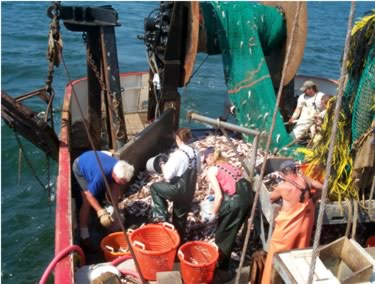 Biologists and volunteers on the "Seawolf" sort a sea robin catch.
 |
In this particular catch, little skate, winter skate and
spiny dogfish account for most of the weight. There are a large number of sea
herring, some winter flounder, a few striped bass, and ocean pout. The catch also
includes a large Atlantic sturgeon, a species rarely caught, and a variety of
other fishes such as sand lance, longhorn sculpin, sea raven and butterfish. Most
of these fish prefer cold water and their presence is typical for the time of
year; although the air temperature is 65 degrees Fahrenheit, the ocean is still
wintry, only 44 degrees.
This catch represents one of 39 samples collected during
the April survey, only one of five surveys conducted annually. The others take
place in January, June, August and October. Each survey samples the approximately
1,800-square-mile area of Atlantic Ocean between Sandy Hook, New Jersey and Cape
Henlopen, Delaware.
 Frank and Harvey return to the shoal just as the latest net of samples is plucked from the ocean.
 |
All samples are collected randomly; so if the same location
happens to be sampled in two different surveys, it is only by chance. The idea
behind this is that every fish in the survey area has an equal chance of getting
caught. When the catch data are analyzed to determine estimates of population
size, this random design permits the use of robust statistical procedures that
provide relatively accurate results.
This fish-counting program, known officially as the ocean
stock assessment program, or trawl survey for short, began in August 1988 and
continues today. And therein lies its greatest value: more than 15 years of continuous
sample collecting. Throughout those years, the program used the same collecting
and processing procedures for more than 75 survey cruises, enabling fisheries
researchers and resource managers to examine the annual ups and downs of species
abundance, knowing that any trends observed most likely reflect true population
changes, rather than varying net size.
|
Program data contribute to the development and modification
of fisheries management plans which affect everyone who handles saltwater fish,
including the grocery shopper looking for flounder fillets, the angler releasing
a fish too small to keep, and the commercial fisherman returning to the dock because
he has caught the limit.
Meanwhile, the Sea Wolf has come to a dead stop in 24 feet of water off Island Beach State Park. Surf fishermen are a short distance away, casting just past the breakers. The survey crew deploys a meter to measure the water temperature
at three-foot depth intervals and a water bottle to collect surface and bottom samples to determine dissolved oxygen and salinity. In a few minutes, the water sampling will be completed, and the net will be lowered into the sea to collect yet another sample. The new information gathered will be incorporated into management plans to ensure fish will provide abundant harvests for years to come.
|







 Some
files on this site require adobe acrobat pdf reader to view.
Some
files on this site require adobe acrobat pdf reader to view.