With the availability of improved data and a growing acceptance of accountability reporting, New Jersey is providing more and better information about its higher education system to state policy makers, students and parents, employers, and taxpayers. The Commission on Higher Education’s fourth annual systemwide accountability report builds on past efforts and complements the annual accountability reports prepared by each public college and university. Together with the state’s new performance funding initiative, these reports monitor the progress of institutions, sectors, and the higher education system as a whole as they strive to achieve New Jersey’s vision for higher education excellence, access, and affordability.
This year’s systemwide report updates several key data indicators examined in earlier reports and adds new ones. It also intensifies the focus on student outcomes, providing detailed information about transfer students.
Key findings in the 1999 systemwide accountability report:
Previous enrollment trends continued through 1998 at New Jersey higher education institutions. A decline of about 4.5% between 1993 and 1998 in the overall number of credit-seeking students reflects a marked decrease in part-time enrollment. The decrease was primarily at the community colleges, a trend generally attributed to the booming economy. Preliminary data for 1999 indicate that this decline has leveled off. Full-time enrollment continued to increase in all other sectors. The overall number of degrees and certificates granted increased, fueled by gains in the state colleges/universities, community colleges, and the proprietary institutions.
Minority student enrollment, particularly among Hispanic and Asian students, continues to grow. Although the majority of students enrolled statewide are white, in all but the theological institutions white students account for a smaller proportion of enrollment in 1998 than in 1993.
Tuition and fees in all public sectors account for an increasing share of institutional revenues, and these prices continue to exceed national averages. The percentage of revenue derived from state government declined for all sectors except the community colleges between FY 1995 and FY 1997. New Jersey community colleges will buck the trends to an even greater degree in the future owing to a substantial increase in state funding over four years beginning in FY 1999 coupled with tuition freezes or minimal increases.
New Jersey continues to lead the nation in state-funded student assistance. The state ranks first in the percentage of undergraduates receiving need-based aid, second in need-based dollars per student, and sixth in percentage of total state higher education funding devoted to student financial aid.
New Jersey’s higher education sectors outperformed their national counterparts in several key student outcome measures. Most notably, graduation and retention rates at Rutgers, The State University of New Jersey far exceed national benchmarks. The retention rates for the state college and university sector significantly exceed peer institutions across the nation, and the sectorwide five- and six-year graduation rates are similar to or higher than national averages.
The number of students transferring from New Jersey community colleges to four-year institutions increased significantly over the past 10 years. While this first examination of transfer student performance at receiving institutions shows primarily positive results, more emphasis on transfer articulation is needed to stem the loss of credits by students moving from two-year to four-year institutions.
The Commission continues its commitment to enhancing higher education accountability in New Jersey through the framework of institutional and systemwide reports and the state’s performance funding initiative. In the coming months, the Commission will work with the higher education community to improve the form and content of institutional accountability reports. The Commission also will undertake annual reviews of the state’s performance funding indicators so that they continue to spur improved performance and attention to statewide goals for higher education.
In the decade of the 1990s higher education conscientiously addressed the public expectation for an effective framework to ensure quality and accountability. Accountability indicators are now used across the nation, with most states seeking to document productivity through various measures of effectiveness at colleges and universities.
New Jersey’s heightened attention to accountability began in 1994 with the Higher Education Restructuring Act’s requirement for annual institutional reports to inform state policy makers and the public about the condition of each public college and university. In addition to the institutional reports, the Commission on Higher Education prepares an annual report to provide aggregate data and information about the various sectors, as well as the system as a whole.
This fourth annual systemwide accountability report builds upon previous efforts, updating basic characteristics of students and faculty, tracking and analyzing outcomes, and reporting on costs, revenues, state support, and tuition. As in past years, the report includes data on New Jersey’s higher education system and primarily each of its four major sectors: public research universities, state colleges and universities, community colleges, and four-year independent colleges and universities. The three public research institutions are treated separately in some instances where their differing missions render aggregate data meaningless. Further, although the 14 independent institutions with a public mission are considered an integral part of the state’s higher education system, data limitations make it impossible to include the independent sector in some sections of the report.
The report examines New Jersey higher education, as well as the circumstances in which it exists, in relation to peer institutions, the region, and the nation. In doing so, it highlights progress, as well as areas that need additional attention. This year’s report intensifies the focus on students, providing new information about financial assistance and a look at data on the extent and impact of the transfer of students from New Jersey’s community colleges to the state’s senior institutions.
In most enterprises, accountability and improved performance are closely linked, and higher education should be no exception. Today’s knowledge-based, global economy and society hold extremely high expectations for colleges and universities and their graduates. The challenges at hand demand open communication, the broad involvement of stakeholders, pertinent information about performance, and a commitment to improvement.
Beginning with the 1999-2000 academic year, New Jersey’s institutional and systemwide accountability reports complement a new performance funding initiative that rewards public institutions for achieving benchmarks or improving performance in four key areas identified by Governor Christine Todd Whitman: graduation, transfer and articulation, efficiency and effectiveness, and diversified revenues. This performance funding initiative enhances New Jersey’s higher education accountability framework and demonstrates the state’s commitment to quality.
II. Updates of Previously Reported Indicators
Section II presents a broad overview of the New Jersey higher education system. In order to clarify the various "sectors," all New Jersey colleges and universities are listed and classified below:
| New Jersey Colleges and Universities by Sector | ||||
|
Public Research Universities (3)
State Colleges and Universities (9)
Community Colleges (19)
|
Public-Mission Independent Doctoral Institutions (5) *
Public-Mission Independent Nondoctoral Institutions (9) *
Proprietary Institutions (3) **
Theological Institutions (8) ***
|
|||
Between 1993 and 1998, there was enrollment growth at the proprietary institutions and, to a lesser extent, the public research universities and theological institutions. Overall, however, the number of enrolled students at New Jersey colleges and universities decreased by 15,500 students—a decline of about 4.5% (Table 1). The overall decline occurred primarily at the undergraduate level, particularly at the community colleges. (Table 1, and all other enrollment data presented in this section, are based on headcounts. Also, this report includes only students taking courses for college credit; it omits the many noncredit students, most of whom are enrolled at community colleges, where in some cases they outnumber credit students.)
|
Table 1: |
||||||
|
Sector |
# of Undergraduate Students |
# of Postbaccalaureate Students |
Total Number of Students |
|||
|
1993 |
1998 |
1993 |
1998 |
1993 |
1998 |
|
|
Public research universities |
40,574 |
42,637 |
18,958 |
18,669 |
59,532 |
61,306 |
|
State colleges/ universities |
67,318 |
66,707 |
11,541 |
10,965 |
78,859 |
77,672 |
|
Community colleges |
139,915 |
121,114 |
0 |
0 |
139,915 |
121,114 |
|
Public-mission independent institutions |
40,281 |
39,377 |
17,070 |
16,544 |
57,351 |
55,921 |
|
Proprietary institutions |
2,775 |
6,257 |
0 |
0 |
2,775 |
6,257 |
|
Theological institutions |
655 |
1,298 |
2,270 |
2,304 |
2,925 |
3,602 |
|
TOTAL |
291,518 |
277,390 |
49,839 |
48,482 |
341,357 |
325,872 |
|
SOURCE: NCES, IPEDS, Fall Enrollment Survey, 1993 and 1998. |
||||||
Part-time students account almost entirely for the overall undergraduate enrollment decline. Systemwide, the number of full-time undergraduates actually increased by about 10,000 between 1993 and 1998; almost every sector participated in this increase (Table 2). During this time the full-time percentage of students increased in all four major sectors. While the growing state economy explains much of the decline in part-time students, the demographic phenomenon known as the "baby boom echo" is causing an increase in full-time students, and will continue to do so in all or most sectors for at least another 10 years. Preliminary enrollment data for fall 1999 suggest that the part-time enrollment decline at the community colleges has bottomed out, and that full-time enrollment has increased to an all-time high. There are other factors that are likely to increase enrollment in general; of particular importance is the increasing need for lifelong education in our high-technology, information-driven economy, as epitomized by New Jersey.
|
Table 2: |
||||||
|
Sector |
# of Full-Time Students |
# of Part-Time Students |
% Full-Time |
|||
|
1993 |
1998 |
1993 |
1998 |
1993 |
1998 |
|
|
Public research universities |
31,595 |
34,578 |
8,979 |
8,059 |
77.9% |
81.1% |
|
State colleges/universities |
40,246 |
42,843 |
27,072 |
23,864 |
59.8% |
64.2% |
|
Community colleges |
54,923 |
53,643 |
84,992 |
67,471 |
39.3% |
44.3% |
|
Public-mission independent institutions |
27,122 |
29,412 |
13,159 |
9,965 |
67.3% |
74.7% |
|
Proprietary institutions |
2,060 |
4,542 |
715 |
1,715 |
74.2% |
72.6% |
|
Theological institutions |
636 |
1,221 |
19 |
77 |
97.1% |
94.1% |
|
TOTAL |
156,582 |
166,239 |
134,936 |
111,151 |
53.7% |
59.9% |
|
SOURCE: NCES, IPEDS, Fall Enrollment Survey, 1993 and 1998. |
||||||
The community college sector still has the largest share of undergraduates, though that proportion did fall slightly between 1993 and 1998 (Table 3). The second largest share is accounted for by the state colleges and universities. The public research universities and public-mission independent institutions have the largest shares of graduate students. With regard to shares of full-time faculty, the four major sectors are within seven percentage points of each other.
|
Table 3: |
||||||
|
Sector |
% of Undergraduate Students |
% of Postbaccalaureate Students |
% of |
|||
|
1993 |
1998 |
1993 |
1998 |
1993 |
1998 |
|
|
Public research universities |
13.9% |
15.4% |
38.0% |
38.5% |
26.3% |
27.4% |
|
State colleges/universities |
23.1% |
24.0% |
23.2% |
22.6% |
23.9% |
24.8% |
|
Community colleges |
48.0% |
43.7% |
0.0% |
0.0% |
22.0% |
20.5% |
|
Public-mission independent institutions |
13.8% |
14.2% |
34.3% |
34.1% |
26.4% |
25.5% |
|
Proprietary institutions |
1.0% |
2.3% |
0.0% |
0.0% |
0.8% |
1.2% |
|
Theological institutions |
0.2% |
0.5% |
4.6% |
4.8% |
0.5% |
0.7% |
|
TOTAL |
100% |
100% |
100% |
100% |
100% |
100% |
|
SOURCES: NCES, IPEDS, Fall Enrollment Survey, 1993 and 1998. NCES, IPEDS, Salaries, Tenure and Fringe Benefits of Full-Time Instructional Faculty Survey, 1993-94 and 1998-99. |
||||||
Systemwide, over 90% of the undergraduates attending college in New Jersey are state residents (Table 4). Notably, at the public-mission independent institutions over 75% of the students are from New Jersey, demonstrating the extent to which these institutions serve state residents.
|
Table 4: |
||||||
|
Sector |
# of In-State Students |
# of Out-of-State Students |
% In-State |
|||
|
1993 |
1998 |
1993 |
1998 |
1993 |
1998 |
|
|
Public research universities |
37,630 |
38,757 |
2,944 |
3,880 |
92.7% |
90.9% |
|
State colleges/universities |
61,856 |
61,494 |
5,462 |
5,213 |
91.9% |
92.2% |
|
Community colleges |
138,364 |
119,350 |
1,551 |
1,764 |
98.9% |
98.5% |
|
Public-mission independent institutions |
31,268 |
30,128 |
9,013 |
9,249 |
77.6% |
76.5% |
|
Proprietary institutions |
2,679 |
5,609 |
96 |
648 |
96.5% |
89.6% |
|
Theological institutions |
275 |
348 |
380 |
950 |
42.0% |
26.8% |
|
TOTAL |
272,072 |
255,686 |
19,446 |
21,704 |
93.3% |
92.2% |
|
SOURCE: NJ IPEDS Form #23, Fall Enrollment Survey, 1993 and 1998. |
||||||
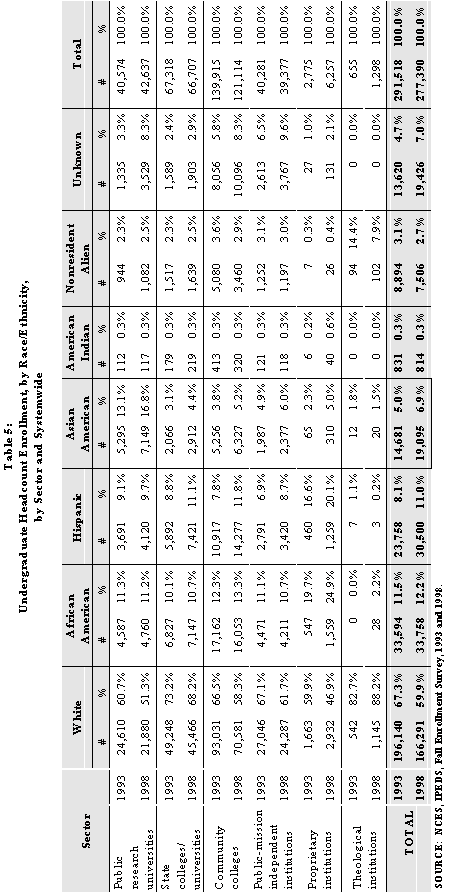
From 1993 to 1998, African American, Hispanic, and Asian American students increased their share of total undergraduate enrollment (Table 5). State colleges/universities, community colleges, and proprietary institutions increased the shares of all three groups among their students. Public research universities and public-mission independent institutions increased the shares of Hispanics and Asians, but not of African Americans. In most sectors the share of "race unknown" grew, possibly indicating an increase in mixed-race students.
 |
New Jersey institutions awarded 51,500 degrees and certificates in FY 1998, a 3.8% gain over FY 1993 (Table 6). The growth occurred in master’s degrees, associate degrees, and certificates. The gains at the master’s level occurred in all sectors with institutions licensed to confer these degrees. The gains at the associate-degree and certificate levels were particularly dramatic at the proprietary institutions. It should be noted that the data on public-mission independent institutions may be affected by the closing of Upsala College in May 1995.
|
Table 6: |
||||||||
|
Sector |
Certificate |
Associate |
Bachelor’s |
Master’s |
Doctoral |
1st Profess. |
Total |
|
|
Public research |
1993 |
224 |
54 |
7,648 |
2,960 |
552 |
964 |
12,402 |
|
1998 |
123 |
113 |
7,665 |
3,151 |
544 |
964 |
12,560 |
|
|
State colleges/ universities |
1993 |
6 |
276 |
10,527 |
1,968 |
-- |
-- |
12,777 |
|
1998 |
2 |
177 |
10,896 |
2,111 |
-- |
-- |
13,186 |
|
|
Community |
1993 |
656 |
11,166 |
-- |
-- |
-- |
-- |
11,822 |
|
1998 |
658 |
11,521 |
-- |
-- |
-- |
-- |
12,179 |
|
|
Public-mission |
1993 |
37 |
362 |
6,943 |
3,162 |
397 |
411 |
11,312 |
|
1998 |
47 |
266 |
6,615 |
3,438 |
383 |
446 |
11,195 |
|
|
Proprietary |
1993 |
171 |
460 |
-- |
-- |
-- |
-- |
631 |
|
1998 |
673 |
1,062 |
-- |
-- |
-- |
-- |
1,735 |
|
|
Theological |
1993 |
1 |
4 |
160 |
86 |
16 |
377 |
644 |
|
1998 |
-- |
20 |
82 |
254 |
32 |
222 |
610 |
|
|
TOTAL |
1993 |
1,095 |
12,322 |
25,278 |
8,176 |
965 |
1,752 |
49,588 |
|
1998 |
1,503 |
13,159 |
25,258 |
8,954 |
959 |
1,632 |
51,465 |
|
|
SOURCE: NCES, IPEDS, Completions Survey, 1992-93 and 1997-98. |
||||||||
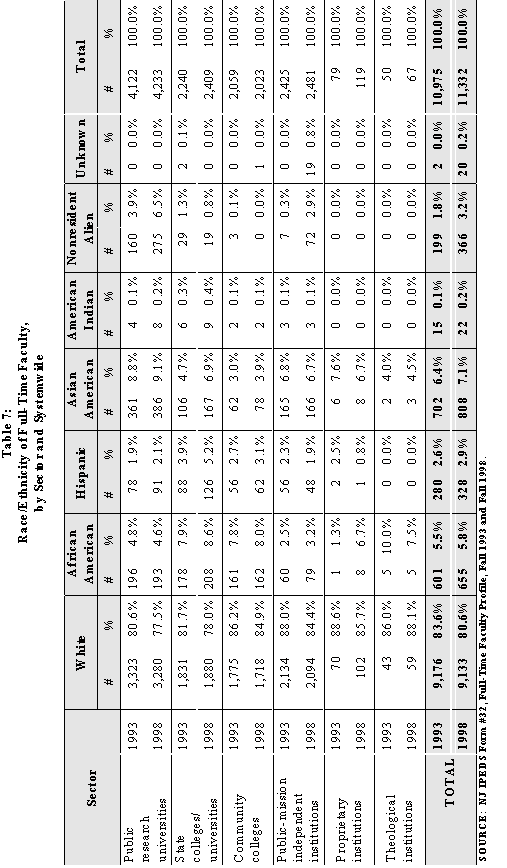
While African American, Hispanic, and Asian American representation among the faculty systemwide increased over the five years, the gains were extremely small—less than one percentage point in all three instances (Table 7). Overall, while the state colleges and universities appear to have made the most progress (by modest margins) between 1993 and 1998, there is a great deal of room for further improvement in all sectors.
 |
New Jersey’s public research universities, which graduate about two-thirds of their full-time students within six years, exceed the rates at NCAA Division I2 public institutions by more than 10 percentage points (Table 8). The state colleges and universities in the state, with graduation rates of about one-half, surpass the Division II3 public institutions and are about equal to the Division III4 publics. The NCAA institutional rates are highly credible because they (like the Student Right-to-Know rates) are taken directly from the IPEDS Graduation Rate Survey.5
|
Table 8: |
||||||
|
PUBLIC RESEARCH UNIVERSITIES (UMDNJ excluded) |
||||||
|
Cohort |
NJ* |
NCAA-Div. I# |
||||
|
1992-98 |
66.4% |
-- |
||||
|
1991-97 |
65.1% |
52% |
||||
|
STATE COLLEGES/UNIVERSITIES (Edison excluded) |
||||||
|
Cohort |
NJ* |
NCAA-Div. II## |
NCAA-Div. III## |
|||
|
1992-98 |
49.9% |
-- |
-- |
|||
|
1991-97 |
48.5% |
40% |
50% |
|||
|
* |
NJ Commission on Higher Education, Student Unit Record Enrollment (SURE) system. |
|||||
|
# |
National Collegiate Athletic Association, 1998 NCAA Division I Graduation-Rates Report (Overland Park, KS: NCAA, November 1998), p. 634. |
|||||
With regard to five-year graduation rates, the state colleges/universities in New Jersey, at slightly over two-fifths, are marginally above the national benchmarks reported by the College Board and by ACT, while the public research universities, at about three-fifths, once again exceed their benchmarks by more than 10 points (Table 9).
|
Table 9: |
||||
|
NJ* |
US-ACT# |
US-CEEB## |
|
|
State colleges/universities |
42.3% |
39.6% |
39.8% |
|
|
Public research universities |
59.1% |
46.4% |
44.4% |
|
|
Total |
50.3% |
42.2% |
41.8% |
|
|
* |
NJ Commission on Higher Education, Student Unit Record Enrollment (SURE) system; UMDNJ and Edison are excluded. |
|||
|
# |
Compiled from the ACT Institutional Data File, 1999. Data are from one year earlier. |
|||
|
## |
The College Board, Annual Survey of Colleges 1997-98: Summary Statistics and Fall Enrollment (New York: CEEB, 1998), p. 24. Data are from two years earlier. |
|||
New Jersey community colleges have a three-year sectorwide graduation rate of about 13%. While the College Board and ACT report higher national three-year community college graduation rates (based on voluntary reporting), the New Jersey figure is closer to what often appears in other states’ reports that include community college graduation rates. Improved national benchmarks will soon be available, when data from the IPEDS Graduation Rate Survey (GRS) (based on mandatory reporting) are posted on the Internet.
Both the public research universities and the state colleges/universities in New Jersey are well above the national benchmarks for third-semester retention rates (Table 10). The public research sector is about 10 points higher, and the state college/university sector has an even wider margin of superiority. Both sectors have percentages in the mid-80s range.
|
Table 10: |
||||
|
PUBLIC RESEARCH UNIVERSITIES (UMDNJ excluded) |
||||
|
Cohort |
NJ* |
ACT# |
CEEB## |
|
|
1997-1998 |
85.8% |
76.5% |
75.3% |
|
|
STATE COLLEGES/UNIVERSITIES (Edison excluded) |
||||
|
Cohort |
NJ* |
ACT# |
CEEB## |
|
|
1997-1998 |
83.3% |
68.9% |
69.2% |
|
|
* |
NJ Commission on Higher Education, Student Unit Record Enrollment (SURE) system. |
|||
|
# |
Compiled from the ACT Institutional Data File, 1999; data are from one year earlier. |
|||
|
## |
The College Board, Annual Survey of Colleges 1997-98: Summary Statistics and Fall Enrollment (New York: CEEB, 1998), p. 23. Data are from two years earlier. |
|||
The state’s community college sector rate, at well over one-half, is above the national benchmarks on retention (Table 11). The margin is relatively small.
|
Table 11: |
||||
|
Cohort |
NJ* |
ACT# |
CEEB## |
|
|
1997-1998 |
57.7% |
52.5% |
55.2% |
|
|
* |
NJ Commission on Higher Education, Student Unit Record Enrollment (SURE) system. |
|||
|
# |
Compiled from the ACT Institutional Data File, 1999; data are from one year earlier. |
|||
|
## |
The College Board, Annual Survey of Colleges 1997-98: Summary Statistics and Fall Enrollment (New York: CEEB, 1998), p. 23. Data are from two years earlier. |
|||
For the purposes of this report, transfer students are those who begin at a New Jersey community college and later enroll, with or without an associate degree, at a New Jersey senior institution. The four-year transfer rate for the community college sector in New Jersey, about one-fourth, is slightly above the national benchmark (Table 12). This benchmark, compiled by the Center for the Study of Community Colleges at UCLA, is a particularly solid one, with a standardized methodology that was used by every participating state agency.
|
Table 12: |
|||
|
Cohort |
NJ# |
US## |
|
|
1994-1998 |
25.3% |
23.4% |
|
|
* |
Includes only students with 12 or more credits. |
||
|
# |
NJ Commission on Higher Education, Student Unit Record Enrollment (SURE) system. |
||
|
## |
Center for the Study of Community Colleges, Los Angeles, CA. Data refer to 1993-1997 time frame. |
||
During the 10 years between 1987 and 1997, New Jersey institutions of higher education collectively increased their research funding by well over one-fourth (Table 13). This increase is largely accounted for by the institutions that were receiving most of the research funding at the beginning of the period in question. They include three public institutions—New Jersey Institute of Technology (NJIT), Rutgers University, and University of Medicine and Dentistry of New Jersey (UMDNJ)—and one independent institution—Princeton University.6
|
Table 13: |
||||
|
FY 1987 |
FY 1997 |
Absolute Change |
Percent Change |
|
|
NJIT |
$17,488,800 |
$31,571,000 |
$14,082,200 |
80.5% |
|
Rutgers |
$107,618,648 |
$128,924,000 |
$21,305,352 |
19.8% |
|
UMDNJ |
$41,501,459 |
$81,260,000 |
$39,758,541 |
95.8% |
|
All Public Institutions |
$169,360,469 |
$246,551,023 |
$77,190,554 |
45.6% |
|
Princeton |
$97,945,955 |
$110,034,000 |
$12,088,045 |
12.3% |
|
Stevens |
$11,767,398 |
$7,677,572 |
$(4,089,826) |
-34.8% |
|
All Independent Institutions |
$119,106,435 |
$122,586,234 |
$3,479,799 |
2.9% |
|
Total system |
$288,466,904 |
$369,137,257 |
$80,670,353 |
28.0% |
|
* Data are from IPEDS. Adjustment for inflation is according to HEPI (Research & Development subindex). |
||||
In 1987, 1992, and 1997, New Jersey research institutions’ total funding in dollars per capita was below the nation and each of four peer states—New York, Pennsylvania, North Carolina, and Virginia (Table 14). Between 1987 and 1992, the Garden State grew more than the nation and all of the peers. However, between 1992 and 1997, New Jersey grew less than the nation and all but one of the peers (Virginia, which declined).
|
Table 14: |
||||||
|
NJ |
US |
NY |
PA |
NC |
VA |
|
1987 |
$42 |
$73 |
$94 |
$76 |
$73 |
$52 |
|
1992 |
$57 |
$86 |
$99 |
$95 |
$98 |
$69 |
|
1997 |
$57 |
$90 |
$101 |
$104 |
$109 |
$68 |
|
Change (87-92) Relative (%) |
$15 36.2% |
$13 18.4% |
$4 4.7% |
$19 25.1% |
$25 33.7% |
$17 32.5% |
|
Change (92-97) Relative (%) |
$1 1.0% |
$3 3.5% |
$2 2.5% |
$8 8.8% |
$11 11.1% |
($1) -1.2% |
|
SOURCES: National Science Foundation, WebCASPAR Database System. US Bureau of the Census, Population Estimates Branch, 12/30/98 (1992, 1997 pop. est.). US Bureau of the Census, Current Population Reports, series P-25, No. 1044 (1988 pop. est.). |
||||||
|
Note 1: Adjustment for inflation is according to HEPI (Research & Development subindex). |
||||||
|
Note 2: NJ institutions with R&D expenditures are as follows: |
||||||
Between 1993 and 1998, tuition and fees at New Jersey’s three public research universities continued to be higher in dollar terms than those of their respective national peers (Table 15). In percentage terms, NJIT and UMDNJ remained significantly more expensive than their peers, but to a lesser degree than earlier. By contrast, Rutgers, which had been somewhat more expensive, increased its gap slightly.
|
Table 15: |
|||||||
|
NJ Unadjusted |
NJ Adjusted |
US |
$ Difference |
% Difference |
|||
|
Rutgers |
FY 1993 |
$3,923 |
$3,269 |
$2,808 |
$461 |
16.4% |
|
|
FY 1998 |
$5,242 |
$4,531 |
$3,827 |
$704 |
18.4% |
||
|
NJIT |
FY 1993 |
$4,524 |
$3,431 |
$1,875 |
$1,556 |
83.0% |
|
|
FY 1998 |
$5,802 |
$4,592 |
$2,816 |
$1,776 |
63.1% |
||
|
UMDNJ* |
FY 1993 |
$12,245 |
$10,704 |
$7,295 |
$3,409 |
46.7% |
|
|
FY 1998 |
$15,827 |
$14,333 |
$10,657 |
$3,677 |
34.5% |
||
|
Four-year public |
FY 1993 |
$2,872 |
$2,393 |
$2,286 |
$107 |
4.7% |
|
|
FY 1998 |
$4,142 |
$3,580 |
$3,050 |
$530 |
17.4% |
||
|
Two-year public |
FY 1993 |
$1,485 |
$1,238 |
$1,077 |
$161 |
14.9% |
|
|
FY 1998 |
$2,020 |
$1,746 |
$1,372 |
$374 |
27.3% |
||
|
Independent |
FY 1993 |
$14,382 |
$11,985 |
$11,077 |
$908 |
8.2% |
|
|
FY 1998 |
$18,283 |
$15,802 |
$13,131 |
$2,671 |
20.3% |
||
|
Independent |
FY 1993 |
$9,355 |
$7,796 |
$8,908 |
-$1,112 |
-12.5% |
|
|
FY 1998 |
$12,272 |
$10,607 |
$11,629 |
-$1,022 |
-8.8% |
||
|
SOURCE: NJ data were adjusted for cost of living. The COLI (Cost of Living Index) was obtained from AFT Interstate COLI 1993 and 1997. |
* For UMDNJ, in-state tuition and required fees for the medical degree (M.D.) are reported. UMDNJ’s School of Health Related Professions, which offers undergraduate programs, has a tuition schedule that is not comparable to those for peer institutions. |
||||||
Both the state colleges and universities and the community colleges in this state were more expensive in 1993 than their peers, and these differences intensified during the next five years. A similar pattern can be seen for the independent doctoral institutions, but the independent nondoctoral institutions were less costly than their peers in 1993, and remained so, though to a somewhat reduced extent. (Owing to an increase in state funding that began in FY 1999, tuition at the community colleges was frozen in that year. Average community college tuition in FY 2000 increased less than the cost of living.) Tuition and fees must be viewed in the context of state support and financial aid. New Jersey is a leader in assisting students, as discussed in Sections II.C.5 and II.D.
3. State/Local Government Support for Higher Education
Table 16 benchmarks New Jersey against the nation on state government spending per FTE student in public higher education for FY 1993 and FY 1998.7 New Jersey was well above the nation in both years, though less so in the more recent one. It should be pointed out that (a) New Jersey state government also spends significant amounts of money on independent institutions and their students, and (b) the county governments provide a significant portion of the funding for community colleges (see Tables 19a-19e below).
|
Table 16: |
|||
|
FY 1993 |
FY 1998 |
||
|
NJ |
US |
NJ |
US |
|
121 |
100 |
115 |
100 |
|
SOURCE: Calculated from data in Kent Halstead, State Profiles: Financing Public Higher Education, 1998 Rankings (Washington, D.C.: Research Associates of Washington, September 1998), Table 3, p. 32. |
|||
In proportional terms, public higher education revenues in New Jersey are somewhat more reliant on state and local government spending than is typical throughout the nation (Table 17). In fact, during the five years between 1991 and 1996 this reliance grew slightly.
|
Table 17: |
|||
|
FY 1991 |
FY 1996 |
||
|
NJ |
US |
NJ |
US |
|
106 |
100 |
108 |
100 |
|
SOURCE: Calculated from data in National Center for Education Statistics, Digest of Education Statistics: 1993, Table 322, p. 326 and 1998, Table 331, p. 355. |
|||
In Tables 18a-18c and the following series of tables, each of the public research institutions in New Jersey has a custom-tailored set of peers that they selected in consultation with the Commission. All three institutions are spending considerably less than their peers. Moreover, to varying degrees all three institutions were further below their peers in FY 1997 than in FY 1995.
|
Table 18a: |
|||||
|
Fiscal Year |
AAU |
RU-Unadjusted |
RU-Adjusted |
(RU-Adjusted - AAU) |
% Diff. |
|
FY 1995 |
$14,698 |
$12,952 |
$12,055 |
-$2,643 |
-18.0% |
|
FY 1997 |
$15,813 |
$13,711 |
$12,761 |
-$3,052 |
-19.3% |
|
SOURCE: NCES, IPEDS, Finance Survey, FY 1995 and FY 1997. |
|||||
|
Table 18b: |
|||||
|
Fiscal Year |
Peers |
NJIT-Unadjusted |
NJIT-Adjusted |
(NJIT-Adjusted - Peers) |
% Diff. |
|
FY 1995 |
$13,309 |
$12,831 |
$11,158 |
-$2,151 |
-16.2% |
|
FY 1997 |
$14,814 |
$13,349 |
$11,608 |
-$3,206 |
-21.6% |
|
SOURCE: NCES, IPEDS, Finance Survey, FY 1995 and FY 1997. |
|||||
|
Table 18c: |
|||||
|
Fiscal Year |
Peers |
UMDNJ-Unadjusted |
UMDNJ-Adjusted |
(UMDNJ-Adjusted - Peers) |
% Diff. |
|
FY 1995 |
$67,917 |
$57,870 |
$55,422 |
-$12,495 |
-18.4% |
|
FY 1997 |
$73,866 |
$53,473 |
$51,211 |
-$22,655 |
-30.7% |
|
SOURCE: NCES, IPEDS, Finance Survey, FY 1995 and FY 1997. |
|||||
During the same two-year period, the New Jersey state colleges/universities continued spending more than their peers but to a lesser extent (Table 18d). (The peers consist of all four-year public nondoctoral institutions in the United States as defined by IPEDS.) The community colleges in the state shifted from being above their peers to being further above them (Table 18e). It is important to understand that what happened with regard to these two sectors is in part a function of their enrollment rather than simply dollars spent. While the state colleges/universities had proportionally larger enrollment increases than their counterparts across the nation, the community colleges in the state, but not their counterparts across the nation, had enrollment declines.
Because enrollment measures are in the denominators of the expenditure ratios, the state college/university sector ratio shrank relative to the U.S., while the community college ratio expanded. During the period in question, expenditures at New Jersey state colleges/universities increased by 9.4% as compared with 9.9% nationally, while expenditures at New Jersey community colleges increased by 6.7% as compared with 3.1% nationally. By contrast, New Jersey state college/university student FTEs increased by 2.1% as compared with 0.2% nationally, while New Jersey community college credit FTEs dropped 4.2% as compared with 0.0% nationally.
The Commission intends to explore more fully the use of peer states, rather than the total U.S., especially for the community colleges. These states would be selected on the basis of such variables as per capita income, unionization, and demographics.
|
Table 18d: |
|||||
|
Fiscal Year |
US |
NJ-Unadjusted |
NJ-Adjusted |
(NJ-Adjusted - US) |
% Diff. |
|
FY 1995 |
$7,664 |
$9,392 |
$8,680 |
$1,016 |
13.3% |
|
FY 1997 |
$8,407 |
$10,062 |
$9,300 |
$892 |
10.6% |
|
SOURCE: NCES, IPEDS, Finance Survey, FY 1995 and FY 1997. |
|||||
|
Table 18e: |
|||||
|
Fiscal Year |
US |
NJ-Unadjusted |
NJ-Adjusted |
(NJ-Adjusted - US) |
% Diff. |
|
FY 1995 |
$3,906 |
$4,818 |
$4,453 |
$547 |
14.0% |
|
FY 1997 |
$4,026 |
$5,365 |
$4,958 |
$932 |
23.1% |
|
SOURCE: NCES, IPEDS, Finance Survey, FY 1995 and FY 1997. |
|||||
Both Rutgers and its peers relied more heavily on tuition and fees in FY 1997 than in FY 1995 (Table 19a), but Rutgers changed more, going from a smaller share than its peers to an equivalent share. NJIT and its peers both moved toward an expanded role for tuition/fees (Table 19b). NJIT’s share went from being about 10 points higher to a margin of about 12 points. While UMDNJ expanded its tuition/fee share, its peers remained about the same (Table 19c).
|
Table 19a: |
||||
|
FY 1995 |
FY 1997 |
||
|
AAU |
RU |
AAU |
RU |
|
|
Tuition and fees |
34.7% |
32.7% |
35.5% |
35.3% |
|
State government |
51.7% |
58.7% |
50.2% |
56.2% |
|
Other |
13.7% |
8.7% |
14.3% |
8.5% |
|
TOTAL |
100.0% |
100.0% |
100.0% |
100.0% |
|
SOURCE: NCES, IPEDS, Finance Survey, FY 1995 and FY 1997. |
||||
|
Table 19b: |
||||
|
FY 1995 |
FY 1997 |
||
|
Peers |
NJIT |
Peers |
NJIT |
|
|
Tuition and fees |
24.9% |
35.2% |
27.1% |
39.2% |
|
State government |
62.2% |
59.5% |
60.2% |
55.1% |
|
Other |
12.9% |
5.4% |
12.8% |
5.7% |
|
TOTAL |
100.0% |
100.0% |
100.0% |
100.0% |
|
SOURCE: NCES, IPEDS, Finance Survey, FY 1995 and FY 1997. |
||||
|
Table 19c: |
||||
|
FY 1995 |
FY 1997 |
||
|
Peers |
UMDNJ |
Peers |
UMDNJ |
|
|
Tuition and fees |
11.1% |
12.2% |
10.9% |
15.4% |
|
State government |
64.6% |
81.2% |
61.4% |
77.4% |
|
Other |
24.3% |
6.6% |
27.7% |
7.2% |
|
TOTAL |
100.0% |
100.0% |
100.0% |
100.0% |
|
SOURCE: NCES, IPEDS, Finance Survey, FY 1995 and FY 1997. |
||||
Both the state colleges/universities and their peers (defined in the discussion of Table 18d) increased their dependence on tuition and fees (Table 19d) as the state share of revenues declined. The New Jersey shifts were greater. The community colleges and their peers boosted their reliance on tuition/fees to roughly the same small extent (Table 19e).
|
Table 19d: |
||||||
|
FY 1995 |
FY 1997 |
||||
|
US |
NJ |
US |
NJ |
|||
|
Tuition and fees |
36.7% |
33.9% |
38.3% |
37.2% |
||
|
State government |
59.1% |
63.3% |
57.1% |
59.1% |
||
|
Other |
4.2% |
2.8% |
4.6% |
3.7% |
||
|
TOTAL |
100.0% |
100.0% |
100.0% |
100.0% |
||
|
SOURCE: NCES, IPEDS, Finance Survey, FY 1995 and FY 1997. |
||||||
|
Table 19e: |
||||
|
FY 1995 |
FY 1997 |
||
|
US |
NJ |
US |
NJ |
|
|
Tuition and fees |
26.3% |
41.6% |
27.7% |
43.3% |
|
State government |
47.0% |
20.7% |
47.6% |
20.4% |
|
Other |
26.8% |
37.7% |
24.7% |
36.4% |
|
TOTAL |
100.0% |
100.0% |
100.0% |
100.0% |
|
SOURCE: NCES, IPEDS, Finance Survey, FY 1995 and FY 1997. |
||||
The state’s proportional contribution toward overall institutional revenues declined for each of the public research universities as well as for their peers. The same may be said of the state colleges/universities and their peers. However, the state’s relative funding role stayed about the same for both New Jersey and U.S. community colleges.
5. Student Assistance Programs8
New Jersey is maintaining its commitment to need-based financial aid while expanding its merit-based efforts, particularly in the form of the Outstanding Scholars Recruitment Program (OSRP). In terms of need-based aid, the state ranks first in the percentage of undergraduates receiving such aid, second in the number of need-based dollars per student, and sixth in financial aid as a percentage of total state higher education funding.9
Table 20a presents data by sector and systemwide on each of New Jersey’s specific financial aid programs: Tuition Aid Grants (TAG) and the Educational Opportunity Fund (EOF), which are need-based; two merit programs; and the state loan program (NJCLASS). Over one-third of the full-time undergraduates systemwide receive TAG, ranging from over one-fourth at community colleges to over one-half at independent institutions. EOF has a significant presence in every sector, as do the merit-based programs in the baccalaureate sectors. Table 20b presents data by sector and systemwide on specific federal financial aid programs, and Table 20c does the same for institutional aid.
|
Table 20a: |
||||||
|
TAG* |
EOF* |
Merit Awards* |
NJCLASS Loans** |
OSRP*** |
||
|
Public Research Universities: |
||||||
|
No. |
12,389 |
3,060 |
2,848 |
472 |
1,336 |
|
|
Pct. of FTUs |
36.8% |
9.1% |
8.4% |
1.4% |
8.8% |
|
|
$(000) |
$38,196 |
$2,883 |
$3,311 |
$2,596 |
$3,591 |
|
|
Avg. Award |
$3,083 |
$942 |
$1,163 |
$5,500 |
$2,687 |
|
|
State Colleges/Universities: |
||||||
|
No. |
14,925 |
4,005 |
2,642 |
552 |
785 |
|
|
Pct. of FTUs |
33.0% |
8.9% |
5.8% |
1.2% |
3.7% |
|
|
$(000) |
$28,634 |
$3,594 |
$2,342 |
$2,724 |
$2,055 |
|
|
Avg. Award |
$1,919 |
$897 |
$886 |
$4,935 |
$2,616 |
|
|
Community Colleges: |
||||||
|
No. |
17,546 |
4,448 |
121 |
43 |
-- |
|
|
Pct. of FTUs |
26.6% |
6.8% |
0.2% |
0.1% |
-- |
|
|
$(000) |
$21,076 |
$2,735 |
$101 |
$156 |
-- |
|
|
Avg. Award |
$1,201 |
$615 |
$831 |
$3,630 |
-- |
|
|
Public-Mission Independents: |
||||||
|
No. |
12,544 |
1,991 |
1,781 |
1,934 |
111 |
|
|
Pct. of FTUs |
53.9% |
8.6% |
7.7% |
8.3% |
0.8% |
|
|
$(000) |
$53,043 |
$3,828 |
$3,311 |
$15,268 |
$182 |
|
|
Avg. Award |
$4,229 |
$1,923 |
$1,859 |
$7,894 |
$1,638 |
|
|
System Total: |
||||||
|
No. |
57,404 |
13,504 |
7,392 |
3,001 |
2,233 |
|
|
Pct. of FTUs |
34.2% |
8.0% |
4.4% |
1.8% |
4.5% |
|
|
$(000) |
$140,949 |
$13,041 |
$9,064 |
$20,744 |
$5,827 |
|
|
Avg. Award |
$2,455 |
$966 |
$1,226 |
$6,912 |
$2,610 |
|
|
* FY 1999. |
||||||
|
Note 1: All aid recipients and FTUs are restricted to NJ residents. |
||||||
|
Table 20b: |
|||||||
|
Pell* |
Work Study* |
Perkins* |
SEOG* |
Stafford Subsdzd* |
Stafford Unsubsd* |
PLUS* |
|
|
Public Research Universities: |
|||||||
|
No. |
10,604 |
3,744 |
2,175 |
3,063 |
15,485 |
7,625 |
997 |
|
Pct. of FTUs |
31.5% |
11.2% |
6.5% |
9.1% |
45.9% |
22.6% |
3.0% |
|
$(000) |
$19,797 |
$5,403 |
$2,869 |
$2,374 |
$52,061 |
$24,558 |
$6,030 |
|
Avg. Award |
$1,867 |
$1,432 |
$1,319 |
$775 |
$3,362 |
$3,221 |
$6,048 |
|
State Colleges/Universities: |
|||||||
|
No. |
13,835 |
2,865 |
1,414 |
4,714 |
19,621 |
11,912 |
2,027 |
|
Pct. of FTUs |
30.6% |
6.3% |
3.1% |
10.4% |
43.4% |
26.3% |
4.5% |
|
$(000) |
$24,896 |
$2,619 |
$2,063 |
$2,202 |
$58,577 |
$35,587 |
$8,968 |
|
Avg. Award |
$1,799 |
$914 |
$1,459 |
$$467 |
$2,985 |
$2,987 |
$4,424 |
|
Community Colleges: |
|||||||
|
No. |
28,490 |
1,982 |
9 |
7,816 |
5,961 |
4,129 |
153 |
|
Pct. of FTUs |
43.3% |
3.0% |
0.0% |
11.9% |
9.1% |
6.3% |
0.2% |
|
$(000) |
$43,365 |
$2,903 |
$9 |
$2,376 |
$11,187 |
$8,514 |
$466 |
|
Avg. Award |
$1,522 |
$1,465 |
$1,000 |
$304 |
$1,877 |
$2,062 |
$3,046 |
|
Public-Mission Independents: |
|||||||
|
No. |
8,735 |
5,922 |
5,816 |
5,127 |
14,849 |
5,545 |
1,943 |
|
Pct. of FTUs |
37.5% |
25.5% |
25.0% |
22.0% |
63.8% |
23.8% |
8.4% |
|
$(000) |
$15,821 |
$6,111 |
$8,405 |
$5,276 |
$53,986 |
$20,608 |
$15,494 |
|
Avg. Award |
$1,811 |
$1,032 |
$1,383 |
$1,029 |
$3,636 |
$3,717 |
$7,974 |
|
System Total: |
|||||||
|
No. |
61,664 |
14,543 |
9,414 |
20,720 |
55,916 |
29,211 |
5,120 |
|
Pct. of FTUs |
36.7% |
8.7% |
5.6% |
12.3% |
33.3% |
17.4% |
3.0% |
|
$(000) |
$103,879 |
$17,036 |
$12,986 |
$12,228 |
$175,811 |
$89,267 |
$30,958 |
|
Avg. Award |
$1,685 |
$1,171 |
$1,379 |
$590 |
$3,144 |
$3,056 |
$6,046 |
|
* FY 1998. |
|||||||
|
Table 20c: |
|||
|
Grants & Scholarships |
Loans |
Total |
|
|
Public Research Universities: |
|||
|
No. |
12,320 |
35 |
12,355 |
|
Pct. of FTUs |
36.5% |
0.1% |
36.7% |
|
$(000) |
$25,225 |
$90 |
$25,315 |
|
Avg. Award |
$2,047 |
$2,571 |
$2,049 |
|
State Colleges/Universities: |
|||
|
No. |
6,913 |
-- |
6,913 |
|
Pct. of FTUs |
15.3% |
-- |
15.3% |
|
$(000) |
$10,863 |
-- |
$10,863 |
|
Avg. Award |
$1,571 |
-- |
$1,571 |
|
Community Colleges: |
|||
|
No. |
2,771 |
-- |
2,771 |
|
Pct. of FTUs |
4.2% |
-- |
4,2% |
|
$(000) |
$3,443 |
-- |
$3,443 |
|
Avg. Award |
$1,243 |
-- |
$1,243 |
|
Public-Mission Independents: |
|||
|
No. |
20,870 |
636 |
21,506 |
|
Pct. of FTUs |
89.7% |
2.7% |
92.4% |
|
$(000) |
$112,297 |
$1,181 |
$113,478 |
|
Avg. Award |
$5,381 |
$1,857 |
$5,277 |
|
System Total: |
|||
|
No. |
42,874 |
671 |
43,545 |
|
Pct. of FTUs |
25.5% |
0.4% |
25.9% |
|
$(000) |
$151,828 |
$1,271 |
$153,099 |
|
Avg. Award |
$3,541 |
$1,894 |
$3,516 |
|
* FY 1998. |
|||
D. THE EXTENT OF STUDENT ASSISTANCE
Section II.D uses a new source of financial aid information.10 The new data, which focus on full-time first-time undergraduates, deal with types of aid (i.e., federal grants, state/local grants, institutional grants, loans) rather than individual programs, such as those presented in Section II.C.5. They include for the first time the percentage of students receiving any type of aid. Since the new data are part of a national data system, it will be possible eventually to use them to benchmark New Jersey against the nation and other states.
The data in this section are separated according to three sectors: senior public institutions, community colleges, and independent institutions. The senior public sector excludes Thomas Edison State College and the University of Medicine and Dentistry of New Jersey. However, it treats the three campuses of Rutgers University—New Brunswick, Newark, and Camden—as separate entities, in order to avoid the misleading impressions that would result from ignoring important differences among them with regard to financial aid.
1. The Median Extent of Assistance for Each Sector
Table 21 presents the percentage of students receiving any aid or a specific type of aid at the median institution in each sector. The "median" institution is the one in the middle when institutions are listed in ascending or descending order based on percentage of students. This measure is presented instead of the mean because the distributions of institutions within sectors are skewed.
|
Table 21: |
|||
|
Senior Public Institutions |
Community |
Independent Institutions |
|
|
Any aid |
71 |
47 |
92 |
|
Federal grants |
33 |
33 |
33 |
|
State/local grants |
41 |
29 |
41 |
|
Institutional grants |
28 |
2 |
84 |
|
Loans |
49 |
10 |
60 |
|
* "Median" refers to the middle institution within a given sector. |
|||
The percentage of students receiving any type of aid at the median institution is highest at New Jersey’s independent institutions, which have the highest tuition and fees, but it is still almost 50% at the community colleges, which have the lowest tuition and fees.
The median percentage of students receiving federal grants is one-third in each sector. The percentage receiving state grants (about 40%) is the same for the senior publics’ and independents’ median institutions, and lower at the community colleges. Institutional grants are more prevalent (over 80%) in the independent sector than in the others. Finally, while loans are most prevalent in the independent sector (60%), the senior public institutions are only about 10 percentage points lower, followed by the community colleges. The amounts of the loans and the levels of indebtedness are not reflected in these figures.
2. The Range of Institutions within Each Sector
Table 22 presents the ranges between the lowest and highest institutions with regard to the percentages of students receiving any type of aid or a specific type of aid. Looking at students who receive any type of aid, the range among the senior publics is from 53% to 85%; the highest percentages seem to be a function of relatively high tuition in some cases and relatively low family incomes in others. The community college range is much greater, 18% to 75%. While most of the community colleges with the highest percentages have relatively low-income students, it is interesting to note that these institutions are as likely to be rural as they are to be urban. Among the independents the range is from 43% to 98%. Low incomes are clearly a factor in at least some of the high-percentage independent institutions. Among the independents, high tuition does not necessarily lead to a high incidence of financial aid.
|
Table 22: |
|||
|
Senior Public Institutions |
Community |
Independent Institutions |
|
|
Any aid |
53-85 |
18-75 |
43-98 |
|
Federal grants |
18-53 |
14-70 |
11-71 |
|
State/local grants |
19-58 |
12-60 |
17-77 |
|
Institutional grants |
7-48 |
1-16 |
41-98 |
|
Loans |
36-54 |
1-45 |
36-73 |
|
* "Range" refers to the lowest and highest institution within a given sector. |
|||
Turning to the four specific types of aid, the range among the senior public institutions is about 35-40 points on each type of grant, but only about half as much on loans. Among the community colleges the range is about 45-55 points on all types of aid except institutional grants, where it is only 15 points. Finally, among the independents the range is about 55-60 points on all types of aid except loans, where it is 37.
The fact that a need-based program, Pell Grants, dominates the federal grants helps explain why institutions with relatively more low-income students tend to have high percentages receiving federal grants. In New Jersey, state need-based aid also predominates (over merit-based aid), and consequently, a similar pattern obtains. In the case of institutional grants, the resources of the institution seem to come into play among the senior publics (though there are clearly other factors as well), but that seems to be less true among the independents. The fact that the incidence of loans does not vary dramatically among the senior publics may explain the apparent absence of clear relationships with other factors. Among the independents it appears to be the institutions with predominantly middle-income students that have the greatest incidence of loans.
The data presented in Section II.D demonstrate four important points:
(1) The overall extent of financial need in New Jersey can be summed up by the fact that more than one-half of the students at more than one-half of the colleges and universities receive aid of some kind. This point reinforces the importance of maintaining a sound financial aid system, encompassing state government, the federal government, and (at least in the case of the independent sector) the institutions. Also, we are reminded once again of the critical importance of holding tuition increases to a minimum.
(2) While there are enormous differences within sectors, with a few notable exceptions the differences among sectors are not great. The independent institutions stand out on the high side with regard to institutional grants, while the community colleges stand out on the low side with regard to this type of aid, as well as loans. Otherwise the similarities among the sectors tend to outweigh the differences.
(3) Three-fifths of the students (or families) at the median independent institution take out loans, as do one-half of the students at the median senior public institution.
(4) More students (or families) at the median senior public institution take out loans than participate in federal, state/local, and institutional grant programs. At the median independent, institutional grants are the only category of grants that exceeds loans.
Serious efforts are underway to eliminate barriers to qualified students or graduates from New Jersey community colleges who wish to transfer to a senior institution in this state. Two important examples of such efforts are the principles of agreement among the presidents regarding transfer articulation, as well as the ARTSYS system, a computerized database that Rutgers is piloting with the community colleges. ARTSYS is designed to inform prospective transfer students about academic requirements for specific transfer circumstances. The Commission is working closely with the Presidents’ Council to improve the transfer process. Given these developments, now is a propitious time to examine where the New Jersey higher education system has been with regard to numbers of transfer students, the transfer of credits, and the academic performance of transfer students.
Data on transfer flows capture only one of the many issues related to transfer articulation. Two other aspects of greater significance are acceptance of credits in general and allowance of credits toward the major. Yet another issue is whether transfer students can compete successfully with "native" students in terms of quality of academic performance and probability of graduation. The Commission expects that the policy actions mentioned above, along with continuing program-specific discussions among faculty from different institutions, will improve the transfer process. The effect should be a smoother transition and advancement of students’ academic careers. Operationally, this should be reflected in a reduced loss of credits and therefore lower expenditures for repeating coursework, as well as an expedited completion of degree programs. A student-centered approach to transfer cannot ignore any of these issues.11
A. THE NUMBERS OF TRANSFER STUDENTS
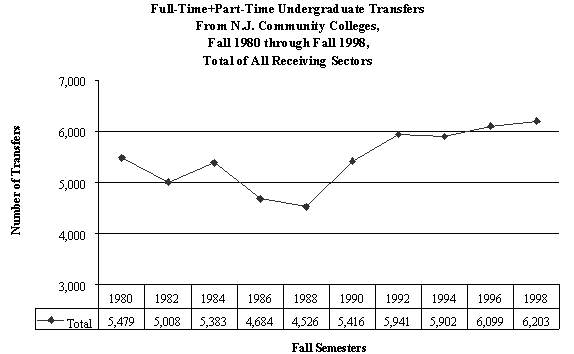
The Commission’s data on transfer flows encompass the last 18 years. Figure 1a plots the total number of transfers from New Jersey community colleges to the state’s senior institutions during that period. While the 1980s were marked largely by a decline in transfers, the period since 1988 has witnessed significant increases.
Figure 1a:
SOURCE: NJ IPEDS Form #27, Undergraduate Transfers Received by Four-Year Colleges.
Figure 1b shows that of the three major baccalaureate sectors, state colleges/ universities have consistently received the most transfer students, public research universities have received fewer, and the independent institutions have consistently received the fewest. Moreover, while transfers to state colleges/universities have followed the overall pattern of increases shown in Figure 1a since 1988, the other two senior sectors have not exhibited any trend during this period. Figure 1b is intended to establish baselines, and should not be used to evaluate the individual receiving sectors.
Figure 1b:

The observable patterns in Figures 1a and 1b cannot be attributed to fluctuations in community college enrollments. Even when one considers these enrollment fluctuations by forming ratios of transfers to such enrollments, the patterns change remarkably little. Part of the reason for this similarity in results may be that enrollment fluctuations at the community colleges, at least in the current decade, have tended to occur among part-time students, who account for only 27% of the transfer students.
Ratios of transfers to enrollments at receiving sectors indicate that during the current decade all three sectors have increased their percentages of new students who are transfers. Over the entire 18-year period the state colleges and universities have consistently been above the average of the three senior sectors, while the independent institutions have consistently been below it. The public universities were above the average during the 1980s, but have fallen below it in the 1990s. Except for a brief period in the mid-1980s, the state colleges and universities have exceeded all other sectors in new transfers relative to enrollments.
Using broad estimates, this investigation of academic credits as an outcome of the transfer process addresses two questions: (1) What is the average number of credits lost by transfer students at the time of transfer and throughout their first semester at the receiving institution? (2) At the time of graduation from the senior public institution, do students who entered as transfers have more accumulated credits than do native graduates? Have they taken longer to graduate, as a result of flaws in the transfer process?
According to Commission estimates (explained in Appendix A), transfer students lost an average of 13.7 credits in fall 1998. Graduating transfer and native students have an essentially identical number of accumulated credits on average (the means are 134.3 and 134.6, respectively) (see Appendix B).
The credit estimates presented above can and should be refined for future reports in at least one, if not two, ways. First, there must be an improvement in the quality of the data on credits that the Commission receives. These data are submitted at the beginning of the fall and spring semesters and include credits accumulated up to those points, as well as credits enrolled for in the semester that is just beginning. Second, the Commission currently lacks summer credit data of any kind, as well as end-of-semester credit data for the fall and spring, which would promptly reflect courses dropped or failed during those semesters.
C. THE ACADEMIC PERFORMANCE OF TRANSFER STUDENTS
In the most recent year for which data are available, the average community college transfer student at a state college or university attained (exactly) a "B" average in his/her junior year; this hypothetical student came within two-hundredths of a grade point of equaling the average native junior student (Table 23a). At the public research universities, both the average transfer junior and the average native junior were below a "B" average; the natives were 0.16 points higher, on average, than the transfers (Table 23b). When all senior public institutions are combined, the result is a weighted average of the two sectors just described; both transfers and natives were slightly below a "B" average (the native juniors missed by the slimmest of margins); the difference between them was 0.08 points (Table 23c). Overall, the junior-year grade performance of transfer students was nearly equal to that of native students.12
|
Table 23a: |
||||
|
Ranges |
Transfers |
Natives |
||
|
# |
% |
# |
% |
|
|
0.0 - 0.9 |
43 |
2.3 |
66 |
1.9 |
|
1.0 - 1.9 |
69 |
3.7 |
164 |
4.8 |
|
2.0 - 2.9 |
634 |
34.4 |
1,022 |
29.6 |
|
3.0 - 4.0 |
1,095 |
59.4 |
2,186 |
63.4 |
|
Unknown |
1 |
0.1 |
12 |
0.3 |
|
TOTAL |
1,842 |
100.0 |
3,450 |
100.0 |
|
MEAN GPA |
3.00 |
3.02 |
||
|
SOURCE: NJ Commission on Higher Education, Student Unit Record Enrollment (SURE) system. |
||||
|
Table 23b: |
||||
|
Ranges |
Transfers |
Natives |
||
|
# |
% |
# |
% |
|
|
0.0 - 0.9 |
27 |
2.8 |
75 |
1.9 |
|
1.0 - 1.9 |
52 |
5.5 |
166 |
4.1 |
|
2.0 - 2.9 |
388 |
40.7 |
1,315 |
32.5 |
|
3.0 - 4.0 |
484 |
50.8 |
2,471 |
61.1 |
|
Unknown |
2 |
0.2 |
14 |
0.3 |
|
TOTAL |
953 |
100.0 |
4,041 |
100.0 |
|
MEAN GPA |
2.81 |
2.97 |
||
|
SOURCE: NJ Commission on Higher Education, Student Unit Record Enrollment (SURE) system. |
||||
|
Table 23c: |
||||
|
Ranges |
Transfers |
Natives |
||
|
# |
% |
# |
% |
|
|
0.0 - 0.9 |
70 |
2.5 |
141 |
1.9 |
|
1.0 - 1.9 |
121 |
4.3 |
330 |
4.4 |
|
2.0 - 2.9 |
1,022 |
36.6 |
2,337 |
31.2 |
|
3.0 - 4.0 |
1,579 |
56.5 |
4,657 |
62.2 |
|
Unknown |
3 |
0.1 |
26 |
0.3 |
|
TOTAL |
2,795 |
100.0 |
7,491 |
100.0 |
|
MEAN GPA |
2.91 |
2.99 |
||
|
SOURCE: NJ Commission on Higher Education, Student Unit Record Enrollment (SURE) system. |
||||
At the state colleges and universities, the baccalaureate graduation rates for transfers and natives are similar. How early or late a transfer arrived in his/her academic career is not significantly related to transfers’ performance relative to that of natives (Table 24a). At the public research universities the natives have higher graduation rates than the transfers regardless of when the transfers enter, but the gap is smaller when they arrive as freshmen (Table 24b). It may be somewhat misleading to label all of these freshman enrollees from community colleges as "transfers," since some may have earned few credits at their original institution. In any case, the overall graduation rate for transfers is 64% at the public research universities and 70% at the state colleges and universities.
|
Table 24a: |
||
|
Number in |
Graduation Rate |
|
All Transfers from CC |
2,267 |
70.3% |
|
Native Freshmen |
6,455 |
50.3% |
|
Freshman Transfers from CC |
543 |
52.7% |
|
Native Sophomores |
5,901 |
71.3% |
|
Sophomore Transfers from CC |
942 |
71.4% |
|
Native Juniors |
5,353 |
84.5% |
|
Junior Transfers from CC |
745 |
80.9% |
|
SOURCE: NJ Commission on Higher Education, Student Unit Record Enrollment (SURE) system. |
||
|
Table 24b: |
||
|
Number in |
Graduation Rate |
|
All Transfers from CC |
1,174 |
64.1% |
|
Native Freshmen |
5,612 |
66.4% |
|
Freshman Transfers from CC |
222 |
58.6% |
|
Native Sophomores |
5,556 |
78.6% |
|
Sophomore Transfers from CC |
473 |
59.0% |
|
Native Juniors |
5,372 |
88.1% |
|
Junior Transfers from CC |
447 |
72.7% |
|
SOURCE: NJ Commission on Higher Education, Student Unit Record Enrollment (SURE) system. |
||
|
Table 24c: |
||
|
Number in |
Graduation Rate |
|
All Transfers from CC |
3,441 |
68.2% |
|
Native Freshmen |
12,067 |
57.8% |
|
Freshman Transfers from CC |
765 |
54.4% |
|
Native Sophomores |
11,457 |
74.8% |
|
Sophomore Transfers from CC |
1,415 |
67.3% |
|
Native Juniors |
10,725 |
86.3% |
|
Junior Transfers from CC |
1,192 |
77.9% |
|
SOURCE: NJ Commission on Higher Education, Student Unit Record Enrollment (SURE) system. |
||
The evidence presented here on the fairness and efficiency of the transfer process and its effects is somewhat mixed. More research is needed, particularly on time to completion. As far as the performance of transfer students is concerned, the results are predominantly positive. Finally, there is a need to improve both the quantity and the quality of the raw data on which such analyses are based. However, even with perfect data, some aspects of the transfer process cannot be captured quantitatively. Therefore, first-hand qualitative knowledge and insight will always be important.
The fourth systemwide accountability report does three primary things.
It provides an update on a wide range of data pertinent to higher education in New Jersey, including some comparisons with peer institutions and practices across the nation.
It presents new information on the extent of financial aid.
It examines student transfer data and sets a base on which to monitor improvement.
As an integral part of the framework for higher education accountability in New Jersey, the systemwide report serves as a reference point for members of the higher education community, policy makers, and the general public. It also has the potential to serve as the basis for ongoing discussions and further analyses to inform future planning.
The Commission on Higher Education is committed to enhancing the higher education accountability framework. Building on the information in this report to stimulate discussions and conducting additional analyses throughout the year are one way to do that. Also, ongoing accountability deliberations will encompass the Commission’s stated intent to improve both the form and content of the institutional accountability reports and its commitment to annually review and enhance the performance funding indicators. Consultation with the Presidents’ Council will be vital to the further development of the accountability framework.
APPENDIX A*:
Methodology for Estimating the Number of Credits Lost by a Student
Transferring from a Community College to a Senior Public Institution in Fall 1998
Symbols
AS98:accumulated degree credits at the beginning of spring 1998 (CC)
ES98:credits enrolled in spring 1998 (CC)
EF98:credits enrolled in fall 1998 (SP)
AS99:accumulated degree credits at the beginning of spring 1999 (SP)
Formula
(AS98 + ES98 + EF98) – AS99 = credits lost
* This calculation requires the following enrollment data: spring 1998, fall 1998, and spring 1999. Senior public institutions received 4,961 new transfers from community colleges in fall 1998. Of these, 3,292 were enrolled in the sending institution in spring 1998; of these, 2,951 enrolled in the receiving institution in spring 1999. Finally, of the last group, 2,386 had calculated credit change numbers that were zero or positive.
APPENDIX B*:
Methodology for Determining Whether Graduates of a Senior
Public Institution Who Had Entered as Transfers Had to Accumulate
More Credits than Graduates Who Had Entered as First-Time Students
Focus on 6/98 graduates of senior publics. Sum their spring 98 accumulated degree credits and their spring 98 credits enrolled; call this sum total credits.
Determine which graduates had entered as transfers and which had entered as first-time. For each group, compute and compare their mean total credits.
*There were 10,882 bachelor’s degree recipients at senior public institutions in May 1998. Of these, 9,831 were enrolled in spring 1998 and, according to the Commission’s calculation formula, had 120 or more credits at the time of graduation. Of the latter graduates, first-time admits constituted 62.1% (6,104); transfer admits, 37.9% (3,727).

 Commission Home Page