Focusing on Higher Education Outcomes:
The Third Systemwide Accountability Report
Mr. Alfred J. Cade
Chairman
Mr. Alfred C. Koeppe
Vice Chairman
|
Dr. Peter F. Burnham |
Dr. William J. King |
|
Mr. Lawrence R. Codey |
Ms. Anne Loyle |
|
Dr. Nancy S. Cole |
Ms. Gloria Soto |
|
Mr. William M. Freeman |
Accountability Committee
Mr. Lawrence R. Codey
Chairman
Mr. Alfred J. Cade
Dr. William King
TABLE OF CONTENTS
|
I. |
|||
|
II. |
|||
|
New Jersey Colleges and Universities by Sector |
|||
|
Characteristics |
|||
|
Students |
|||
|
Degrees |
|||
|
Faculty |
|||
|
Retention and Transfer Rates |
|||
|
Fiscal Indicators |
|||
|
Tuition and Fees |
|||
|
Student Assistance |
|||
|
Revenues and Costs |
|||
|
III. |
|||
|
Student Outcomes as One Indicator of Institutional Quality |
|||
|
Comparing Several Cohorts Over Time |
|||
|
Full-Time Cohorts |
|||
|
Part-Time Cohorts |
|||
|
Tracking a Single Cohort Over an Extended Period of Time |
|||
|
Full-Time Cohorts |
|||
|
Part-Time Cohorts |
|||
|
Analysis and Implications |
|||
|
IV. |
Adjusting Graduation Rates of Sectors and States: Experimenting With a New Method of Analysis |
||
|
Public Four-Year Nondoctoral Institutions |
|||
|
Public Doctoral Institutions |
|||
|
Independent Four-Year Nondoctoral Institutions |
|||
|
Independent Doctoral Institutions |
|||
|
V. |
|||
Higher education is a vital public enterprise that responds to a variety of crucial educational, economic, and societal needs. Because of higher education's importance, and the substantial public support it receives, calls for increased accountability are heard throughout the nation. Among government and educational policy makers, there is a growing insistence upon measures of higher education quality, effectiveness, efficiency, and productivity to guide planning and resource allocation and monitor the return on the taxpayers' significant public investment. Students, parents, businesses, and taxpayers are also looking for more and better information to help them judge the quality of available higher education opportunities.
For example, a 1997 survey conducted by the national organization of State Higher Education Executive Officers found that 37 states use some sort of performance indicators. This is more than double the number of states with such measures in place three years earlier. Seven additional states reported plans to implement accountability reporting or performance measures in the near future.
Quantitative examinations of the performance of institutions, sectors, and higher education systems serve several important functions:
The use of quantitative data does require caution, however, since such data can be misinterpreted and/or misused.
In New Jersey, a heightened focus on accountability is consistent with the national trend and the increased institutional autonomy provided by the Higher Education Restructuring Act of 1994. The restructuring law specifically requires New Jersey's public colleges and universities to prepare annual reports that inform the public and state policy makers about the condition and progress of the institutions. In addition, the Commission on Higher Education prepares an annual systemwide accountability report to provide aggregate data and information on the various sectors, including the state's independent institutions, and the system as a whole. A third accountability component will be added in FY 2000, when New Jersey implements the performance funding initiative for public institutions proposed by Governor Christine Todd Whitman. This initiative seeks to align institutional priorities with state priorities as set forth in Looking to the New Millennium: New Jersey's Plan for Higher Education.
In 1996, New Jersey's first systemwide accountability report provided a broad overview of the state's higher education system and reported on performance indicators in various areas, including affordability; retention, transfer, graduation, and time to degree; access and academic success; and return on the public investment in higher education. Last year, the second systemwide report focused on higher education costs, comparing revenue, spending levels, and spending patterns for New Jersey's higher education system and the individual sectors to their national counterparts.
This year's systemwide report provides more recent data on some of the key indicators addressed in the Commission's first two accountability reports, including information about enrollment, student and faculty characteristics, degrees awarded, retention and transfer rates, tuition and fees, student assistance, and revenues and costs. The report also examines some of these performance indicators over time.
Given the importance of student outcomes as an indicator of quality, the report also provides an in-depth examination of graduation rates and community college graduation-plus-transfer rates. In addition to new data reflecting long-term graduation patterns, the report undertakes a new, experimental analysis of completion rates that adjusts for the effects of certain student characteristics that have a strong influence on outcomes.
Section II presents a broad overview of the New Jersey higher education system. In order to clarify the various "sectors," all New Jersey colleges and universities are listed and classified below:
New Jersey Colleges and Universities by Sector
Public Research Universities (3)
Rutgers, the State University of New Jersey, the New Jersey Institute of Technology, and the University of Medicine and Dentistry of New Jersey
State Colleges and Universities (9)
The College of New Jersey, Kean University, Montclair State University, New Jersey City University, Ramapo College of New Jersey, The Richard Stockton College of New Jersey, Rowan University, Thomas Edison State College, and William Paterson University of New Jersey
Community Colleges (19)
Atlantic Community College, Bergen Community College, Brookdale Community College, Burlington County College, Camden County College, Cumberland County College, Essex County College, Gloucester County College, Hudson County Community College, Mercer County Community College, Middlesex County College, County College of Morris, Ocean County College, Passaic County Community College, Raritan Valley Community College, Salem Community College, Sussex County Community College, Union County College, and Warren County Community College
Public-Mission Independent Doctoral Institutions (5)
Drew University, Fairleigh Dickinson University, Princeton University, Seton Hall University, and Stevens Institute of Technology
Public-Mission Independent Nondoctoral Institutions (9)
Bloomfield College, Caldwell College, Centenary College, College of Saint Elizabeth, Felician College, Georgian Court College, Monmouth University, Rider University, and Saint Peter's College
Proprietary Institutions (3)
Berkeley College, DeVry Institute, and Katharine Gibbs School
Theological Institutions (8)
Assumption College for Sisters, Beth Medrash Govoha, New Brunswick Theological Seminary, Philadelphia College of Bible, Princeton Theological Seminary, Rabbi Jacob Joseph School, Rabbinical College of America, and Talmudical Academy
This section contains 16 tables that present data from diverse sources, and in some cases, they refer to different time periods.1
The New Jersey higher education system enrolled over 325,000 students at all 56 of its public and independent institutions in fall 1997 (Table 1). Total enrollment declined by about 15,000 students since 1992, primarily at the community colleges, where the economic recovery is widely believed to be responsible for reduced part-time enrollment, because these students decided to forsake education for employment. Full-time enrollment increased during this period of time, and is expected to increase further with the full-fledged arrival of the "baby boom echo." DeVry Institute was part of the higher education system in fall 1997, but not in 1992. Upsala College was closed at the end of the 1994-95 academic year.
Table 1: | ||||||
|
Sector |
Number of |
Number of |
Total |
|||
|
1992 |
1997 |
1992 |
1997 |
1992 |
1997 |
|
|
Public research universities |
41,119 |
41,468 |
18,731 |
19,474 |
59,850 |
60,942 |
|
State colleges/ universities |
68,229 |
66,807 |
11,640 |
11,028 |
79,869 |
77,835 |
|
Community colleges |
138,728 |
122,588 |
0 |
0 |
138,728 |
122,588 |
|
Public-mission independents |
40,443 |
38,946 |
17,333 |
16,145 |
57,776 |
55,091 |
|
Proprietary institutions |
1,878 |
5,712 |
0 |
0 |
1,878 |
5,712 |
|
Theological institutions |
651 |
1,089 |
2,150 |
2,370 |
2,801 |
3,459 |
|
TOTAL |
291,048 |
276,610 |
49,854 |
49,017 |
340,902 |
325,627 |
SOURCE: NCES, IPEDS, Fall Enrollment Survey, 1992 and 1997.
Table 1 and all other tables pertaining to students include only credit enrollment. Noncredit enrollment is a major part of the community college mission. In fact, community colleges typically enroll more noncredit students per year than credit students.
With nearly 123,000 full- and part-time students, the 19 community colleges account for over 44% of all undergraduates. Public research universities and public-mission independent institutions account for the largest share of postbaccalaureate students. The community college sector has a relatively small share of full-time faculty (21%), suggesting that the sector relies more heavily than other sectors on part-time and adjunct faculty (Table 2).
Table 2: | ||||||
|
Sector |
Sector's Percentage of NJ Undergraduate Students |
Sector's Percentage of NJ Postbaccalaureate Students |
Sector's Percentage of NJ Full-Time Faculty |
|||
|
|
1992 |
1997 |
1992 |
1997 |
1992 |
1997 |
|
Public research universities |
14.1% |
15.0% |
37.6% |
39.7% |
25.9% |
27.1% |
|
State colleges/ universities |
23.4% |
24.2% |
23.3% |
22.5% |
24.1% |
24.9% |
|
Community colleges |
47.7% |
44.3% |
0.0% |
0.0% |
22.1% |
21.1% |
|
Public-mission independents |
13.9% |
14.1% |
34.8% |
32.9% |
26.8% |
25.2% |
|
Proprietary institutions |
0.6% |
2.1% |
0.0% |
0.0% |
0.5% |
1.1% |
|
Theological institutions |
0.2% |
0.4% |
4.3% |
4.8% |
0.6% |
0.6% |
|
TOTAL |
100.0% |
100.0% |
100.0% |
100.0% |
100.0% |
100.0% |
SOURCE: NCES, IPEDS, Fall Enrollment Survey, 1992 and 1997; NCES, IPEDS, Salaries, Tenure and Fringe Benefits of Full-Time Instructional Faculty Survey, 1992-93 and 1997-98.
Sectors with high percentages of part-time students would account for a somewhat smaller share of total enrollment if percentages were calculated on an FTE basis rather than a headcount basis. In addition, it is noteworthy that Table 2 includes only instructional faculty; as a result, substantial numbers of research faculty, located primarily at research institutions, are omitted. In contrast, Table 7 below (on faculty by race/ethnicity) includes both instructional and noninstructional faculty.
Between fall 1992 and fall 1997, the full-time share of undergraduates systemwide increased from 50% to 55% (Table 3). Full-time enrollment increased by about 8,000 students, while part-time enrollment decreased by almost three times that number. While all sectors contributed to the shift toward more full-time enrollment, the community colleges accounted for about half of the part-time enrollment decline. As noted earlier, declining part-time enrollment is frequently attributed to the economic recovery. According to this reasoning, in good economic times, people feel more secure in their jobs and are less likely to seek further education, to enhance their careers or future employability. The reverse is true when unemployment rises substantially.
Table 3: | ||||||
|
Sector |
Number of Full-Time Students |
Number of Part-Time Students |
% Full-Time |
|||
|
|
1992 |
1997 |
1992 |
1997 |
1992 |
1997 |
|
Public research universities |
40,164 |
42,090 |
19,686 |
18,852 |
67.1% |
69.1% |
|
State colleges/ universities |
41,984 |
43,230 |
37,885 |
34,605 |
52.6% |
55.5% |
|
Community colleges |
52,584 |
53,323 |
86,144 |
69,265 |
37.9% |
43.5% |
|
Public-mission independents |
32,703 |
33,610 |
25,073 |
21,481 |
56.6% |
61.0% |
|
Proprietary institutions |
1,291 |
3,832 |
587 |
1,880 |
68.7% |
67.1% |
|
Theological institutions |
2,298 |
2,932 |
503 |
527 |
82.0% |
84.8% |
|
TOTAL |
171,024 |
179,017 |
169,878 |
146,610 |
50.2% |
55.0% |
SOURCE: NCES, IPEDS, Fall Enrollment Survey, 1992 and 1997.
Across the system, New Jersey residents constituted 92% of all undergraduates in both 1992 and 1997 (Table 4). All of the public sectors were above 90%. At the four-year independent institutions, over 75% of the undergraduate students were state residents.
Table 4: | ||||||
|
Sector |
Number of In-State Students |
Number of Out-of-State Students |
% In-State |
|||
|
|
1992 |
1997 |
1992 |
1997 |
1992 |
1997 |
|
Public research universities |
38,133 |
37,877 |
2,986 |
3,591 |
92.7% |
91.3% |
|
State colleges/ universities |
62,673 |
61,470 |
5,556 |
5,337 |
91.9% |
92.0% |
|
Community colleges |
137,018 |
121,028 |
1,710 |
1,560 |
98.8% |
98.7% |
|
Public-mission independents |
31,228 |
29,869 |
9,215 |
9,077 |
77.2% |
76.7% |
|
Proprietary institutions |
1,772 |
5,012 |
106 |
700 |
94.4% |
87.7% |
|
Theological institutions a |
- |
291 |
- |
798 |
- |
26.7% |
|
TOTAL |
270,824 |
255,547 |
19,573 |
21,063 |
93.3% |
92.4% |
SOURCE: NJ IPEDS Form #23, Fall Enrollment Report: NJ Supplements, Fall 1992 and Fall 1997.
a Residency data for theological institutions in 1992 were not available.
As shown in Table 5, there were notable increases in both Hispanic and Asian enrollment at the undergraduate level between 1992 and 1997. These changes, in both absolute and percentage terms, occurred in all sectors except the theological institutions. By contrast, African American enrollment changed little during the time period except for an increased share at the proprietary institutions. These changes reflect a more diverse population.
Table 5: | |||||||||||||||||
|
Sector |
White |
African American |
Hispanic |
Asian |
American |
Nonresident |
Unknown |
Total |
|||||||||
|
Public research universities |
1992 1997 |
25,539 21,949 |
62.1% 52.9% |
4,620 4,630 |
11.2% 11.2% |
3,504 4,180 |
8.5% 10.1% |
4,954 6,758 |
12.0% 16.3% |
80 115 |
0.2% 0.3% |
989 908 |
2.4% 2.2% |
1,443 2,928 |
3.5% 7.1% |
41,119 41,468 |
100.0% 100.0% |
|
State colleges/ universities |
1992 1997 |
49,771 46,219 |
72.9% 69.2% |
6,787 7,079 |
9.9% 10.6% |
5,582 7,095 |
8.2% 10.6% |
1,939 2,850 |
2.8% 4.3% |
178 234 |
0.3% 0.4% |
1,432 1,583 |
2.1% 2.4% |
2,540 1,747 |
3.7% 2.6% |
68,229 66,807 |
100.0% 100.0% |
|
Community colleges |
1992 1997 |
94,047 74,702 |
67.8% 60.9% |
16,971 15,918 |
12.2% 13.0% |
10,420 13,597 |
7.5% 11.1% |
5,148 6,255 |
3.7% 5.1% |
356 334 |
0.3% 0.3% |
4,455 3,054 |
3.2% 2.5% |
7,331 8,728 |
5.3% 7.1% |
138,728 122,588 |
100.0% 100.0% |
|
Public-mission independent institutions |
1992 1997 |
27,353 24,951 |
67.6% 63.1% |
4,396 4,180 |
10.9% 10.7% |
2,758 3,291 |
6.8% 8.5% |
1,911 2,230 |
4.7% 5.7% |
100 115 |
0.2% 0.3% |
1,224 1,204 |
3.0% 3.1% |
2,701 3,335 |
6.7% 8.6% |
40,443 38,946 |
100.0% 100.0% |
|
Proprietary institutions |
1992 1997 |
1,221 2,859 |
65.0% 50.1% |
267 1,355 |
14.2% 23.7% |
331 1,046 |
17.6% 18.3% |
50 261 |
2.7% 4.6% |
1 9 |
0.1% 0.2% |
5 24 |
0.3% 0.4% |
3 158 |
0.2% 2.8% |
1,878 5,712 |
100.0% 100.0% |
|
Theological institutions |
1992 1997 |
555 913 |
85.3% 83.8% |
0 38 |
0.0% 3.5% |
8 7 |
1.2% 0.6% |
13 5 |
2.0% 1.4% |
0 0 |
0.0% 0.0% |
75 116 |
11.5% 10.7% |
0 0 |
0.0% 0.0% |
651 1,089 |
100.0% 100.0% |
|
TOTAL |
1992 1997 |
198,486 171,233 |
68.2% 61.9% |
33,041 33,200 |
11.4% 12.0% |
22,603 29,216 |
7.8% 10.6% |
14,015 18,369 |
4.8% 6.6% |
715 807 |
0.2% 0.3% |
8,180 6,889 |
2.8% 2.5% |
14,008 16,896 |
4.8% 6.1% |
291,048 276,610 |
100.0% 100.0% |
In 1996-97, New Jersey higher education institutions conferred more than 50,000 degrees and certificates (Table 6). This figure represents an increase of more than 3,000 over a five-year period. The largest increase in the number of degrees conferred was in the state college and university sector. The proprietary institutions more than doubled the number of associate degrees awarded between 1991-92 and 1996-97, although this increase is largely attributable to the addition of DeVry Institute as a degree-granting institution in New Jersey in July 1992. The nearly threefold increase in the number of certificates awarded by the degree-granting proprietary institutions may be similarly attributed.
Table 6: | ||||||||
|
Sector |
Certificate |
Associate |
Bachelor's |
Master's |
Doctorate |
First Professional |
Total |
|
|
Public research universities |
1992 1997 |
174 123 |
18 82 |
7,462 7,599 |
2,937 3,071 |
521 566 |
957 1,012 |
12,069 12,453 |
|
State colleges/ universities |
1992 1997 |
11 2 |
284 214 |
9,505 10,597 |
1,822 2,075 |
-- -- |
-- -- |
11,622 12,888 |
|
Community colleges |
1992 1997 |
683 563 |
10,096 11,534 |
-- -- |
-- -- |
-- -- |
-- -- |
11,589 12,097 |
|
Public-mission independents |
1992 1997 |
66 59 |
381 278 |
6,643 6,725 |
3,100 3,227 |
443 433 |
382 415 |
11,015 11,137 |
|
Proprietary institutions |
1992 1997 |
236 664 |
411 856 |
-- -- |
-- -- |
-- -- |
-- -- |
647 1,520 |
|
Theological institutions |
1992 1997 |
-- -- |
-- 17 |
170 187 |
103 196 |
30 39 |
380 353 |
683 792 |
|
TOTAL |
1992 1997 |
1,170 1,411 |
12,000 12,981 |
23,780 25,108 |
7,962 8,569 |
994 1,038 |
1,719 1,780 |
47,625 50,887 |
SOURCE: NCES, IPEDS, Completions Survey, 1991-92 and 1996-97.
The public research universities, the state colleges and universities, and the four-year independent institutions all made important contributions on both the bachelor's and master's levels. Most doctoral degrees were conferred by the three public research universities and the five independent doctoral institutions. These two sectors, joined by the theological institutions, granted all first-professional degrees.
The data on faculty by race are for 1991 and 1996, not 1992 and 1997, because of changes in the relevant survey forms and the resulting lack of full comparability.2
The number of full-time faculty at New Jersey colleges and universities increased by about 4%, becoming more diverse as well (Table 7). While minorities still account for small percentages of full-time faculty, gains were made from 1991 to 1996. The numbers of African American and Hispanic full-time faculty grew by 19% and 20%, respectively, while the number of Asian full-time faculty teaching at New Jersey institutions increased by 24% during the same period.
Table 7: | |||||||||||||||
|
Year |
White |
African American |
Hispanic |
Asian |
American Indian |
Total |
|||||||||
|
Public research universities |
|||||||||||||||
|
1991 1996 |
1970 2081 |
84.0% 81.4% |
122 139 |
5.2% 5.4% |
52 64 |
2.2% 2.5% |
198 268 |
8.4% 10.5% |
2 4 |
0.1% 0.2% |
2344 2556 |
||||
|
State colleges & universities |
|||||||||||||||
|
1991 1996 |
1830 1825 |
83.1% 79.2% |
160 201 |
7.3% 8.7% |
89 111 |
4.0% 4.8% |
118 160 |
5.4% 6.9% |
5 6 |
0.2% 0.3% |
2202 2303 |
||||
|
Community colleges |
|||||||||||||||
|
1991 1996 |
1703 1768 |
87.3% 86.0% |
140 161 |
7.2% 7.8% |
45 61 |
2.3% 3.0% |
60 64 |
3.1% 3.1% |
2 3 |
0.1% 0.1% |
1950 2057 |
||||
|
Public-mission independent institutions |
|||||||||||||||
|
1991 1996 |
2167 2091 |
88.5% 87.9% |
61 69 |
2.5% 2.9% |
59 55 |
2.4% 2.3% |
161 162 |
6.6% 6.8% |
1 2 |
0.0% 0.1% |
2449 2379 |
||||
|
Proprietary institutions |
|||||||||||||||
|
1991 1996 |
34 87 |
97.1% 83.7% |
1 4 |
2.9% 3.8% |
0 2 |
0.0% 1.9% |
0 11 |
0.0% 10.6% |
0 0 |
0.0% 0.0% |
35 104 |
||||
|
Theological institutions |
|||||||||||||||
|
1991 1996 |
41 45 |
89.1% 84.9% |
3 6 |
6.5% 11.3% |
0 0 |
0.0% 0.0% |
2 2 |
4.3% 3.8% |
0 0 |
0.0% 0.0% |
46 53 |
||||
|
TOTAL |
|||||||||||||||
|
1991 1996 |
7745 7897 |
85.8% 83.5% |
487 580 |
5.4% 6.1% |
245 293 |
2.7% 3.1% |
539 667 |
6.0% 7.1% |
10 15 |
0.1% 0.2% |
9026 9452 |
||||
SOURCE: NJ IPEDS Form #32, Full-Time Faculty Profile, Fall 1991 and Fall 1996.
Third-semester retention in both New Jersey's public research universities and its state colleges and universities has exceeded performance by the nation as a whole over a number of years (Table 8). Third-semester retention rates at the state colleges and universities also improved slightly over time. New Jersey community colleges, while above the nation five years ago, are now located roughly at the national benchmark, having declined slightly in recent years (Table 9).
Table 8: | |||||||
|
PUBLIC RESEARCH UNIVERSITIES a |
|||||||
|
Cohort |
NJ |
CEEB c |
ACT d |
||||
|
1996-1997 1991-1992 |
86% 86% |
75% 78% |
76% 76% |
||||
|
STATE COLLEGES/UNIVERSITIESb |
|||||||
|
Cohort |
NJ |
CEEB c |
ACT d |
||||
|
1996-1997 1991-1992 |
83% 80% |
69% 70% |
68% 68% |
||||
a UMDNJ is excluded.
b Edison is excluded.
c Sources: College Board (CEEB), Annual Survey of Colleges, 1991-92: Summary Statistics, Table 14, p. 22; CEEB, Annual Survey of Colleges, 1995-96/1996/97: Summary Statistics, Table 13, p. 101. Data for both cohorts are from two years earlier.
d Sources: The American College Testing Program (ACT), "National Dropout Rates," 1992; ACT, "National Dropout Rates," 1997. Data for both cohorts are from two years earlier.
Table 9: | |||
|
Cohort |
NJ |
CEEB a |
ACT b |
|
1996-1997 1991-1992 |
56% 60% |
56% 54% |
53% 52% |
a Source: See footnote c in Table 8.
b Source: See footnote d in Table 8.
Four-year transfer rates for New Jersey community college students who completed 12 credits (which is how the leading national benchmark is defined) have gone from being virtually even with the nation to being very slightly above (Table 10). The May 1998 adoption of extensive transfer and articulation recommendations by the Presidents' Council will likely further improve New Jersey's performance relative to the nation.
Table 10: | ||
|
Cohort |
NJ |
US a |
|
1993-1997 1988-1992 |
23.4%c 22.7% |
21.8% b 22.1% |
a Source: Center for the Study of Community Colleges; includes only students with 12 or more credits.
b Data for this cohort are from three years earlier.
c New Jersey rates include only transfers to NJ senior public institutions plus four NJ independent institutions. The national rates also are not fully inclusive.
The New Jersey figures are derived from the Commission's centralized student tracking system (SURE), which includes only four independent institutions and cannot track transfers out of state. However, similar limitations apply to most other states' tracking systems, and many states do not have any tracking system at all.
While the remainder of this section presents separate data on each of several fiscal topics-tuition, financial aid for students, state-funded operating aid for institutions, institutional expenditure levels, and institutional revenue structures-it is important to emphasize the high degree of interdependence among these elements of the overall fiscal picture. In many cases, state policy is a key determinant that affects several different fiscal indicators.
Table 11 presents data on tuition and fees for New Jersey institutions/sectors and national peers for FY 1990, FY 1992, and FY 1997. Note that these results cannot be compared with those that were reported in the Commission's first systemwide accountability report two years ago because the current data were produced by a different (and superior) methodology made possible by access to institutional data that were not previously available.
The concept of national peers has a variety of meanings. In the case of the public and independent nondoctoral sectors and the independent doctoral sector, "national peers" refers to all institutions in the country that fall in those categories. However, in the cases of Rutgers, NJIT, and UMDNJ, the peers are a limited number of institutions that have been identified as peers by the particular New Jersey public research university in question.
Because of the high cost of living in New Jersey, tuition and fee data must be adjusted to allow valid fiscal comparisons with the nation. For NJIT and UMDNJ, the cost of living in the area of each peer institution must be taken into account as well; Rutgers' peers are more numerous, and are reasonably representative of the nation.
Table 11: | ||||||||
|
NJ (adj.) Compared with US |
||||||||
|
|
NJ Unadj. |
NJ Adj. |
US |
$ Diff. |
% Diff. |
|||
|
Rutgers |
FY 1990 FY 1992 FY 1997 |
$2,996 $3,721 $4,992 |
$2,317 $2,916 $4,315 |
$2,066 $2,540 $3,708 |
$251 $376 $607 |
12.2% 14.8% 16.4% |
||
|
NJIT |
FY 1990 FY 1992 FY 1997 |
$3,560 $4,288 $5,466 |
$2,521 $3,028 $4,326 |
$1,560 $1,726 $2,510 |
$961 $1,302 $1,816 |
61.6% a 75.4% a 72.4% a |
||
|
UMDNJ b |
FY 1990 c FY 1992 FY 1997 |
$9,093 $11,053 $14,492 |
$6,861 $9,222 $13,124 |
$5,934 $6,301 $9,575 |
$927 $2,921 $3,549 |
15.6% 46.4% 37.1% |
||
|
Public 4-yr. nondoctoral d |
FY 1990 FY 1992 FY 1997 |
$2,046 $2,629 $3,812 |
$1,582 $2,060 $3,295 |
$1,683 $2,044 $2,915 |
-$101 $16 $380 |
-6.0% 0.8% 13.0% |
||
|
Public 2-yr. |
FY 1990 FY 1992 FY 1997 |
$1,128 $1,372 $1,970 |
$872 $1,075 $1,703 |
$800 $1,005 $1,321 |
$72 $70 $382 |
9.0% 7.0% 28.9% |
||
|
Independent doctoral |
FY 1990 FY 1992 FY 1997 |
$11,446 $13,741 $17,437 |
$8,852 $10,769 $15,071 |
$8,829 $10,421 $12,528 |
$23 $348 $2,543 |
0.3% 3.3% 20.3% |
||
|
Independent nondoctoral |
FY 1990 FY 1992 FY 1997 |
$7,329 $8,724 $11,621 |
$5,668 $6,837 $10,044 |
$7,121 $8,428 $11,141 |
-$1,453 -$1,591 -$1,097 |
-20.4% -18.9% -9.8% |
||
a As explained on page 15, NJIT's overall costs are well below those of its peers, but it receives a smaller share of revenues from the state than do its peers.
bFor UMDNJ, in-state tuition and required fees for the medical degree (M.D.) are reported. UMDNJ's School of Health Related Professions, which offers undergraduate programs, has a tuition schedule that is not comparable to those for peer institutions.
cData on tuition and fees for University of California-San Francisco and University of Connecticut Health Center are not available for FY 1990.
d Thomas Edison State College is excluded.
SOURCE: Computed from raw data in national files based on NCES, IPEDS, Survey on Institutional Characteristics, 1990, 1992, 1997.
NOTE: All New Jersey data were adjusted for the cost of living in the state in each of the three years. NJIT's and UMDNJ's peers were also adjusted; Rutgers' peers were not adjusted, because they are representative of the nation. The adjustments were based on the Interstate Cost of Living Index that was developed by the American Federation of Teachers (AFT) Research Department and is available on their Web site. See F. Howard Nelson, "An Interstate Cost of Living Index," Education Evaluation and Policy Analysis, Spring 1991, Vol. 13, pp. 103-111. In constructing its index, the AFT relied on a combination of census data and the metropolitan-area cost-of-living index developed by the American Chamber of Commerce Researchers' Association (ACCRA); this index is developed for 310 urban areas, and is published in the quarterly periodical ACCRA Cost of Living Index.
Tuition and fees at New Jersey's three public research universities, in the state college/university sector, and in the community college sector all exceeded that of their peers (for individual universities) or national averages (for sectors) in FY 1997. In most cases the gap has increased over time. As a general rule, a heavy reliance on tuition and fee revenues tends to be due to a number of factors, most notably increasing higher education costs, primarily salaries, coupled with limited growth in other sources of revenue, particularly state support.
Tuition and fee cost differences between Rutgers University and its peer institutions3 rose slowly from FY 1990 to FY 1997. Over the seven-year period, UMDNJ's tuition and fees for M.D. programs, compared with those of its peers,4 were consistently higher. However, it is impossible to draw more specific conclusions about this disparity because data for the UMDNJ peers are incomplete.
NJIT's percentage gap declined slightly from FY 1992 to FY 1997, but the contrast with the peers5 was very large in all three years. The comparisons for NJIT are subject to significant qualifications. NJIT, unlike Rutgers, UMDNJ, or the state college/university sector, receives a smaller share of its revenues from the state than do its peers, rather than a larger share (see Tables 16a-16d below). Also, NJIT's overall costs are well below those of its peers (see Table 15b below).
For FY 1997, tuition and fees in New Jersey's state college and university sector were 13% above the national average for public nondoctoral institutions, a large increase since FY 1990, when these institutions were 6% below the national average.
In the community college sector, tuition and fees were 29% above the national average in FY 1997, an increase of 22 percentage points since FY 1992. The community college sector receives a significantly smaller share of revenues from the state than do their peers, and their county funding is unpredictable in some instances. The tuition gap is expected to decrease in future years due to a substantial increase in state funding for community colleges, coupled with a pledge by the institutions to hold tuition level in FY 1999.6
In the independent sector, nondoctoral institutions are significantly less expensive than their national peers, with tuition and fees that are 10% below the national average. This difference has decreased since FY 1990 when the sector was 20% below the national average. The independent doctoral institutions are 20% above the national average, a substantial change since FY 1990 when their tuition and fees were about average for the nation.
Even students and families who pay the full price of going to college, without financial aid, are not paying the full cost of providing an undergraduate education. At public four-year colleges and universities throughout the nation, the average annual cost of providing an education and related services to a full-time student was $12,416 in 1996. Yet the average tuition, or "sticker price," was $3,918. In other words, the average student who attends a public four-year college or university receives a built-in subsidy of $8,498, or 68%.
At private four-year colleges and universities nationwide, the numbers are different, but the principle is the same. In 1996, one year of education cost $18,387 to provide, but average tuition was $13,250, or 72% of the cost. At private colleges, then, the average built-in subsidy is approximately 28% of the cost. Public universities have a higher subsidy, and lower tuition, because much of the cost of educating students is paid for by state appropriations, funded by the taxpayer. For students from low- and middle-income families, financial aid can often make up the difference between the price of a private and a public college.7
For full-time students, the relatively high tuition and fees in New Jersey are ameliorated, to some degree, by a full array of federal financial aid programs, as well as an extensive set of state-funded programs.
New Jersey ranks second among all states in the amount of state-funded need-based aid provided per full-time undergraduate, and it ranks third in the percentage of full-time undergraduates receiving such aid.8 The Tuition Aid Grant (TAG) program, the primary state need-based grant program, encompasses about a third of all full-time undergraduates systemwide (Table 12); the percentage is high in every sector. New Jersey's strong commitment to need-based grant programs also helps to offset the impact of the national trends toward greater loan indebtedness and the substitution (at the federal level) of loans for grants.
Table 12: | ||||||||||||||
|
|
STATE |
FEDERAL |
INSTITUTIONAL |
|||||||||||
|
|
TAG a |
EOF a |
Merit Awards a |
NJCLASS Loans b |
Pell Grants b |
Work- Study b |
Perkins Loans b |
SEOG b |
Stafford Subsdzd b |
Stafford Unsub'zd b |
PLUS Loans b |
grants/ Schlrshp b |
Loans b |
|
|
Public Doctoral Institutions |
|
|
||||||||||||
|
No. |
12,765 |
3,122 |
4,617 |
163 |
9,234 |
3,379 |
1,803 |
2,427 |
11,801 |
5,567 |
1,022 |
13,241 |
57 |
|
|
% Of FTUs |
40.5% |
10.0% |
14.8% |
0.5% |
29.5% |
10.8% |
5.8% |
7.8% |
37.7% |
17.8% |
3.3% |
42.4% |
0.2% |
|
|
$(000) |
$37,319 |
$2,962 |
$3,719 |
$965 |
$16,266 |
$4,332 |
$1,907 |
$1,913 |
$38,220 |
$16,228 |
$5,058 |
$18,921 |
$151 |
|
|
Avg. Award |
$2,944 |
$949 |
$805 |
$5,923 |
$1,762 |
$1,282 |
$1,058 |
$788 |
$3,239 |
$2,915 |
$4,949 |
$1,429 |
$2,649 |
|
|
Public Nondoctoral Institutions |
|
|
||||||||||||
|
No. |
14,871 |
3,840 |
2,960 |
203 |
11,411 |
2,309 |
1,183 |
4,170 |
14,572 |
8,407 |
1,678 |
7,604 |
-- |
|
|
% Of FTUs |
34.5% |
8.9% |
6.9% |
0.5% |
26.4% |
5.4% |
2.7% |
9.7% |
33.8% |
19.5% |
3.9% |
17.6% |
-- |
|
|
$(000) |
$27,086 |
$3,481 |
$2,489 |
$929 |
$19,791 |
$2,302 |
$1,792 |
$1,955 |
$42,096 |
$24,138 |
$6,620 |
$7,751 |
-- |
|
|
Avg. Award |
$1,821 |
$907 |
$841 |
$4,578 |
$1,734 |
$997 |
$1,515 |
$469 |
$2,889 |
$2,871 |
$3,945 |
$1,019 |
-- |
|
|
Community Colleges |
|
|
||||||||||||
|
No. |
18,712 |
4,673 |
174 |
16 |
20,510 |
1,413 |
8 |
5,946 |
3,744 |
2,163 |
112 |
2,347 |
-- |
|
|
% Of FTUs |
27.1% |
6.8% |
0.3% |
0.0% |
29.7% |
2.0% |
0.0% |
8.6% |
5.4% |
3.1% |
0.2% |
3.4% |
-- |
|
|
$(000) |
$21,692 |
$2,790 |
$132 |
$42 |
$33,681 |
$1,765 |
$7 |
$1,703 |
$7,091 |
$4,464 |
$302 |
$1,023 |
-- |
|
|
Avg. Award |
$1,159 |
$597 |
$756 |
$2,611 |
$1,642 |
$1,249 |
$875 |
$286 |
$1,894 |
$2,064 |
$2,696 |
$436 |
-- |
|
|
Public-Mission Independents |
|
|
||||||||||||
|
No. |
10,218 |
1,942 |
1,878 |
419 |
6,756 |
3,651 |
3,397 |
4,079 |
11,043 |
4,410 |
1,425 |
14,423 |
471 |
|
|
% Of FTUs |
46.8% |
8.9% |
8.6% |
1.9% |
31.0% |
16.7% |
15.6% |
18.7% |
50.6% |
20.2% |
6.5% |
66.1% |
2.2% |
|
|
$(000) |
$41,998 |
$3,738 |
$1,630 |
$2,797 |
$12,002 |
$3,672 |
$4,211 |
$2,603 |
$37,388 |
$14,411 |
$9,139 |
$60,253 |
$791 |
|
|
Avg. Award |
$4,110 |
$1,925 |
$868 |
$6,676 |
$1,776 |
$1,006 |
$1,240 |
$638 |
$3,386 |
$3,268 |
$6,413 |
$4,178 |
$1,679 |
|
|
System Total |
|
|
||||||||||||
|
No. |
56,476 |
13,577 |
9,629 |
801 |
47,911 |
10,752 |
6,391 |
16,622 |
41,160 |
20,547 |
4,237 |
37,615 |
528 |
|
|
% Of FTUs |
34.2% |
8.2% |
5.8% |
0.5% |
29.0% |
6.5% |
3.9% |
10.1% |
24.9% |
12.4% |
2.6% |
22.8% |
0.3% |
|
|
$(000) |
$128,096 |
$12,971 |
$7,969 |
$4,734 |
$81,740 |
$12,071 |
$7,917 |
$8,174 |
$124,795 |
$59,241 |
$21,119 |
$87,948 |
$942 |
|
|
Avg. Award |
$2,268 |
$955 |
$828 |
$5,910 |
$1,706 |
$1,123 |
$1,239 |
$492 |
$3,032 |
$2,883 |
$4,984 |
$2,338 |
$1,784 |
|
a FY 1998.
b FY 1997.
NOTE 1: All aid recipients and FTUs are restricted to NJ residents.
NOTE 2: An unduplicated count of FTUs for FY 1997 was estimated by multiplying the total number of fall 1996 full-time NJ residents with the ratio of FY98 TAG unduplicated awards to fall 1997 TAG awards.
SOURCES: NJ IPEDS Form #41, FY 1996-97, Student Financial Aid report; the NJ Grants Records System, a financial database that deals with all NJ state-funded grant programs and is maintained by the NJ Office of Student Assistance (NJOSA); and the NJCLASS database, also maintained by NJOSA.
The Educational Opportunity Fund (EOF), which further benefits a subset of TAG students who are both economically and academically disadvantaged, serves 8% of full-time undergraduates systemwide.
Federal grant programs are not far behind TAG in coverage and are strong in every sector. Federal loans are widely used in all three four-year sectors. Finally, two-thirds of the full-time students at the four-year independent institutions receive institutional grants and/or scholarships; about two-fifths of the students at the public doctoral institutions receive such awards.9 Though not shown in the table, the independent institutions also give significant amounts of institutional aid to graduate students.
In FY 1997, state spending on public higher education per FTE in New Jersey was 21% higher than in the nation as a whole (), a slight increase over FY 1992 when New Jersey was 19% above the nation. With regard to state and local government's share of public higher education revenues, New Jersey was 7% above the US (Table 14) as of FY 1995. This margin was slightly higher in FY 1990. These data do not include capital expenditures.
Table 13: | |||
|
FY 1992 |
FY 1997 |
||
|
NJ |
US |
NJ |
US |
|
119 |
100 |
121 |
100 |
SOURCES: Calculated from data in Kent Halstead, State Profiles: Financing Public Higher Education, 1978 to 1992 (Washington, DC: Research Associates), Table 3, p. 59; and Halstead, State Profiles: Financing Public Higher Education, 1997 Rankings (Washington, DC: Research Associates), Table 3, p. 32. Data for New Jersey in each year were adjusted for Halstead's System Support Index (SSI), which includes "cost of living" for academic institutions. All expenditure figures include state-funded student assistance.
Table 14: | |||
|
FY 1990 |
FY 1995 |
||
|
NJ |
US |
NJ |
US |
|
109 |
100 |
107 |
100 |
SOURCE: Calculated from data in National Center for Education Statistics (NCES), Digest of Education Statistics 1992 (Washington, DC: US Department of Education [USDE]), Table 317, p. 322; and NCES, Digest of Education Statistics 1997 (Washington, DC: USDE), Table 330, p. 346.
The data in Tables 13 and 14 are on a very high level of aggregation; they encompass the entire public system of higher education in New Jersey, along with its national counterpart. While this vantage point is useful for some purposes (e.g., quick summary overviews), one must also be aware of significant differences among the sectors that are obscured by this level of generality. In the case of the public research universities, there are also significant differences within a sector. The next two sets of tables illustrate these points.
Tables 15a-15e and 16a-16e use the same methodologies that were used in last year's systemwide accountability report. (The data for FY 1994 are reproduced from that report.) The more recent data reported here-from FY 1996-are still preliminary but are very unlikely to change noticeably, according to the National Center for Education Statistics.
All three public research universities spent significantly less than their peers in FY 1996 (Tables 15a-15c). The other public institutions in New Jersey outspent their peers in both 1994 and 1996. During that two-year period the state colleges/universities increased the amount by which they outspent their peers from 5% to 8% (Table 15d); the community college margin increased from 5% to 14% (Table 15e).
Table 15a: | |||||
|
Fiscal Year |
AAU |
RU-Unadj. |
RU-Adj. |
RU-Adj. - AAU |
% Diff. |
|
FY 1994 |
13,801 |
12,230 |
10,799 |
-3,002 |
-21.8% |
|
FY 1996 a |
14,803 |
13,503 |
11,923 |
-2,880 |
-19.5% |
|
Table 15b: | |||||
|
Fiscal Year |
Peers |
NJIT-Unadj. |
NJIT-Adj. |
NJIT-Adj. - Peers |
% Diff. |
|
FY 1994 |
13,423 |
11,710 |
10,445 |
-2,977 |
-22.2% |
|
FY 1996 a |
14,852 |
12,699 |
11,328 |
-3,524 |
-23.7% |
|
Table 15c: | |||||
|
Fiscal Year |
Peers b |
UMDNJ-Unadj. |
UMDNJ-Adj. |
UMDNJ-Adj. - Peers |
% Diff. |
|
FY 1994 |
59,507 |
55,875 |
50,343 |
-9,614 |
-15.4% |
|
FY 1996 a |
59,722 |
54,610 |
49,203 |
-10,519 |
-17.6% |
Table 15d: | |||||
|
Fiscal Year |
US |
NJ-Unadj. |
NJ-Adj. |
NJ-Adj. - US |
% Diff. |
|
FY 1994 |
7,388 |
8,786 |
7,776 |
388 |
5.3% |
|
FY 1996 a |
7,950 |
9,683 |
8,570 |
620 |
7.8% |
|
Table 15e: | |||||
|
Fiscal Year |
US |
NJ-Unadj. |
NJ-Adj. |
NJ-Adj. - US |
% Diff. |
|
FY 1994 |
136 |
162 |
143 |
7 |
5.1% |
|
FY 1996 a |
138 |
178 |
157 |
20 |
14.1% |
a Data are preliminary.
b In the case of the University of California-San Francisco, for both 1994 and 1996, "ancillary support" (dental clinics, medical laboratories, etc.) were subtracted from total E & G expenditures, since the university includes the former under "academic support," which is part of E & G.
SOURCE: Computed from raw data in national files based on NCES, IPEDS, Survey on Finance, FY 1994 and FY 1996. Data for both years were adjusted in accordance with Kent Halstead's System Support Index for the middle year (1995). See Halstead, State Profiles: Financing Public Higher Education, 1978 to 1995, Table 1, p. 20. This compromise adjustment strategy was used in last year's Commission cost report, in which a combination of FY 1994 IPEDS data and FY 1996 Halstead data led to the use of a 1995 adjustment.
The three public research universities exhibit both differences and similarities with regard to their revenue structures (Table16a-16c). Rutgers derives a slightly lower share from tuition and fees than do its peers, and a decidedly higher one from state government. NJIT relies much more on tuition and fees, and less on state government, than do its peers. UMDNJ depends slightly more on tuition and fees, and far more on the state. All three institutions, however, derive considerably lower shares from private gifts/grants/contracts and endowment income, although NJIT and UMDNJ increased their shares from these sources between FY 1994 and FY 1996. It should be noted that Rutgers, unlike most of its peers, does not have a medical school, which affects its ability to garner external funds; it also has a smaller proportion of out-of-state undergraduate students, which affects its revenue stream, since nonresident tuition is higher. For all of the universities and their peers the tuition/fee share increased slightly during the same period, while the state share declined slightly.
|
Table 16a: |
||||
|
|
FY 1994 |
FY 1996 a |
||
|
|
AAU |
RU |
AAU |
RU |
|
Tuition and Fees |
33.7% |
32.7% |
34.7% |
33.9% |
|
State Government |
52.5% |
59.0% |
49.7% |
57.9% |
|
Other |
13.8% |
8.2% |
15.6% |
8.2% |
|
TOTAL |
100.0% |
100.0% |
100.0% |
100.0% |
|
Table 16b: | ||||
|
|
FY 1994 |
FY 1996 a |
||
|
|
Peers |
NJIT |
Peers |
NJIT |
|
Tuition and Fees |
24.1% |
36.9% |
26.2% |
37.1% |
|
State Government |
63.4% |
59.1% |
61.4% |
56.8% |
|
Other |
12.6% |
4.0% |
12.4% |
6.1% |
|
TOTAL |
100.0% |
100.0% |
100.0% |
100.0% |
|
Table 16c: |
||||
|
|
FY 1994 |
FY 1996 a |
||
|
|
Peers |
UMDNJ b |
Peers |
UMDNJ b |
|
Tuition and Fees |
10.5% |
11.4% |
11.5% |
12.8% |
|
State Government |
64.5% |
78.1% |
63.7% |
75.4% |
|
Other |
25.0% |
10.4% |
24.9% |
11.8% |
|
TOTAL |
100.0% |
100.0% |
100.0% |
100.0% |
a Data are preliminary.
b For both 1994 and 1996, the revenue data for UMDNJ have been adjusted to correct for the fact that while the peers record all of their indirect cost recovery under restricted grants and contracts (in this table "other"), UMDNJ records only 34% of its indirect cost recovery in this manner (the remainder is restricted). Because this adjustment was not made in last year's accountability report, the 1994 revenue data for UMDNJ have changed somewhat.
New Jersey's state colleges and universities rely somewhat less on tuition and fees than their peers, and more on the state (Table 16d); the pattern for the state's community colleges is reversed to a marked degree (Table16e). In both sectors, as with the universities, the tuition/fees share increased slightly in New Jersey and elsewhere between FY 1994 and FY 1996, while the state share decreased slightly.
|
Table 16d: |
||||
|
|
FY 1994 |
FY 1996 a |
||
|
|
US |
NJ |
US |
NJ |
|
Tuition and Fees |
36.7% |
33.5% |
38.4% |
35.2% |
|
State Government |
57.8% |
64.1% |
56.8% |
61.7% |
|
Other |
5.5% |
2.4% |
4.8% |
3.1% |
|
TOTAL |
100.0% |
100.0% |
100.0% |
100.0% |
|
Table 16e: |
||||
|
|
FY 1994 |
FY 1996 a |
||
|
|
US |
NJ |
US |
NJ |
|
Tuition and Fees |
26.3% |
39.8% |
27.5% |
42.8% |
|
State Government |
47.0% |
23.7% |
47.4% |
21.3% |
|
Other |
26.7% |
36.5% |
25.1% |
36.0% |
|
TOTAL |
100.0% |
100.0% |
100.0% |
100.0% |
a Data are preliminary.
SOURCE: Computed from raw data in national files based on NCES, IPEDS, Survey on Finance, FY 1994 and FY 1996.
III. Long-Term Analysis of Graduation Rates and Other Outcomes
STUDENT OUTCOMES AS ONE INDICATOR OF INSTITUTIONAL QUALITY
Higher education serves society in myriad ways. Colleges and universities support economic growth and development. They undertake vital research that extends the boundaries of knowledge and produces exciting new discoveries. They provide public service and cultural opportunities that enhance citizens' quality of life.
First and foremost, however, the mission of higher education is to provide quality undergraduate education that prepares students for future challenges. The undergraduate experience should equip students with the ability to communicate clearly, think critically, solve problems, and make effective use of technology-the basic tools needed to succeed in the workplace of today and tomorrow. College students should also be well prepared to exercise their social and civic responsibilities, and to pursue further academic or career-based learning.
Given the paramount responsibility of colleges and universities for cultivating and supporting student learning, which ultimately affects both individual achievement and future contributions to society, it is not surprising that measures of student success are increasingly important indicators of institutional performance. Retention, transfer, and graduation rates are commonly used to gauge the quality of undergraduate education.
In a September 1997 Higher Education White Paper focusing on undergraduate education, Russell Edgerton, Director of the Education Program for the Pew Charitable Trusts, criticized the tendency to define excellence in higher education as having the most talented students and the most widely recognized faculty. Instead, he recommended judging quality on the basis of criteria such as the extent to which students who embark on a course of study actually finish their program and acquire a degree. While many factors unrelated to the quality of the educational experience may influence students' success, including the level of preparation for college work, Edgerton and numerous educational researchers agree that graduation figures are valid and telling indicators of educational quality.
For this reason, Section III of the systemwide accountability report focuses on graduation rates or, in the case of the community colleges, graduation-plus-transfer rates. In an effort to examine both success rates and the time frames involved, this section tracks the progress of several cohorts of students over time, using a variety of time frames, and also looks at the progress of a single group over an extended time frame.
Recognizing that graduation rates are influenced by many factors, Section IV of the report undertakes a new type of analysis that examines and adjusts for factors that are primarily not under the direct control of institutions. While still somewhat experimental in nature, because it has not been replicated many times, this valuable analysis permits the comparison of graduation statistics for New Jersey institutions with their national peers when the effects of certain key factors are removed.
COMPARING SEVERAL COHORTS OVER TIME
Cohort analysis involves tracking students who enter a given institution, or type of institution, at the same time. While this method is widely used to compute retention and graduation rates, its use in the past (in New Jersey and elsewhere) has had significant shortcomings. For example, reporting on one cohort at a time may obscure progress in graduation rates and/or other outcomes. Also, such analyses focus largely on full-time students, ignoring the significant segment of part-time students. Finally, the time frames for analysis of a single cohort are limited, offering an incomplete picture of outcomes.
Until recently, the Commission on Higher Education did not have data for enough years in the SURE (Student Unit Record Enrollment) System to permit more extensive analyses. With the availability of more years of data, the Commission is now able to undertake a multiple-cohort analysis, as well as an analysis of longer time frames, and to include part-time students in both analyses. For the four-year public institutions, this section focuses strictly on graduation rates. For the community colleges, the indicator used includes both graduation and transfer.
New Jersey's 14 four-year independent colleges and universities are not included in this analysis of long-term graduation rates because most do not yet participate in the SURE system. Among the public research universities, Rutgers University and the New Jersey Institute of Technology (NJIT) are examined separately; the University of Medicine and Dentistry of New Jersey (UMDNJ) is not included because it has virtually no freshman students. For the state college and university sector, eight of the nine institutions are included in this analysis; Thomas Edison State College is excluded because of its unique mission. For the community college sector, all 19 institutions are included.
In all of the analyses of graduation rates that are presented in this report, "graduation" always means graduation from the institution in which the student was first enrolled. Also, these analyses do not assume that all students who enter as full-time remain full-time throughout their college careers; a parallel point applies to students who enter as part-time. Nor is it assumed that all students are continuously enrolled. Many do not conform to traditional enrollment patterns, especially in certain sectors and institutions. For example, of the 544 members of the 1991 full-time entering cohort at NJIT, only 24 were continuously enrolled on a full-time basis for seven consecutive fall semesters, and only 77 were continuously enrolled at all. While it is clear that many NJIT students persist despite this enrollment pattern, it is apparent that many of the remaining students in the 1991 cohort dropped out at a certain point, because they have been continuously not enrolled for significant periods of time.
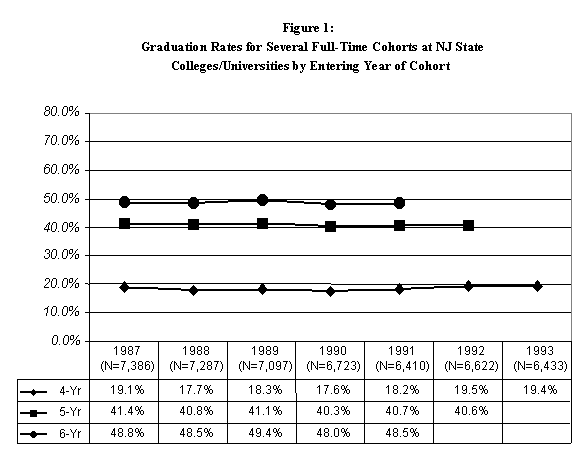
The state college and university sector's graduation rates are remarkably constant for the last several years (Figure 1). This consistency applies equally to four-, five-, and six-year rates. Adding a fifth year brings the graduation rate to over 41%, more than double the four-year rate; the additional increment provided by a sixth year is less dramatic. The five-year rates are similar to national averages for all public four-year nondoctoral institutions.10 Currently there are no four- or six-year national benchmarks for public four-year nondoctoral institutions.
SOURCE: NJ Commission on Higher Education, SURE (Student Unit Record Enrollment) System.
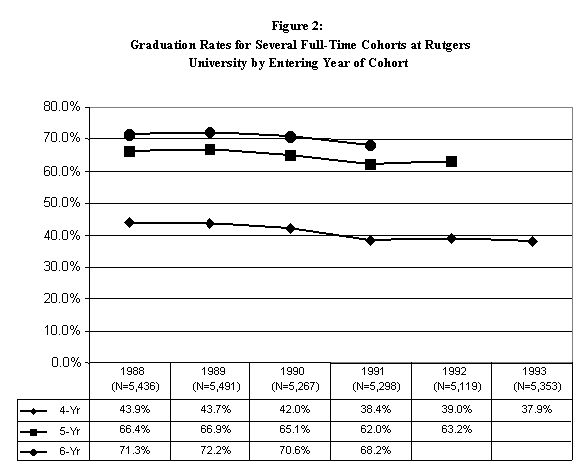
Graduation rates at Rutgers University are notably higher than those of public doctoral institutions across the nation for both five- and six-year cohorts. The five-year rates are consistently above 60% (Figure 2), as compared with national rates that range from 46% to 50% for the 1990-1995 and 1987-1992 cohorts.11 Rutgers' six-year rates hover around 70%, as compared with the NCAA national benchmark of 53%.12 Rutgers' graduation rates declined slightly for both time frames; the national five-year rates also declined, while the six-year rates remained stable. There are no four-year benchmarks for public doctoral institutions.
SOURCE: NJ Commission on Higher Education, SURE (Student Unit Record Enrollment) System.
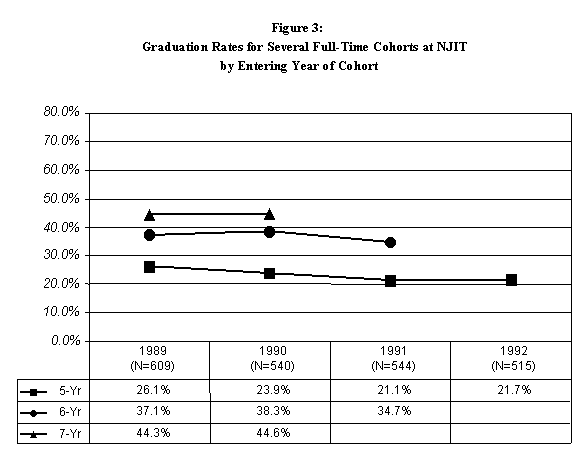
Seven-year cohorts are used to evaluate NJIT graduation rates because most of the university's degree programs require an extended period of study. A minimum of 148 credit hours is required for NJIT's four-year engineering programs, and its architecture program requires five years. The two NJIT seven-year cohorts show consistency in the very early part of the decade (Figure 3), but are below the NCAA national six-year rate of 53%.
SOURCE: NJ Commission on Higher Education, SURE (Student Unit Record Enrollment) System.
Forming several cohorts representing all New Jersey senior public institutions (except UMDNJ and Edison) produces an aggregate five-year graduation rate that has been consistently above the nation's senior public institutions over the last five years (Figure 4).13
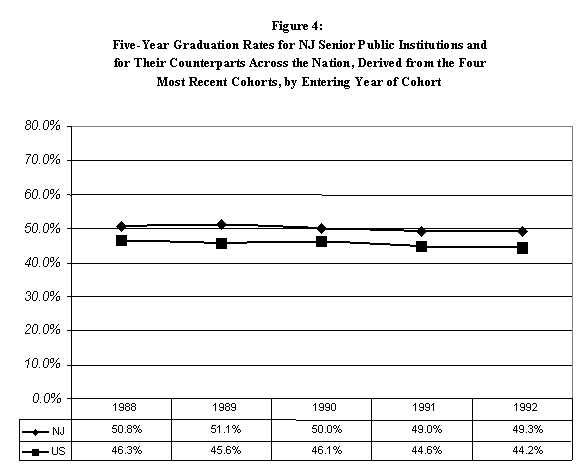
SOURCE: NJ Commission on Higher Education, SURE (Student Unit Record Enrollment) System; the national data are from American College Testing (ACT), as published in the September 1997 issue of Postsecondary Education OPPORTUNITY.
Before the data for the community colleges are discussed, the point made above regarding the limitations of the transfer data should be reiterated. The data do not include transfers to the majority of independent institutions in New Jersey or to any institutions in other states. In addition, it should be stressed that "full-time" cohorts consist of students who began as full-time; an unknown number of these students did not remain so. Finally, the community colleges have significant numbers of students, who, though credit-seeking, are not degree-seeking; they are omitted from the analyses in this section.
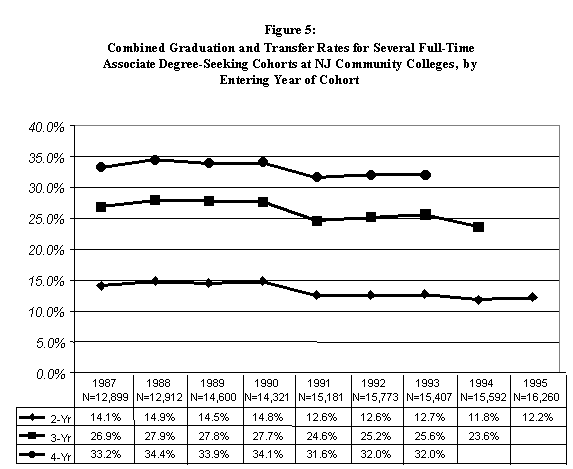
Following initial increases, two-, three-, and four-year graduation-plus-transfer rates for cohorts of full-time students seeking associate degrees at New Jersey's 19 community colleges are marked by long-term declines, interrupted by periods of constancy (Figure 5). However, the four-year rates have declined only very slightly.
SOURCE: NJ Commission on Higher Education, SURE (Student Unit Record Enrollment) System.
No national benchmarks are available for graduation-plus-transfer rates; moreover, national benchmarks for pure graduation rates at community colleges are lacking in both quality and quantity.14 However, the three-year graduation rate for the 1989-1992 cohort in New Jersey was very close to its national contemporary counterpart. While the New Jersey rate has declined, more recent national rates are unknown.15
More than for full-time students, the graduation rates for part-time cohorts are affected by many factors, including the number of credits/courses taken each semester and family/job demands. Just as economic fluctuations affect part-time enrollments, so do they affect graduation rates for part-time students. Unlike the case of full-time cohorts, where standard time frames of two to four years for associate degrees and four to six years for most baccalaureate degrees have emerged, there is little national data to indicate how long it typically takes-or should take-successful part-time students to attain their degrees.
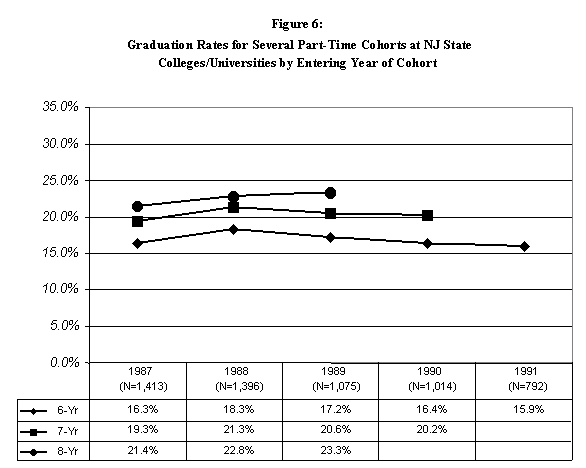
The pattern for the part-time state college and university sector cohorts is characterized by small initial gains followed by more recent small declines in the six- and seven-year graduation rates (Figure 6). However, the eight-year graduation rate, which is available only for three cohorts, increased slightly over time, to 23%. Continuing examination of data regarding eight-year rates may prove encouraging.
SOURCE: NJ Commission on Higher Education, SURE (Student Unit Record Enrollment) System.
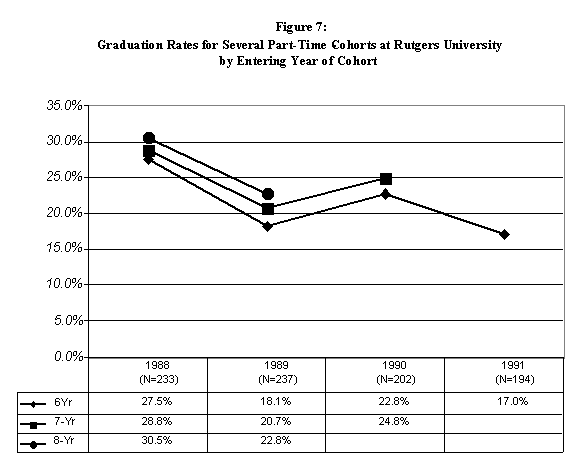
While graduation by part-time cohorts at Rutgers within a six-year time frame has experienced a long-term decline, it is too early to tell whether this pattern is replicated for seven- and eight-year time frames (Figure 7). The longer time frames may reflect more realistic goals for students attending the university part-time.
SOURCE: NJ Commission on Higher Education, SURE (Student Unit Record Enrollment) System.
The NJIT part-time cohorts are too small to be meaningful. Although NJIT actually has a substantial number of part-time students, most of them are transfers who were not included in the first-time freshman cohorts. With 36% of its students entering as transfers, many of whom are enrolled part-time, it is important to note that a significant number of students at NJIT are not included in either the full-time or the part-time cohorts that were constructed for this report.
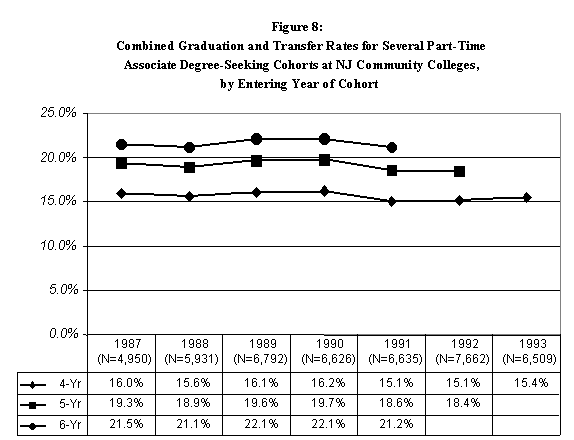
The part-time community college degree-seeking cohorts held fairly steady over the last three years with regard to graduation-plus-transfer rates (Figure 8). This statement applies to four-, five-, and six-year time frames.
Source: NJ Commission on Higher Education, SURE (Student Unit Record Enrollment) System.
TRACKING A SINGLE COHORT OVER AN EXTENDED PERIOD OF TIME
In this single-cohort analysis, both full-time and part-time cohorts are again analyzed by sector. While this analysis and the preceding multiple-cohort piece both employ the long-term tracking capability of the SURE data system, they do so in different ways-this analysis lengthens the duration of each cohort, while the multi-cohort analysis increases the number of cohorts.
The SURE system was phased in gradually over time; therefore, the first year for which data are available differs for each sector.
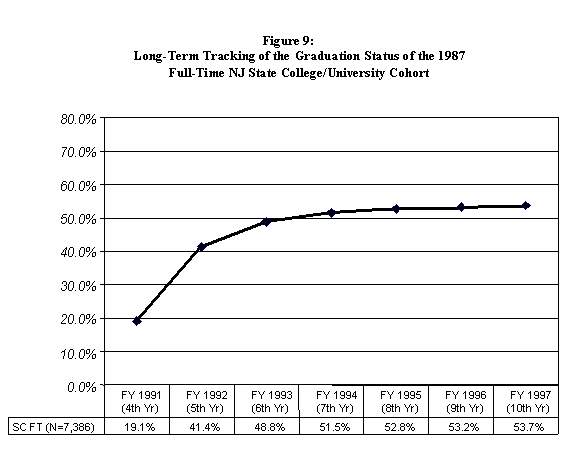
The state college and university sector's 1987 full-time entering cohort doubled its graduation rate between the end of the fourth year and the end of the fifth year (Figure 9), increasing from about 19% to over 41%. The rate increased further to almost 49% in the sixth year, and over 51% in the seventh. Beyond that point, annual gains occurred, but they were very small.
SOURCE: NJ Commission on Higher Education, SURE (Student Unit Record Enrollment) System.
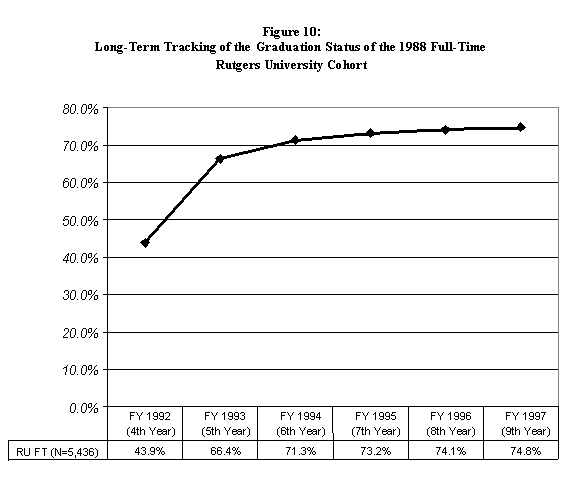
The pattern of increase for Rutgers University's 1988 cohort is very similar to that for the state colleges, except that at each stage Rutgers' rate was higher (Figure 10). (Note that Rutgers' data end after the ninth year.) The four-year graduation rate of about 44% increased substantially, to over 66% in the fifth year and to over 71% in the sixth year. Smaller increases in the seventh, eighth and ninth years bring the graduation rate to almost 75%.
SOURCE: NJ Commission on Higher Education, SURE (Student Unit Record Enrollment) System.
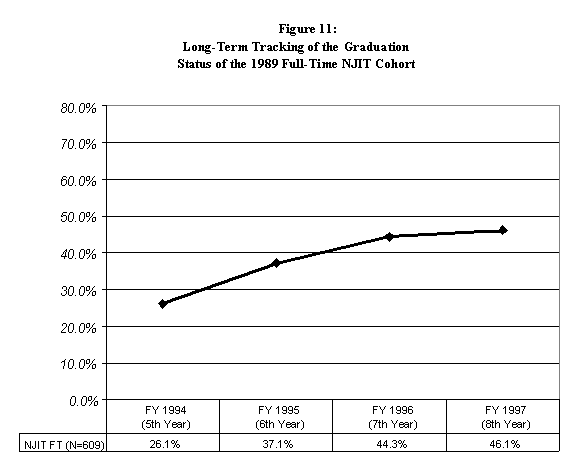
The graphic depiction of the pattern for the NJIT 1989 cohort begins with the fifth year, because of the institution's five-year program and the unusually high credit requirements even for its four-year programs (Figure 11). There were large gains in the sixth and seventh years, when the rate exceeded 44%. There was a small gain to 46% in the eighth year (where the data end).
SOURCE: NJ Commission on Higher Education, SURE (Student Unit Record Enrollment) System.
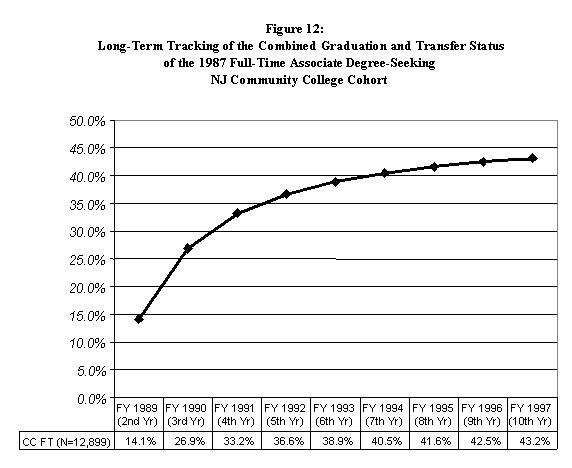
The graduation/transfer rate for full-time students entering community colleges in pursuit of associate degrees in 1987 was 14% after two years, but it rose in every subsequent year (Figure 12). In the tenth year (when the data end), it was still slowly rising. The 10% gain between the fourth and tenth years was about the same as the gain between the third and fifth years.
SOURCE: NJ Commission on Higher Education, SURE (Student Unit Record Enrollment) System.
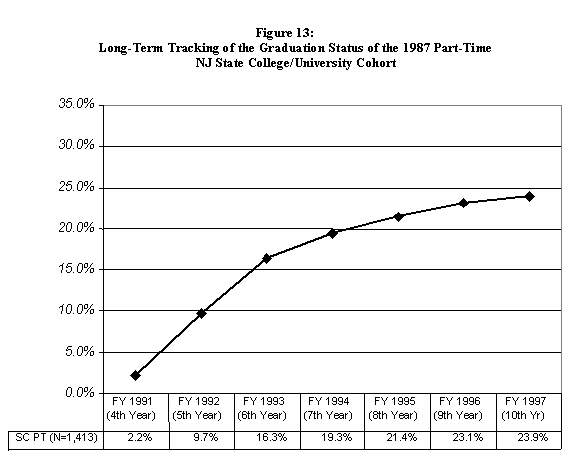
The 1987 state college and university sector part-time entering cohort made significant annual gains in graduation rates until the seventh year, when the graduation rate reached 19.3%. Smaller gains were seen from that point through the 10th year (the last year for which data are available), when almost 24% of the cohort had graduated (Figure 13). It is conceivable that additional students from this cohort will continue to graduate in the 11th or 12th years.
SOURCE: NJ Commission on Higher Education, SURE (Student Unit Record Enrollment) System.
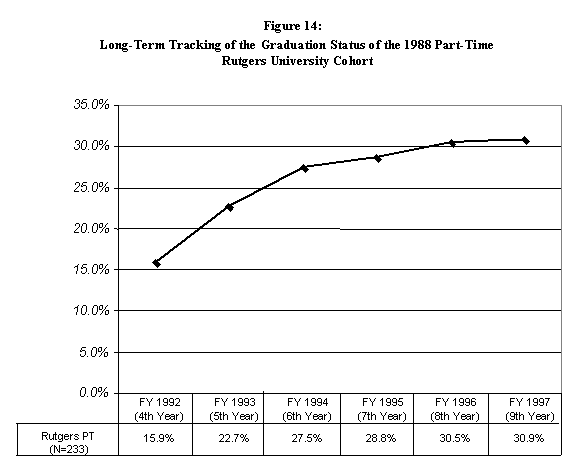
The pattern for Rutgers' 1988 cohort is similar to that for the state colleges, except that at each stage Rutgers' graduation rate was higher (Figure 14). The graduation rate for Rutgers was 27.5% in the sixth year, and increased to almost 31% after nine years, when available data end. The 1989 NJIT part-time cohort is too small to be meaningful.
SOURCE: NJ Commission on Higher Education, SURE (Student Unit Record Enrollment) System.
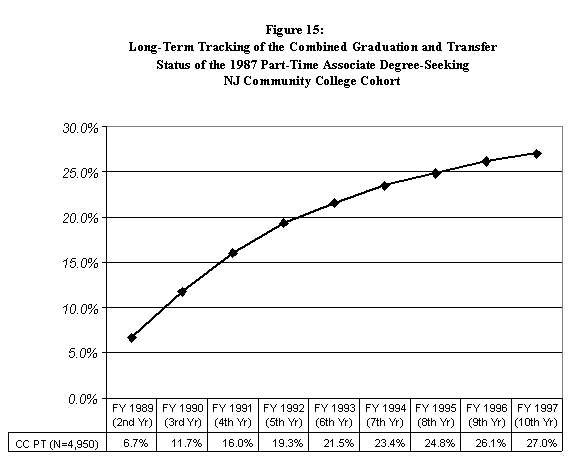
The pattern for the 1987 part-time community college degree-seeking cohort resembles that for its full-time counterpart, except that at each point (beginning in the third year) the part-time graduation/transfer rate was 15-17 percentage points lower (Figure 15). This group's rate after 10 years was almost exactly equal to the full-time community college cohort's rate after three.
SOURCE: NJ Commission on Higher Education, SURE (Student Unit Record Enrollment) System.
The analysis of single cohorts over an extended period for each sector highlights the fact that the majority of students who succeed in college do not earn their degrees in two years for an associate degree or four years for a baccalaureate degree. It is commonplace for students to take five, six, or more years to complete a bachelor's degree, as exemplified by the fact that the percentage of graduating students more than doubled in the fifth year for both the Rutgers and the state college/university sector cohorts, and further increases were seen in the sixth year and beyond. These patterns are fairly typical across the nation.
Economic hardship surely plays a role in lengthening time to degree. For students who enter and remain as full-time, this extended time frame also represents a significant cost to the students and their parents, as well as to institutions and the state. Therefore, institutions and state policy makers should make shortening time to degree a priority. New Jersey's Plan for Higher Education recommends several steps that institutions can take to accomplish this important goal, including:
The ability to transfer credits between institutions can also reduce time to degree, and improve graduation rates, thereby reducing costs for students and the state. Recognizing this, the Presidents' Council in May 1998 adopted a set of principles to improve articulation between colleges and ease student transfer. The Council also called for improved institutional communication and better public information about transfer policies and responsibilities through the development of a computer-based information system.
In addition, advances in distance learning may reduce time to degree by making it easier for students to access required courses on other campuses and enabling students to earn college credit while still in high school. Policies for shortening time to degree must be carefully crafted to avoid the unintended effect of lowering the probability of eventual degree attainment for some.
IV. Adjusting Graduation Rates of Sectors and States: Experimenting With a New Method of Analysis16
This last section carries out an experimental analysis that statistically removes the effects of individual student factors that heavily influence graduation rates. Such analysis provides a better understanding of graduation rates as institutional or sector outcomes. Also, since the background factors vary substantially from institution to institution, removing their impact allows for fairer and more valid comparisons. This approach is supported by several authoritative sources17 and is growing in influence. New Jersey's community college sector cannot be subjected to a similar analysis, because the data file used here contains only baccalaureate institutions, and comparable national data for two-year institutions are not currently available to the Commission.
The data and tables in this section compare average graduation rates across states by sector (state colleges and universities, public doctoral institutions, four-year independent nondoctoral institutions, and independent doctoral institutions), after removing the impact of three factors recognized as having a direct effect on aggregate degree completion: average combined SAT/ACT scores, percentage of freshmen living on campus, and percentage of undergraduates who are full-time. These factors have proven to be statistically powerful in predicting variations among institutional graduation rates.18 While SAT is a measure of academic preparedness, the other two factors pertain to an institution's environment.
The goal of this analysis is to examine institutions' or sectors' success in graduating students after removing the effect of the three factors. The statistical strategy for accomplishing this is to generate a "predicted" graduation rate for each higher education sector in each state, based on the three input factors (and averaged across the relevant institutions). For each sector, the states' actual graduation rates are then compared with their predicted rates. Subtracting the predicted graduation rate from the actual rate removes the effect of the influencing factors, creating a more meaningful measure of institutional success in graduating students. Thus, in this context, the degree to which institutions and sectors exceed their predicted graduation rates is the measure of institutional impact and success in graduating students.
The predictive power of the statistical model used throughout this analysis is consistently good; it always explains more than half of the variation in institutional graduation rates in any sector. However, the Commission's first attempt at this type of analysis is experimental. The credibility of the analytical strategy used here will be enhanced as the quality and consistency of data across the nation improve and more sources of reliable information become available.
Public Four-Year Nondoctoral Institutions
Forty-seven states have public four-year nondoctoral institutions that are the national peers of New Jersey's state college and university sector19; 44 of those states are represented in the data file. The predictive model containing the three predictors mentioned above-average SAT scores, percentage living on campus, and percentage of full-time students-statistically accounts for 56% of the variation in graduation rates among the institutions in question. While all three predictors are highly statistically significant, SAT is the most powerful, while percentage living on campus is the least influential.
The eight state colleges and universities included in this portion of the analysis (Thomas Edison State College is excluded because of its unique mission) are above the median of the states in terms of the average SAT of entering students, but have no advantage over most other states with regard to percentage of students living on campus or percentage enrolled full-time. These factors together lead to a slightly higher than average predicted graduation rate (Table 17a). However, New Jersey's actual rate is five percentage points higher than the predicted rate, leading to a higher rank among all included states in actual graduation rate and a rank of sixth overall when the difference between predicted and actual rates is computed. These results show that when one removes the effects of student population characteristics that influence graduation rates, the eight institutions do very well compared with their national peers.20 The results also demonstrate that public four-year nondoctoral institutions in New Jersey outperformed statistical predictions, indicating that these institutions had a positive effect on their students' performance.
|
Table 17a: | |||||||||
|
Avg. Predicted Rate |
Avg. Actual Rate a |
Actual minus Predicted |
|||||||
|
State |
Value |
Rank |
State |
Value |
Rank |
State |
Value |
Rank |
|
|
NJ |
43% |
17 |
NJ |
48% |
8 |
NJ |
5% |
6 |
|
|
US |
42% |
|
US |
42% |
|
US |
0% |
|
|
|
a 1989-1995. |
|||||||||
|
SOURCE: Multiple regression analyses performed by Commission staff on a data file compiled and furnished by Tom Mortenson, Editor of Postsecondary Education OPPORTUNITY. For more details, see footnote 18. |
|||||||||
All 50 states have public doctoral institutions, and all are represented in this portion of the analysis. The predictive model explains 80% of the variation among these institutions' graduation rates. As in the case of the public four-year nondoctoral institutions, all three predictors are highly statistically significant, but SAT is by far the most powerful, while percentage living on campus has the least effect.
New Jersey's two public doctoral institutions included here (Rutgers University and New Jersey Institute of Technology) together rank quite high on SAT, are well above average with regard to percentage of students living on campus, and are exactly at the national average on percentage of students who are enrolled full-time. These factors lead to a high predicted graduation rate (Table 17b). The actual rate is four percentage points higher still, leading to a similar rank for the actual rate and a rank of 13th for the actual minus predicted rate. The reason New Jersey drops in position when the difference between actual and predicted rates is examined is that many other states also outperformed their predicted rates.
Table 17b: | |||||||||
|
Avg. Predicted Rate |
Avg. Actual Rate a |
Actual minus Predicted |
|||||||
|
State |
Value |
Rank |
State |
Value |
Rank |
State |
Value |
Rank |
|
|
NJ |
64% |
5 |
NJ |
68% |
5 |
NJ |
4% |
13 |
|
|
US |
52% |
|
US |
52% |
|
US |
0% |
|
|
|
a 1989-1995. |
|||||||||
|
SOURCE: see Table 17a. |
|||||||||
The high ranking of New Jersey's public doctoral universities on SAT indicates that the regularly admitted students at these two institutions are relatively high-achieving from a national perspective. Since institutions in a sector/state are weighted equally, New Jersey's flagship institution accounts for half of the state's public doctoral sector, whereas many other states have several public doctoral institutions that may be considerably less competitive than their flagship universities. In addition, some states dispense doctoral status more liberally than does New Jersey, which may result in a greater percentage of low SAT scores at institutions classified as "doctoral."21
Independent Four-Year Nondoctoral Institutions
This portion of the analysis includes data from 47 states and draws comparisons with eight of the nine New Jersey institutions; data were not available for The College of St. Elizabeth. For independent four-year nondoctoral institutions, the predictive model explains 54% of the variation in graduation rates. This is wholly attributable to the influence of SAT scores because the other two factors do not vary sufficiently to be statistically significant across all of the states.
New Jersey's eight independent nondoctoral institutions collectively rank below the median of the states on all three predictors (SAT, percent full-time, percent residential). Not surprisingly, these factors lead to a predicted graduation rate that is also below the median (Table 17c). The actual rate, however, is two percentage points higher, leading to a somewhat higher rank for the actual rate and a much higher rank of 16th for the difference. This is a very positive outcome, showing that when the effects of the student characteristics that influence graduation rates are removed, these independent institutions are in the top one-third of all states nationally in terms of the impact of institutional interventions.
Table 17c: | |||||||||
|
Avg. Predicted Rate |
Avg. Actual Rate a |
Actual minus Predicted |
|||||||
|
State |
Value |
Rank |
State |
Value |
Rank |
State |
Value |
Rank |
|
|
NJ |
48% |
40 |
NJ |
50% |
30 |
NJ |
2% |
16 |
|
|
US |
56% |
|
US |
57% |
|
US |
1% |
|
|
|
a 1989-1995. |
|||||||||
|
SOURCE: see Table 17a. |
|||||||||
Independent Doctoral Institutions
Thirty-seven states have independent doctoral institutions that are the peers of the five in New Jersey; 34 states are represented in this portion of the analysis. The predictive model explains almost three-fourths (73%) of the variation among these institutions' graduation rates. While both SAT and percentage of students living on campus are highly statistically significant, SAT is by far the more powerful predictor. Percentage who are full-time is moderately significant. New Jersey's five independent doctoral institutions, considered as a group, are slightly below the nation on all three predictors. These factors lead to a predicted graduation rate that is two percentage points below the predicted value for the nation (Table 17d). The actual rate for New Jersey equals the predicted rate; both are slightly below the national average. In sum, while graduation rates of New Jersey independent doctoral institutions are somewhat below the nation, they are fully congruent with the characteristics of the students enrolled at these institutions.
Table 17d: | |||||||||
|
Avg. Predicted Rate |
Avg. Actual Rate a |
Actual minus Predicted |
|||||||
|
State |
Value |
Rank |
State |
Value |
Rank |
State |
Value |
Rank |
|
|
NJ |
64% |
17 |
NJ |
64% |
21 |
NJ |
0% |
24 |
|
|
US |
66% |
|
US |
66% |
|
US |
0% |
|
|
|
a 1989-1995. |
|||||||||
|
SOURCE: see Table 17a. |
|||||||||
The Commission on Higher Education's third systemwide accountability report provides updated information on higher education in New Jersey and compares both the progress of institutions and sectors over time as well as their performance in relation to national peers. The report also analyzes program completion as one measure of quality. The updated information and data analyses are provided to assist in measuring progress toward New Jersey's vision of excellence for higher education and to inform policy development at both the institutional and statewide level.
The Commission's examination of outcomes as a measure of quality is in keeping with a national trend. As noted in Section III of the report, the credentials of faculty and the preparedness and prior academic achievements of entering students have played a central role in the traditional view of quality in higher education. During the last several years, however, the emphasis in higher education quality assessment has shifted to student outcomes such as graduation and transfer rates, rather than inputs. This year's systemwide accountability report goes a step further to analyze student outcomes and inputs together, examining graduation rates in the context of student factors that directly affect the end result. While this analysis is valuable in and of itself, it also represents an important step toward linking student outcomes to a greater variety of input factors, particularly fiscal resources.
Efforts to relate institutional costs and expenditures to quality have been very limited to date. While some national magazine rankings have identified "best buys" in higher education, such consumer-oriented efforts are not generally based on rigorous data analysis. The Commission believes that the complex link between institutional expenditures and higher education outcomes must be systematically analyzed. Therefore, as the data and methodology allow, future accountability reports will provide analysis of how spending in general, as well as spending in specific areas, produces explicit outcomes for various types of institutions. Such information will be invaluable as we strive for a system of higher education that is among the best in the world, providing New Jersey with a competitive edge in the global economy.
|
1 |
Of the first 10 tables in Section II, all but one present data for 1997, the most recent year for which data are now available, and 1992. The only exception is Table 7, which presents data for 1996 and 1991; the reasons for this deviation are spelled out in footnote 2. Table 11 adds 1990 to 1997 and 1992, because the methodology used here represents a significant change from that used for a corresponding table in the first systemwide accountability report, and it was felt that a somewhat longer time frame was appropriate to give a fuller picture of the consequences of the new methodology. Table 12 presents data only for the most recent year, because it is too complex to repeat for another year; the interested reader may consult the Commission's first systemwide accountability report for an earlier version of this table. Tables 13 and 14 borrow numbers-and derive calculations-from national data that have already been published. For the former, 1997 and 1992 are feasible; for the latter, 1995 and 1990 are as close as one can come to those years. Finally, Tables 15 and 16 update some cost and revenue calculations that were presented for the first time only a little over a year ago, in the Commission's second systemwide accountability report. The years presented last year were 1989 and 1994; this report repeats 1994, and adds 1996, which is the most recent year now available. |
|
2 |
2 NJ IPEDS Survey #32 (Full-Time Faculty Profile) collected numbers of full-time instructional faculty by five racial/ethnic categories from 1980 through 1996. The survey was discontinued in 1997 because similar, although not identical, data were being collected in odd-numbered years on the federal IPEDS Survey #31 (Fall Staff Report). That survey collects all (not just instructional) full-time faculty by seven racial/ethnic categories. Because of the differences in definition of faculty and number of race categories, the data from these two IPEDS surveys cannot be compared. Therefore, 1996 and 1991 data were compared in this table. |
|
3 |
Rutgers' peers consist of all other 32 public members of the Association of American Universities (AAU). |
|
4 |
UMDNJ's peers are the Medical University of South Carolina, University of Connecticut Medical and Dental Schools, University of Kansas Medical Center, University of Maryland Baltimore Professional Schools, and University of California-San Francisco. |
|
5 |
NJIT's public peers are Georgia Institute of Technology, North Carolina State University, Texas A & M University, and Purdue University. In addition, NJIT has two private peers-Carnegie Mellon University and Rensselaer Polytechnic Institute-but they have been omitted from this analysis because their very different revenue structures render their tuition levels not comparable with NJIT. |
|
6 |
While it would be preferable to calculate community college tuition on a per-credit basis, this information is gathered only by the New Jersey IPEDS form, Tuition and Required Fees (#14). It is not gathered by the federal IPEDS form that contains tuition/fee information (Institutional Characteristics, #10), which had to be used because of the need for national benchmarking. The federal form has only annual full-time tuition/fees, and does not define "full-time" as a specific number of credits (in contrast to the NJ form). |
|
7 |
This paragraph and the preceding one were taken almost verbatim from A. Clayton Spencer, "Higher Education: A Resource on Trends and Perceptions," prepared for the National Association of Independent College and University State Executives, June 1998, p. 6. |
|
8 |
National Association of State Student Grant and Aid Programs (NASSGAP), 28th Annual Survey Report: 1996-97 Academic Year (Albany, NY: New York State Higher Education Services Corporation), Tables Twelve and Thirteen, pp.35 and 36. |
|
9 |
Because their academic calendars are organized according to trimesters, the proprietary institutions, unlike other sectors, often make more than one loan to the same student in a given academic year; as a result, their data cannot be compared with others', and have therefore been omitted. The theological institutions (or, more precisely, a subset) participate in only one of the 13 programs (or types of programs) in Table 12, namely TAG; for that reason they too are omitted. |
|
10 |
See College Board (CEEB), Annual Survey of Colleges, 1991-92: Summary Statistics, Table 15, p. 23; CEEB, Annual Survey of Colleges, 1995-96/1996-97: Summary Statistics, Table 14, p. 102. Also see American College Testing Program (ACT), "National Graduation Rates," 1992; ACT, "National Graduation Rates," 1997. The 41% New Jersey rate for both the 1992-1997 cohort and the 1987-1992 cohort is close to the respective CEEB rates (from two years earlier) of 42% and 43%, respectively, as well as the ACT rates (also from two years earlier) of 42% and 45%. Satisfactory national benchmarks for six-year rates at New Jersey's state colleges/universities are not yet readily available; the new IPEDS Graduation Rate Survey (GRS) will address this problem within the next few years. |
|
11 |
See the sources cited in the preceding footnote. CEEB's published national rates for the 1987 and 1990 cohorts are 50% and 46%, respectively; ACT's are 49% and 47%. CEEB and ACT are the most reliable sources of data on five-year national graduation rates that are currently available. However, they do not reflect the specific peer institutions identified by Rutgers and NJIT, because highly reliable data on the graduation rates of individual institutions across the nation are not yet available. The IPEDS Graduation Rate Survey (GRS) is expected to remedy this problem in the foreseeable future. |
|
12 |
This benchmark refers to both the 1990-1996 and the 1988-1994 national cohort. See National Collegiate Athletic Association (NCAA), 1995 NCAA Division I Graduation-Rates Report (Overland Park, KS: NCAA), p. 624; NCAA, 1997 NCAA Division I Graduation-Rates Report (Overland Park, KS: NCAA), p. 632. The data are based on NCAA Division I institutions, not defined peers of Rutgers or NJIT, for reasons spelled out in the preceding footnote. The expected GRS remedy applies here (see preceding footnote). |
|
13 |
13 The national data are from ACT, as published in the September 1997 issue of Postsecondary Education OPPORTUNITY. |
|
14 |
The IPEDS GRS will be helpful in both of these areas. |
|
15 |
The 1989-1992 New Jersey figure is 15.1%; the corresponding national rate is 14.4%. The former figure is from NJ Commission on Higher Education, SURE (Student Unit Record Enrollment) system; the latter is from National Center for Education Statistics (NCES), Descriptive Summary of 1989-90 Beginning Postsecondary Students: Two Years Later (Washington, DC: US Department of Education [USDE], May 1996), p.44. By 1994-1997, the New Jersey figure had slipped to 11.0%; whether a similar decline occurred nationally is unknown. |
|
16 |
There are solid grounds for optimism regarding improvements in the consistency and comparability of sensitive indicators such as graduation rates and SAT scores. The most important factor regarding graduation is the IPEDS Graduation Rate Survey (GRS), for two reasons. First, as part of the IPEDS system, the submission of this form is mandatory, and it flows through the state IPEDS Coordinator, who provides quality control before the form eventually reaches the National Center for Educational Statistics. Second, the GRS is becoming the standard source for other contexts and organizations (e.g., Student Right-to-Know, the NCAA, and U.S. News and World Report). Another factor, which affects both graduation rates and SAT scores, is the increased public scrutiny regarding possible reporting inconsistencies, along with a greater interest in using data submitted to the bond-rating agencies as checks. |
|
17 |
See, for example, Alexander W. Astin, Assessment for Excellence (Phoenix, AZ: The Oryx Press, 1993). This volume is in the American Council on Education's Series on Higher Education. |
|
18 |
One recent study, after examining several different combinations of five predictors (each of which was individually significant), concluded that the best combination in terms of both collective predictive power and parsimony consisted of the three above-mentioned factors. See the April 1997 issue of Postsecondary Education OPPORTUNITY. Tom Mortenson, who carried out that study as well as a parallel analysis of third-semester retention (see the June 1997 issue), used multiple regression with individual institutions as the unit of analysis, as is done in the present report. However, Mortenson's approach did not view different sectors separately. His model statistically accounted for 66% of the variation in graduation rates among the 1,106 institutions in his data file. This is also the file that the Commission used. The key change made in the current report is to partition the file by type of institution, yielding four separate but parallel analyses. |
|
19 |
While Rowan University and Montclair State University have each been given approval to deliver one doctoral program, they are classified in this report as nondoctoral institutions. |
|
20 |
As noted above, New Jersey's state colleges and universities rank relatively high on average SAT compared with public nondoctoral institutions nationally. This may seem surprising given the large number of high-scoring high school graduates who outmigrate. However, the New Jersey SAT scores tend to include only regularly admitted students; students admitted through the Educational Opportunity Fund and other special admits are generally excluded from the data file. Similar exclusions occur in other states to varying degrees. Also, several of New Jersey's state colleges have established admission standards that deny entrance to low-scoring students, thereby raising the average SAT score of entering freshmen sectorwide. Finally, many states lack well-developed community college systems; therefore, students in those states who might under different circumstances attend a community college, in fact, attend a four-year institution. While Tom Mortenson made use of several sources in constructing his data file, including ACT and IPEDS, U.S. News and World Report's annual America's Best Colleges is the original source of both the SAT scores and the graduation rates in the file used by him and by the Commission in this section. Mr. Mortenson concluded, on the basis of his extensive use of the file, that there are no significant differences among regions or states in the consistency of the data. |
|
21 |
See preceding footnote. |

 Commission Home Page