Governor Chris Christie • Lt. Governor Kim Guadagno
NJ Home | Services A to Z | Departments/Agencies | FAQs
New Jersey State Archives
225 West State Street-Level 2
P.O. Box 307
Trenton, NJ 08625-0307

Contact Information

Email: Feedback@sos.state.nj.us

14th Amendment

Text of 14th Amendment to the U.S. Constitution

 

11 September 1866


19-20 February 1868


25 February 1868


5 March 1868


24 March 1868


23 April 2003


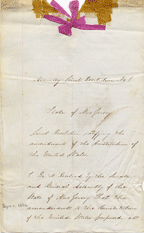
Assembly Joint Resolution No. 1
State of New Jersey


Joint Resolution ratifying the amendment of the Constitution of the United States


1. Be it Resolved by the Senate and General Assembly of the State of New Jersey that the amendment to the Constitution of the United States proposed at [pg. 1]


the first session of the thirty-ninth Congress by a resolution of the Senate and House of Representatives of the United States of America in Congress assembled, to the several state legislatures, be and the same is hereby ratified upon the part of this legislature and made a part of the Constitution of the United States of America, said amendment being in the following words, to wit:


Article XIV


1. All persons born or naturalized in the United States and subject to the jurisdiction thereof are citizens of the United States and of the [pg. 2]


State wherein they reside. No State shall make or enforce any law which shall abridge the privileges or immunities of citizens of the United States; nor shall any State deprive any person of life, liberty, or property without due process of law, nor deny to any person within its jurisdiction the equal protection of the laws.


2. Representatives shall be apportioned among the several states according to their respective numbers, counting the whole number of persons in each State, excluding Indians [pg. 3]


not taxed. But when the right to vote at any election for the choice of electors for President and Vice President of the United States, Representatives in Congress, the Executive and Judicial officers of a State, or the members of the Legislature thereof is denied to any of the male inhabitants of such State, being twenty-one years of age, and citizens of the United States, or in any way abridged, except for participation in rebellions or other crime, the basis of representation therein shall be reduced in the proportion [pg. 4]


which the number of such male citizens shall bear to the whole number of male citizens twenty-one years of age in such State.


3. No person shall be a Senator or Representative in Congress or elector of President and Vice President, or hold any office, civil or military, under the United States, or under any state, who, having previously taken an oath as a member of Congress or as an officer of the United States, or as a member of any State Legislature, or as an executive or judicial [pg. 5]


officer of any State to support the Constitution of the United States, shall have engaged in insurrection or rebellion against the same, or given aid or comfort to the enemies thereof, but Congress may by a vote of two-thirds of each house, remove such disability.


4. The validity of the public debt of the United States, authorized by law, including debts incurred for payment of pensions and bounties for services in suppressing insurrection [pg. 6]


or rebellion, shall not be questioned, but neither the United States nor any State shall assume or pay any debt or obligation incurred in aid of insurrection or rebellion, against the United States, or any claim for the loss or emancipation of any slave, but all such debts, obligations, and claims shall be held illegal and void.


5. The Congress shall have power to enforce, by appropriate legislation the provisions of this article.


Approved September 11, 1866

Marcus L. Ward   [pg. 7]


House of Assembly

September 11, 1866

This joint resolution having been three times read and compared in the House of Assembly

Resolved that the same do pass.

By order of the House of Assembly.

John Hill, Speaker of the House of Assembly  


In Senate

September 11, 1866

This joint resolution having been three times read in the Senate.

Resolved that the same do pass.

By order of the Senate.

James M. Scovel, President of the Senate   [pg. 8]


[Click image to enlarge - Images 1-8]


Senate
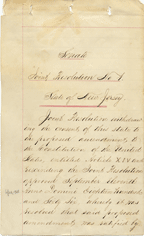
Joint Resolution No. 1
State of New Jersey


Joint Resolution withdrawing the consent of this state to the proposed amendment to the Constitution of the United States, entitled Article XIV and rescinding the Joint Resolution approved September Eleventh Anno Domini Eighteen hundred and Sixty Six, whereby it was resolved that said proposed amendment was ratified by [pg. 1]


the Legislature of this state.

The Legislature of the State of New Jersey having seriously and deliberately considered the present situation of the United States, do declare and make known: That the basis of all government is the consent of the governed; and all constitutions are contracts between the parties bound thereby; that until any proposition to alter the fundamental law, to which all the states have consented, has been ratified by such number of the States, as by the Federal Constitution, makes it binding upon all, any one that has [pg. 2]


assented is at liberty to withdraw that assent, and it becomes its duty to do so, when, upon mature consideration, such withdrawal seems to be necessary to the safety and happiness of all; prudence dictates that a consent once given, should not be recalled for light and transient causes; but the right is a natural right, the exercise of which is accompanied with no injustice to any of the parties; it has therefore been universally recognized as inhering in every party, and has ever been left unimpaired by any positive regulation.

The said proposed amendment [pg. 3]


not having yet received the assent of the three-fourths of the states which is necessary to make it valid, the natural and constitutional right of this state to withdraw its assent is undeniable.

With these impressions and with a solemn appeal to the Searcher of all Hearts, for the rectitude of our intentions and under the conviction that the origin and objects of said proposed amendment were unseemly and unjust, and that the necessary result of its adoption, must be the disturbance of the harmony, if not the destruction of our system of self-government, and that it is our duty to ourselves and our sister [pg. 4]


states to expose the same, do further declare, That, it being necessary, by the Constitution, that every amendment to the same should be proposed by two-thirds of both houses of Congress, the authors of said proposition, for the purpose of securing the assent of the requisite majority, determined to and did exclude, from the said two houses, Eighty representatives from Eleven states of the Union, upon the pretence that there were no such states in the Union; but finding that two-thirds of the remainder of the said houses, could not be brought to assent to the said proposition, they deliberately formed and carried [pg. 5]


out the design of mutilating the integrity of the United States’ Senate, and without any pretext or justification, other than the possession of the power, without the right, and in palpable violation of the Constitution, Ejected a member of their own body representing this state, and thus practically denied to New Jersey its Equal suffrage in the Senate, and thereby nominally secured the vote of two-thirds of the said houses.

The object of dismembering the highest representative assembly in the nation and humiliating a State of the Union, faithful at all times to all its obligations, and the object of said amendment were [pg. 6]


one: to place new and unheard of powers in the hands of a faction, that it might absorb to itself all executive, judicial and legislative power, necessary to secure for itself immunity for the unconstitutional acts it had already committed, and those it has since inflicted on a too patient people.

The subsequent usurpations of these once national assemblies, in passing pretended laws for the establishment in ten states, of martial law, which is nothing but the will of the military commander, and therefore inconsistent with the very nature of all laws, for the purpose of reducing to slavery men of their own race in those [pg. 7]


States, or compelling them, contrary to their own convictions, to exercise the elective franchise in obedience to the dictation of a faction in those Assemblies: the attempt to commit to one man, arbitrary and uncontrollable power, which they have found necessary to exercise, to force the people of those states into compliance with their will; the authority given to the Secretary of War to use the name of the President, to countermand the President’s orders, and to certify military orders to be by direction of the President, when they are notoriously known to be contrary to the President’s direction, thus keeping up the forms of the Constitution [pg. 8]


to which the people are accustomed, but practically deposing the President from his office of Commander-in-Chief, and suppressing one of the great departments of the government, that of the Executive; the attempt to withdraw from the supreme judicial tribunal of the nation, the jurisdiction to examine and decide upon, the conformity of their pretended laws to the Constitution, which was the chief function of that august tribunal, as organized by the fathers of the Republic; all, are but amplified explanations of the power they hoped to acquire by the adoption of the said amendment.

To conceal from the people the immense alterations of the [pg. 9]


fundamental law, they intended to accomplish by the said amendment, they gilded the same with propositions of justice, drawn from the State Constitutions; but like all the essays of unlawful power to commend its designs to populace favor, it is marked by the most absurd and incoherent provisions.

It proposes to make it a part of the Constitution of the United States, that naturalized citizens of the United States shall be citizens of the United States, as if that were not so without such absurd declaration.

It lodges with the legislative branch of the government the power of pardon, which properly be- [pg. 10]


longs, by our system, to the Executive.

It denounces and inflicts punishment for past offences, by constitutional provision, and thus would make the whole people of this great nation, in their most solemn and sovereign act, guilty of violating a cardinal principle of American liberty; that no punishment can be inflicted for any offence, unless it is provided by law, before the commission of the offence.

It usurps the power of punishment, which, in any coherent system of government, belongs to the Judiciary, and commits it to the people in their sovereign capacity. [pg. 11]


It degrades the nation, by proclaiming to the world that no confidence can be placed in its honesty or morality.

It appeals to the fears of the public creditors, by publishing a libel on the American people and fixing it forever in the national constitution, as a stigma upon the present generation, that there must be constitutional guards against a repudiation of the public debt, as if it were possible that a people, who were so corrupt as to disregard such an obligation, would be bound by any contract constitutional or otherwise.

It imposes new prohibitions upon the power of the state to pass [pg. 12]


laws, and interdicts the execution of such parts of the Common law as the national Judiciary may esteem inconsistent with the vague provisions of the said amendment, made vague for the purpose of facilitating encroachments upon the lives, liberties and property of the people.

It enlarges the Judicial power of the United States, so as to bring every law passed by the state, and every principle of the Common law, relating to life, liberty or property, within the jurisdiction of the federal tribunals, and charges those tribunals with duties, to the due performance of which, they, from their nature and organization and their distance from the people, are unequal. [pg. 13]


It makes a new apportionment of representation in the national councils, for no other reason than thereby to secure to a faction, a sufficient number of the votes of a servile and ignorant race, to outweigh the intelligent voices of their own.

It sets up a standard of suffrage dependent entirely upon citizenship majority, inhabitancy and manhood, and any interference whatever by the state, imposing any other reasonable qualifications, as time of inhabitancy, causes a reduction of the State’s representation.

But the demand of the supporters of this amendment in this state, that Congress should [pg. 14]


compel the people of New Jersey to adopt what is called “impartial suffrage,” makes it apparent that this section was intended to transfer to Congress the whole control of the right of suffrage in the state, and to deprive the state of a free representation, by destroying the power of regulating suffrage within its own limits, a power which they have never been willing to surrender to the general government and which was reserved to the states as the fundamental principal on which the Constitution itself was constructed, the principle of self government.

This section, as well as all others of the amendment [pg. 15]


is couched in ambiguous, vague and obscure language, the uniform resort of those who seek to encroach upon public liberty; strictly construed it dispenses entirely with a House of Representatives, unless the states shall abrogate every qualification, and especially that of time of inhabitancy, without which the right of suffrage is worthless.

This Legislature, feeling conscious of the support of the largest majority of the people, that has even given expression to the public will, declare, that the said proposed amendment being designed to confer, or to compel the states to confer, the sovereign right of the elective [pg. 16]


franchise upon a race which has never given the slightest evidence, at any time, or in any quarter of the Globe, of its capacity for self-government, and erect an impracticable standard of suffrage, which will render the right valueless to any portion of the people, was intended to overthrow the system of self government, under which the people of the United States have, for eighty years, enjoyed their liberties, and is unfit from its origin, its objects and its matter to be incorporated with the fundamental law of a free people; Therefore,

1. Be it Resolved by the Senate and General Assembly of the State of [pg. 17]


New Jersey, that the Joint Resolution approved September Eleventh, Anno Domini Eighteen hundred and Sixty-Six relative to amending the Constitution of the United States, which is in the following words, to wit:

“Joint Resolution ratifying the Amendment of the Constitution of the United States

1. Be it Resolved by the Senate and General Assembly of the State of New Jersey, that the amendment to the Constitution of the United States proposed at the first session of the thirty ninth Congress, by a resolution of the senate and house of representatives of the United States of America in Congress assembled, to the several [pg. 18]


state legislatures, be and the same is hereby ratified upon the part of this legislature, and made a part of the constitution of the United States of America, said amendment being in following words, to wit:

“Article XIV

Section 1. All persons born or naturalized in the United States, and subject to the jurisdiction thereof, are citizens of the United States, and of the state wherein they reside. No state shall make or enforce any law which shall abridge the privileges or immunities of citizens of the United States, nor shall any state deprive any person of life, liberty or property, without due process of law, nor deny to any person [pg. 19]


within its jurisdiction the Equal protection of the laws.

Section 2. Representatives shall be apportioned among the several states according to their respective numbers, counting the whole number of persons in each state, excluding Indians not taxed. But when the right to vote at any election for the choice of Electors for President and Vice President of the United States, Representatives in Congress, the executive and judicial officers of a state, or the members of the legislature thereof, is denied to any of the male inhabitants of such state, being twenty-one years of age and citizens of the United States, or in any way abridged, except [pg. 20]


for participation in rebellion or other crime, the basis of representation therein shall be reduced in the proportion which the number of such male citizens shall bear to the whole number of male citizens twenty-one years of age in such state.

Section 3. No person shall be a Senator or Representative in Congress, or Elector of President or Vice President, or hold any office, civil or military, under the United States, or under any state who, having previously taken an oath as a member of Congress, or as an officer of the United States, or as a member of any state legislature or as an executive or judicial officer of any state to support the constitution of the United States, shall have
[pg. 21]


engaged in insurrection or rebellion against the same, or given aid or comfort to the enemies thereof. But Congress may, by a vote of two-thirds of each house, remove such disability.

Section 4. The validity of the public debt of the United States, authorized by law, including debts incurred for the payment of pensions and bounties for services in suppressing insurrection or rebellion, shall not be questioned. But neither the United States, nor any state, shall assume or pay any debt or obligation incurred in aid of insurrection or rebellion against the United States, or any claim for the loss or Emancipation of any slave; but all such debts, obligations and claims shall [pg. 22]


be held illegal and void.

Section 5. The Congress shall have power to enforce, by appropriate legislation, the provisions of this article.”

Be and the same is hereby rescinded, and the consent on behalf of the State of New Jersey to ratify the proposed fourteenth amendment to the Constitution of the United States is hereby withdrawn.

2.  And be it resolved, that copies of the foregoing preamble and resolution, certified to by the President of the Senate and Speaker of the General Assembly, be forwarded to the President of the United States, the Secretary of State of the United States, to each [pg. 23]


of our Senators and Representatives in Congress and to the Governors of the respective states.

3.  And be it resolved, that these Resolutions shall take effect immediately. [pg. 24]


In Senate,

February 19th, 1868.

This Joint Resolution having been three times read and compared in the Senate,

Resolved, that the same do pass.

By order of the Senate.

H. S. Little, President of the Senate  

House of Assembly,

February 20th, 1868.

This Joint Resolution having been three times read and compared in the House of Assembly,

Resolved, that the same do pass.

By order of the House of Assembly.

A. O. Evans, Speaker of House of Assembly   [pg. 25]

[Click image to enlarge -
Images 1-25]


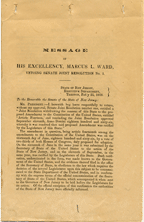
Message
of
His Excellency, Marcus L. Ward
Vetoing Senate Joint Resolution No. 1


STATE OF NEW JERSEY,
EXECUTIVE DEPARTMENT
TRENTON, Feb’y 25, 1868.

To the Honorable the Senate of the State of New Jersey:

MR. PRESIDENT: — I herewith beg leave respectfully to return, without my approval, Senate Joint Resolution number one, entitled a “Joint Resolution withdrawing the consent of this State to the proposed Amendment to the Constitution of the United States, entitled ‘Article Fourteen,’ and rescinding the Joint Resolution approved September eleventh, Anno Domini eighteen hundred and sixty-six, whereby it was resolved that said proposed Amendment was ratified by the Legislature of this State.”

The amendment in question, being article fourteenth among the amendments to the Constitution of the United States, was on the thirteenth day of June, eighteen hundred and sixty-six, by a vote of two-thirds of both Houses of Congress, duly proposed for adoption. On the sixteenth of June in the same year it was submitted by the Secretary of State of the United States to the action of the State of New Jersey, and on the eleventh of September, in the same year, was ratified by the Legislature of this State. Such ratification, authenticated in due form, was made known to the Government of the United States, and the evidence thereof filed in the office of the Secretary of State, in obedience to the law which requires the decision of the several Legislatures upon this subject to be communicated to the State Department of the United States, and in conformity with the express terms of the official communication of the Secretary of State of the United States, which accompanied it when sent to the Governor of New Jersey to be laid before the Legislature for its action. Of the official reception of this ratification the authorities of the State of New Jersey were officially informed. [pg. 1]


I cannot approve the Joint Resolution by which it is now attempted to withdraw or rescind the ratification so made, because,—

1. I deem that such a resolution, if finally adopted, would be of no validity or effect. The only authority by virtue of which the Legislature can take legitimate action upon the subject of amendments to the Constitution of the United States is contained in the fifth article of that instrument. By that article, the State action is limited to the two cases therein specifically named. One is the application by the Legislature to Congress to call a convention for proposing amendments, and the other is when amendments are by Congress proposed to the Legislature. In the latter case, the action of the Legislature can be based only on the proposal then existing and pending before them. When such proposal is accepted and approved, the amendment ratified and returned to the General Government by which it was submitted, the transaction is completed, the decision of the State has been rendered, and the power of the Legislature over the subject is spent. No further action can be taken until the subject is again submitted by Congress, with whom the power to make such submission is exclusively lodged. An omission or failure to ratify by the Legislature of one year, or within any specified time, would not prevent such ratification at a subsequent time; all such legislative cognizance of the subject being dependent upon and continuing with the pendency of the proposal itself.

But with the acceptance of the proposal, and its official and formal return to the authorities, from whom alone it could come, that cognizance must of necessity end. Any other construction is believed to be without support from the Constitution itself, as well as opposed to the general analogies of law.

It must be remembered that while a State has the clear and undoubted right to repeal and rescind its own laws, subject to its contracts, yet that in all its relations to the General Government, its actions are conclusive and final. If a State part with a portion of its soil to the General Government, it cannot recover its title, even under the doctrine of eminent domain. If the Legislature appoint a Senator for the constitutional term, no matter how faithless he may be to the interests of the State, or how wantonly he may disregard the sentiments of her people, the Legislature cannot withdraw the appointment and trust.

An approval or ratification of an amendment to the national Constitution by the Legislature of a State cannot be regarded as experimental or conditional, unless declared to be such when made. When solemnly and unqualifiedly done, it is of the nature and effect of a contract, which cannot be rescinded or changed at the mere will of the State by which it was made.

The Legislature acted on the amendment, under the provisions of the Constitution of the United States; that Constitution fixes no limit of time during which the assent of the requisite number of Legisla- [pg. 2]


tures shall be given. By their ratification the Legislature of New Jersey agreed that the amendment should be a part of the Constitution of the United States, whenever the Legislatures of a sufficient number of States had added their assent to that of New Jersey, to make the whole number of assenting Legislatures equal to three-fourths of the States. The ratification of New Jersey, made under the provisions of the Constitution, was without condition or limit of time within which the Legislatures of the other States, necessary to make the requisite number, should signify their assent. Her action so taken and published, enters into and becomes part of the causes and considerations by which the action of other States in the premises, is influenced and determined, and she cannot, by subsequent action, fix any new limit or condition to the contract into which she has duly entered nor withdraw her assent while the conditions upon which it was given remain unchanged and unbroken.

2. If any doubt can exist as to the power of the Legislature to withdraw its approval of such amendment before it has been ratified by the Legislatures of three-fourths of the States, it is nowhere supposed that such approval could be afterwards withdrawn. This ratification, by three-fourths of the States, must be deemed already to have been made, unless the Legislature shall assume to decide that when more than one-fourth of the States have, by rebellion and war, withdrawn from their duties and functions as States, and rendered constitutional amendments essential to the welfare of the nation, such States can by their action, prevent the adoption of those amendments, and thus occasion, indirectly and partially, the results which rebellion and war were waged more openly and thoroughly to produce. Of the States that have maintained their fidelity to the Union, and their constitutional relations to each other and the General Government, more than three-fourths have ratified the amendment, and I cannot deem it open to doubt that their action is sufficient and conclusive. If open to doubt it is not to be decided by the Legislatures of the States, and should not be assumed by this Legislature to be within its province to determine.

3. But aside from the absence of any proper, legal or constitutional power possessed by the Legislature, I am constrained to withhold my approval from this Joint Resolution, because, I deem it repugnant to the convictions of the majority of the people, and of the voters of the State. In the general election that followed the ratification of the Amendment in New Jersey, the fact that such ratification was approved by the voters of the State, was abundantly shown. Since then, it has not been considered or canvassed by the people, and no reference was had to it in the late election, at which the present Legislature was chosen.

4. Another, and the remaining reason for withholding my approval, is because I deem the Amendment a wise one, and in a high degree important to the welfare of the nation. Its provisions are eminently [pg. 3]


just, and fitted to promote the great objects which the Constitution was formed and intended to secure.

Its first section defines and settles the hitherto disputed question of citizenship, by declaring all persons born or naturalized in the United States, and subject to the jurisdiction thereof, to be citizens of the United States and of the State wherein they reside, and as such, entitled to the equal benefit of the laws. It provides that no State shall make or enforce any law which shall abridge the privileges or immunities of citizens of the United States; and that no State shall deprive any person of life, liberty or property, without due process of law, or deny to any person within its jurisdiction, the equal protection of the laws.

The second section of the amendment fixes the basis of representation in Congress.

Without this section the political power and representation in Congress of the rebellious States would be largely increased as a consequence of the rebellion, while at the same time the population continued the same. The insurrectionary States would elect members of the House of Representatives upon the whole number instead of three-fifths of their colored population, and in this way possess advantages which they have not heretofore enjoyed. It is against the plainest dictates of wisdom and right to make such a discrimination against the people of the States who have been faithful to the Union, and in favor of those who have so lately waged war to destroy it. It cannot be supposed that the people of this State are in favor of such a distinction; rewarding treason by increasing the political power of those who have committed it; entrusting in an enlarged and unprecedented manner the great interests of the nation, its public credit and well-being, to the decision of representatives whose recent efforts and wishes have been directed to the ruin of both.

The third section of the amendment disqualifies from holding political office certain classes of persons who, having taken oaths to support the Constitution of the United States, shall have afterwards engaged in insurrection or rebellion against the same, or given aid or comfort to the enemies thereof, thus adding perjury to treason. It confers, however, upon Congress the power to remove such disability.

The fourth section provides against the possible validity or legality of debts, obligations or claims incurred in aid of the rebellion, and against the possible questioning of the validity of the public debt incurred in suppressing it.

These are the provisions of the amendment which it is now proposed, if possible, to annul. They need no argument to illustrate their wisdom and justice. The simple statement of them is irresistible by the patriotic judgment, and their ratification has received the approval of the people. The amendment was formally and solemnly ratified upon the part of the Legislature of this State, and thereby, to the extent of its power, made a part of the Constitution of the United States. [pg. 4]


Presuming that the object of this Joint Resolution is therein expressed, and my objections being to that object, and to the claim of power to accomplish it, I do not think it necessary or proper to refer to the assumed reasons for the passage of the resolution which are alleged in the preamble which accompanies it.

Although always regretting to differ in opinion from the Legislature, yet, believing that the Joint Resolution now presented would, if approved, be inoperative and vain, in violation of the plighted faith of the State, injurious to the common good, and repugnant to the wishes of the people we represent, I am constrained to return the same to you with my objections as above.

Respectfully,

MARCUS L. WARD  [pg. 5]

[Click image to enlarge -
Images 1-5]


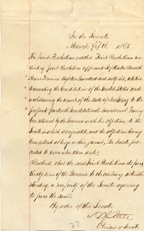
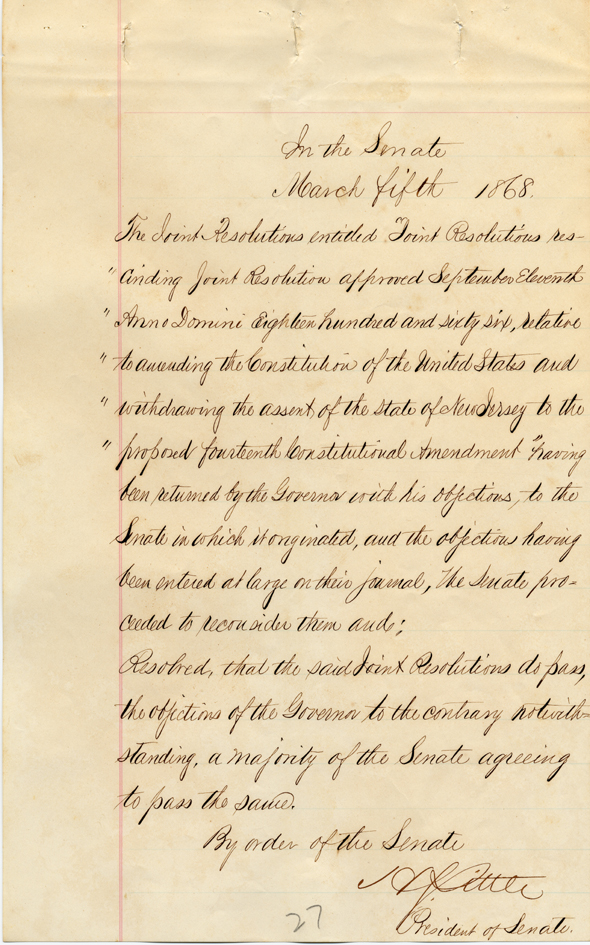
In the Senate
March fifth 1868


The Joint Resolutions entitled “Joint Resolutions rescinding Joint Resolution approved September Eleventh Anno Domini Eighteen hundred and sixty six relative to amending the Constitution of the United States and withdrawing the assent of the State of New Jersey to the proposed fourteenth Constitutional Amendment” having been returned by the Governor with his objections to the Senate in which it originated, and the objections having been entered at large on their journal, the Senate proceeded to reconsider them and:

Resolved, That the said Joint Resolutions do pass, the objections of the Governor to the contrary notwithstanding, a majority of the Senate agreeing to pass the same.

By order of the Senate

H. S. Little, President of Senate  

[Click image to enlarge]


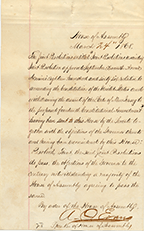
House of Assembly
March 24, 1868


The Joint Resolutions entitled “Joint Resolutions rescinding Joint Resolution approved September Eleventh Anno Domini Eighteen hundred and sixty six relative to amending the Constitution of the United States and withdrawing the assent of the State of New Jersey to the proposed fourteenth Constitutional Amendment” having been sent to this House by the Senate together with the objections of the Governor thereto and having been reconsidered by this House:

Resolved, That the said Joint Resolutions do pass, the objections of the Governor to the contrary notwithstanding a majority of the House of Assembly agreeing to pass the same.

By order of the House of Assembly,

A. O. Evans, Speaker of House of Assembly  


[Click image to enlarge]

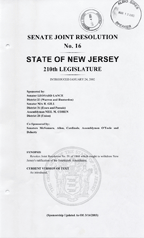
Senate Joint Resolution No. 16


State of New Jersey
210th Legislature

INTRODUCED JANUARY 24, 2002 

Sponsored by:
Senator LEONARD LANCE
District 23 (Warren and Hunterdon)
Senator NIA H. GILL
District 34 (Essex and Passaic)
Assemblyman NEIL M. COHEN
District 20 (Union) 

Co-Sponsored by:
SenatorsMcNamara, Allen, Cardinale,
Assemblymen O'Toole and Doherty 

SYNOPSIS

Revokes Joint Resolution No. IV of 1868 which sought to withdraw New Jersey’s ratification of the Fourteenth Amendment.

CURRENT VERSION OF TEXT
As introduced.

(Sponsorship Updated As Of: 3/14/2003) [pg. 1]


A JOINT RESOLUTION revoking Joint Resolution No. IV of 1868 which sought to withdraw New Jersey’s ratification of the Fourteenth Amendment to the United States Constitution.

WHEREAS, The Fourteenth Amendment to the United States Constitution granted citizenship to, and protected the civil liberties of, freed slaves; and

WHEREAS, The Fourteenth Amendment also prohibits states from abridging the privileges or immunities of any citizen, depriving any person of life, liberty, or property without due process of law, or denying any person equal protection of the laws; and

WHEREAS, The rights guaranteed by the Fourteenth Amendment are part of the foundation of our free society; and

WHEREAS, In 1866, the New Jersey Legislature acted to ensure these rights by ratifying the Fourteenth Amendment; and

WHEREAS, Thereafter, the New Jersey Legislature, in 1868, attempted to withdraw its ratification of this amendment by passage of Joint Resolution No. IV; and

WHEREAS, Both the Federal Secretary of State and the Congress refused to recognize New Jersey’s attempt to withdraw ratification and the Fourteenth Amendment became a part of the United States Constitution on July 20, 1868; and

WHEREAS, The attempt to withdraw New Jersey’s ratification of the Fourteenth Amendment is contrary to this State’s long tradition of respect for, and protection of, the civil rights of all persons; and

WHEREAS, Even though the attempt to withdraw New Jersey’s ratification of the Fourteenth Amendment was without effect, there is, nevertheless, a need to rectify this misguided action; now, therefore,

BE IT RESOLVED by the Senate and General Assembly of the State of New Jersey:

1.

Joint Resolution No. IV of 1868 which attempted to withdraw New Jersey’s ratification of the Fourteenth Amendment is hereby revoked.

2.

Duly authenticated copies of this Joint Resolution shall be transmitted to the federal Secretary of State, the presiding officers of the Congress of the United States, and each member of New Jersey’s congressional delegation.

3.

This Joint Resolution shall take effect immediately.

APPROVED

23rd DAY of APRIL 2003

James E. McGreevey, Governor  

Attest


Michael R. DeCotiis, Chief Counsel to the Governor   [pg. 2]


STATEMENT


This Joint Resolution revokes Joint Resolution No. IV of 1868 which attempted to withdraw New Jersey’s ratification of the Fourteenth Amendment to the United States Constitution.
[pg. 3]


[Click image to enlarge -
Images 1-3]