 Official Site of The State of New Jersey
Grades 6–8 Model Curriculum Framework
Every student and every teacher deserve access to high quality instructional materials. The NJDOE collaborated with OpenSciEd to develop the instructional and professional learning materials for the Grades 6–8 Model Curriculum Framework.
The Scope and Sequence (S&S) in the Grades 6–8 Model Curriculum Framework articulates how the middle school program is organized as performance expectations bundled in a unit, how each unit builds on what students have developed in prior units, and how the elements of the three dimensions of the New Jersey Student Learning Standards for Science (NJSLS-S), disciplinary core ideas (DCIs), crosscutting concepts (CCCs), and science and engineering practices (SEPs) build coherently across the program. Building the three dimensions across the program is central in the Model Curriculum Framework. We attend to both intentional scaffolding of student learning of all three dimensions over the program and to making sure the arrangement of learning makes sense to students. We call this latter influence on the arrangement “coherence from the student’s perspective” or “coherence” for short. It is central in the Model Curriculum Framework and critical to its success in motivating student learning and helping students see science as more connected to their lives.
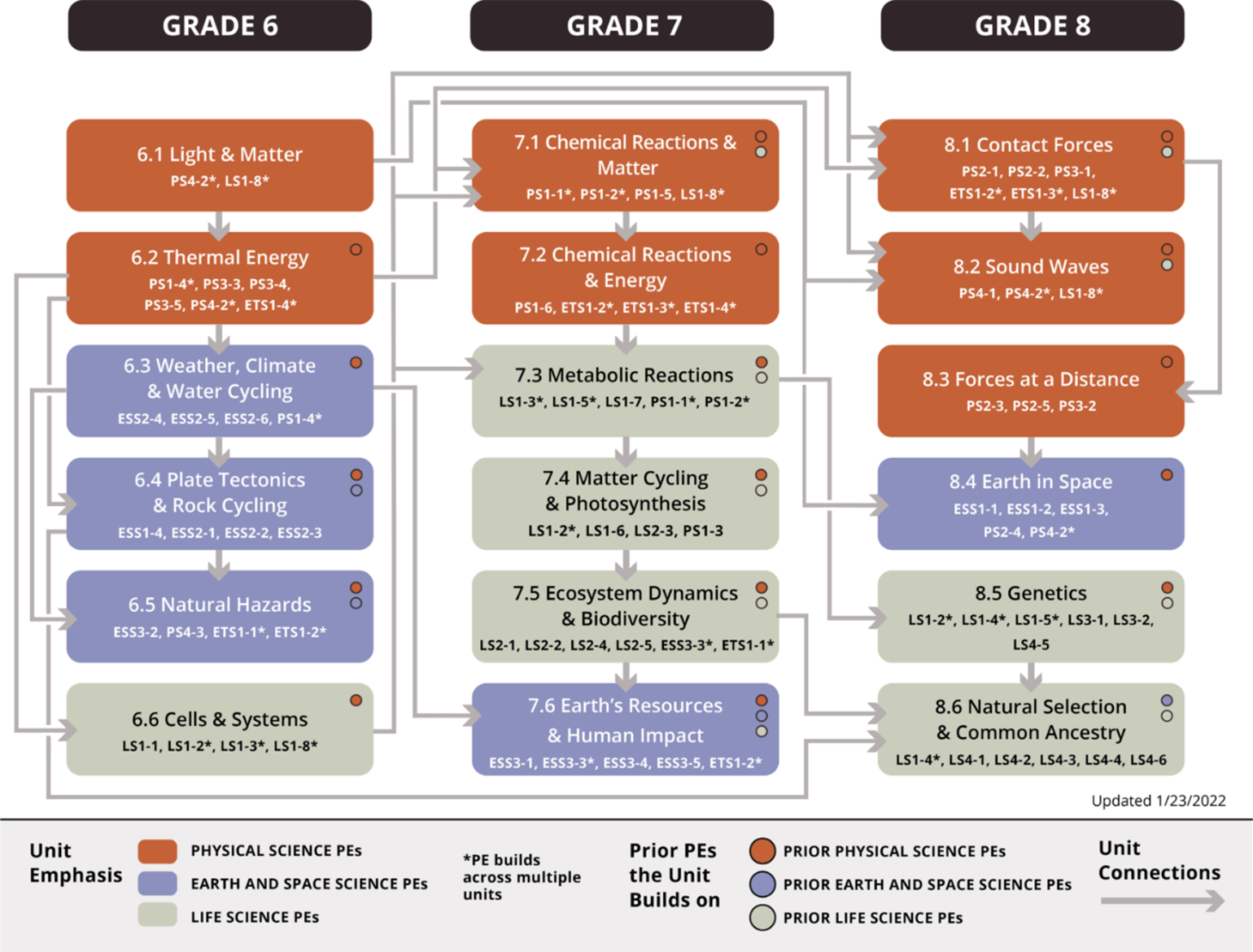
Accessible Text Version of Figure 1: Scope and Sequence
To read more about the Middle School Science Curriculum’s Scope and Sequence, including the summary of the heuristics used to construct the sequence, refer to OpenSciEd's Middle School Standards Alignment webpage.
The instructional units are centered around real-world phenomena students encounter every day! The Department believes that teaching science isn’t just about facts and figures; it’s about creating a science learning experience that sparks students’ curiosity and captures their imaginations. Through hands-on investigations and student-driven discussions, students will embark on a journey of scientific exploration, building a strong foundation for science learning in high school and beyond.
Integration of Computer Science in Science Instruction
OpenSciEd’s middle school program now includes five computer science–integrated units that deepen science learning by providing students with additional tools to investigate the phenomena. Rather than competing with science instruction, computer science works alongside science practices as students design and use technology to collect data, model systems, and test explanations of real-world phenomena. Through this integrated approach, students collaborate to design the technology needed to explore scientific questions and address meaningful, community-based challenges at the center of each unit.
The following units integrate computer science:
High-Quality Instructional Materials
Realizing the vision of effective and inclusive science education isn’t just an aspiration. It’s an achievable goal when schools invest in what research consistently identifies as a game‑changer: high-quality, standards-aligned curricular materials. When these materials are placed in the hands of well-supported educators who know how to use them skillfully, they transform classrooms. Students engage more deeply, teachers spend less time searching for resources, and learning outcomes improve.
The following three articles illustrate the powerful impact that adopting and implementing high-quality instructional materials can have on both student achievement and teacher effectiveness. They offer compelling evidence that thoughtful curriculum choices aren’t just beneficial — they’re essential.
- Steiner, D. (2024). The unrealized promise of high-quality instructional materials. National Association of State Boards of Education.
- TNTP. (2018). The Opportunity Myth: What Students Can Show Us About How School Is Letting Them Down—and How to Fix It.
- Wachowski, S. (2023, June 26). Let high school science teachers know they’re not alone. EdReports.
EdReports gave the OpenSciEd Middle School program green ratings on all three benchmarks:
- designed for the Next Generation Science Standards
- coherence and scope
- usability
Green ratings represent the highest ranking in EdReports’ review system for science programs in grades 6–8.
All of the units have been rated as “quality” by the Science Peer Review Panel at NextGenScience and are the only curriculum designed for the Next Generation Science Standards (NGSS) that has had every unit rated as quality by the Science Peer Review Panel at NextGenScience. In contrast, 93% of instructional materials submitted to the Science Peer Review Panel for review do not achieve a quality ranking. The reviews for all of our units are available on NextGenScience’s page Lessons and Units: Quality Examples of NGSS Design.
Professional Learning
Before implementing the instructional materials included in the model science curriculum framework, educators are strongly encouraged to attend its accompanying professional learning to ensure effective and informed usage. The Liberty Science Center is a certified provider of this professional learning and offers sessions designed to support educators in understanding and applying the material with confidence and fidelity.
Science and Engineering for Grades 6–12: Investigation and Design at the Center (NASEM, 2019) is a foundational professional resource that clarifies why investigation and design matter, what high‑quality implementation looks like, and how educators can support meaningful, standards‑aligned science learning through sustained professional growth.