 Official Site of The State of New Jersey
Grades 9–12 Model Curriculum Framework
Evidence-Based Science Courses
The Grades 9–12 Model Curriculum Framework models one way that a school may design its science curriculum to ensure that instruction centers on investigation and design and every student can demonstrate proficiency with the full range of the science standards.
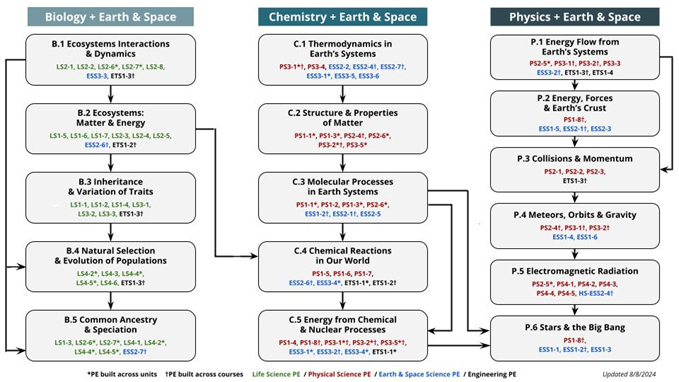
Scope and Sequence for Biology, Chemistry and Physics Courses
The high school scope and sequence proposes both an order for courses and content within courses. In the sequence, students would begin by taking Biology, then Chemistry, and then Physics. Earth and space sciences are integrated throughout. Each course provides students with multiple opportunities to engage with Disciplinary Core Ideas (DCI), Science & Engineering Practices (SEP), and crosscutting concepts targeted in the performance expectations (PEs), with scaffolding fading over the course of the year in each dimension. All the PEs in high school science, including the engineering performance expectations, are included within the three-year sequence.
The phenomena featured in the units encourage students to apply physical and life science concepts to explore experiences in their day-to-day lives and address pressing local and global issues.
Through hands-on investigations and data analysis, students develop critical thinking skills and become independent learners. By gaining a deep understanding of core scientific concepts, students are prepared to excel in Advanced Placement (AP) courses, college, and STEM careers.
The integration of Earth and Space Sciences (ESS) and Engineering, Technology, and Applications of Science (ETS) performance expectations was thoughtfully considered. The PEs bundled within units were identified as having the potential of working synergistically with and/or supporting students in deepening three-dimensional understandings of life and physical science PEs in each course.
High-Quality Instructional Materials
Realizing the vision of effective and inclusive science education isn’t just an aspiration. It’s an achievable goal when schools invest in what research consistently identifies as a game‑changer: high-quality, standards-aligned curricular materials. When these materials are placed in the hands of well-supported educators who know how to use them skillfully, they transform classrooms. Students engage more deeply, teachers spend less time searching for resources, and learning outcomes improve.
The following three articles illustrate the powerful impact that adopting and implementing high-quality instructional materials can have on both student achievement and teacher effectiveness. They offer compelling evidence that thoughtful curriculum choices aren’t just beneficial — they’re essential.
- Steiner, D. (2024). The unrealized promise of high-quality instructional materials. National Association of State Boards of Education.
- TNTP. (2018). The Opportunity Myth: What Students Can Show Us About How School Is Letting Them Down—and How to Fix It.
- Wachowski, S. (2023, June 26). Let high school science teachers know they’re not alone. EdReports.
According to EdReports, an independent nonprofit organization that evaluates the quality of instructional materials, the OpenSciEd high school Biology, Chemistry, and Physics courses received the highest possible ratings (“all-green”) in their reviews. These ratings indicate that the courses fully meet expectations for alignment to the Next Generation Science Standards (NGSS), coherent learning progressions, and ease of use in real classrooms.
In addition, the reviews highlighted that the OpenSciEd materials are designed to support teachers with clear instructional guidance, built-in assessments, and supports for meeting the needs of diverse learners. This ensures that all students have access to challenging, standards-aligned science learning while enabling teachers to focus on effective instruction rather than curriculum design.
All of the high school units have been rated as “quality” by the Science Peer Review Panel at NextGenScience and are the only curriculum designed for the Next Generation Science Standards (NGSS) that has had every unit rated as quality by the Science Peer Review Panel at NextGenScience. In contrast, 93% of instructional materials submitted to the Science Peer Review Panel for review do not achieve a quality ranking. The reviews for all of our units are available on NextGenScience’s page Lessons and Units: Quality Examples of NGSS Design.
Professional Learning
Before implementing the instructional materials included in the model science curriculum framework, educators are strongly encouraged to attend its accompanying professional learning to ensure effective and informed usage. The Liberty Science Center is a certified provider of this professional learning and offers sessions designed to support educators in understanding and applying the material with confidence and fidelity.
Science and Engineering for Grades 6–12: Investigation and Design at the Center (NASEM, 2019) is a foundational professional resource that clarifies why investigation and design matter, what high‑quality implementation looks like, and how educators can support meaningful, standards‑aligned science learning through sustained professional growth.