SAVE THE DATE
May 9, 2012
|
|
Barnegat Bay
On December 9, 2010, Governor Christie announced a comprehensive action plan to address the health of Barnegat Bay: read the announcement here.
The ecological health of Barnegat Bay is in decline, threatening the economic health of the region. This Administration has made addressing the degradation of Barnegat Bay—including resolving the issue of a cooling system at the Oyster Creek nuclear power plant—one of its top environmental priorities.
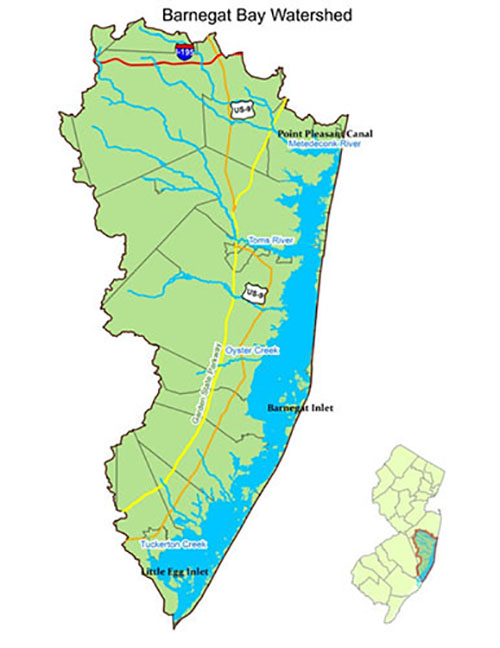
The 660-square-mile Barnegat Bay watershed encompasses most of the 33 municipalities in Ocean County and four municipalities in Monmouth County. Barnegat Bay’s 75-square-mile estuarine system consists of aquatic vegetation, shellfish beds, finfish habitats, waterfowl nesting grounds and spectacular vistas, plus a population of more than 550,000, which balloons during the summer season.
Long appreciated for its great aesthetic, economic and recreational value, an array of human impacts potentially threaten the ecological integrity of this backbay system.
The entire watershed has undergone dramatic growth since 1950, resulting in land use changing from principally undeveloped and agricultural to suburban. Development of the areas surrounding Barnegat Bay has resulted in both a decrease in the natural landscape that helps filter pollutants before they enter the Bay, and an increase in impervious ground cover (such as pavement and buildings) which further limits the ability of the land to regulate what gets into the Bay. Surface and groundwater quality in the watershed have been degraded by nonpoint source pollution and infiltration to groundwater has been prevented by increased impervious surfaces. The estuary’s fisheries and other biological resources also have been negatively impacted by nonpoint source pollution and habitat loss. Boat and personal watercraft traffic on the Bay has grown significantly, raising concerns about the cumulative impacts on the Bay’s water quality and aquatic habitat.
Addressing these issues requires complex and multiple tactics. Different parts of the Bay experience different levels of impact. The Bay cannot be restored to a pristine condition, but further degradation can be prevented and some restoration is possible. Input gained from extensive stakeholder involvement complemented the scientific data and research conducted by the Department of Environmental Protection and other researchers to provide the basis for the Administration’s action plan for Barnegat Bay.
COMPREHENSIVE PLAN OF ACTION
(Click on an item below for further information)
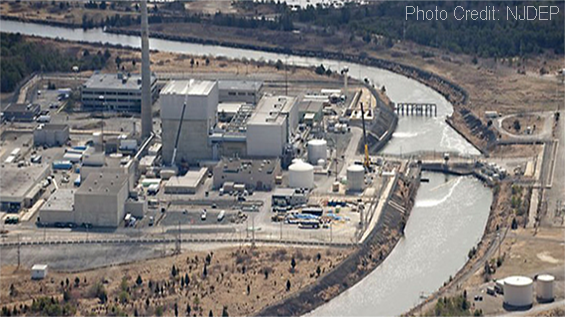
- Close Oyster Creek Nuclear Power Plant - The State has negotiated and entered into an agreement with Exelon Corporation to cease electric generation operations at the Oyster Creek Generating Station within nine years. More
- Fund Stormwater Runoff Mitigation Projects - The State has identified and prioritized funding for projects designed to address nutrient pollution of Barnegat Bay from stormwater basins. More
- Reduce Nutrient Pollution from Fertilizer - On January 5, 2011, Governor Chris Christie signed legislation that established the most restrictive standards in the nation for nitrogen content in fertilizer and application rates for use. More
- Require Post-Construction Soil Restoration - On January 5, 2011, Governor Chris Christie signed into law a measure that requires the Secretary of Agriculture and the Commissioner of Environmental Protection, through the State Soil Conservation Committee, to propose modifications to the exiting soil erosion and sediment control standards. More
- Acquire Land in the Watershed - Acquiring available, ecologically sensitive lands along the Barnegat Bay and its tributaries is a cost-effective and critical measure to prevent development activities that could further degrade the Bay’s water and ecological quality. More
- Establish a Special Area Management Plan - A Special Area Management Plan (SAMP) will be developed in collaboration with members of the Barnegat Bay Partnership and other planning authorities in the region. More
- Adopt More Rigorous Water Quality Standards - After adopting narrative nutrient criteria for coastal waters on December 21, 2010, the DEP and its partners launched a new comprehensive ambient water quality monitoring network in the Barnegat Bay watershed on June 6, 2011. More
- Educate the Public - The DEP is developing a strategy that leverages the media, environmental advocates, and the Barnegat Bay community to educate the public on the impacts of their actions. More
- Fill in the Gaps on Research - The NJDEP Office of Science has been working with the Science Advisory Board, state universities, the U.S. Geological Survey, the U.S. Environmental Protection Agency, and the Barnegat Bay Partnership to develop and fund additional research projects that will address filling in the data gaps, help address how we improve water quality and advance habitat restoration on the Bay, and establish baseline conditions of the Bay. More
- Reduce Water Craft Impacts - Boats and personal water craft can harm the Bay by damaging submerged aquatic vegetation and disrupting aquatic habitats. Designation of a Conservation Zone, similar to the one at Island Beach State Park, can reduce such impacts. More
|