 Official Site of The State of New Jersey
New Jersey State Seal of Biliteracy Annual Report (2024-25)
The State Seal of Biliteracy is awarded by the New Jersey Department of Education (NJDOE) to graduating high school students who demonstrate proficiency in English and at least one other language. This initiative recognizes the linguistic and cultural diversity of New Jersey, encourages students to maintain their home language while learning additional languages, and prepares them for postsecondary success. The 17th state to implement a State Seal of Biliteracy, New Jersey first implemented the Seal on January 19, 2016. This report presents data from the 2024-2025 school year.
Requirements
To earn the State Seal of Biliteracy, students:
- Demonstrate proficiency in the English language
- Demonstrate at least Intermediate Mid linguistic proficiency level (or higher) in the world language using an NJDOE-approved assessment (N.J.A.C. 6A:8-5.3(f))
Benefits
With the State Seal of Biliteracy, students can:
- Earn college credit at William Paterson University, Rowan University and other United States colleges and universities
- Request the Seal be used for course placement at a variety of colleges and universities
- Prove to potential employers that they are multilingual
Growth in the Seal of Biliteracy
- 18.5% increase in Seals awarded
- 18.4% increase in students who earned the Seal
- 2.6% increase in Local Education Agency (LEA) participation
- 10.9% increase in languages in which the Seal was earned
Highlights for the Class of 2025
- 11.1% graduated with the Seal of Biliteracy
- 25.5% of the Multilingual Learners graduated with the Seal of Biliteracy
- 8.9% of students never receiving multilingual services graduated with the Seal of Biliteracy
Student and LEA Demographics
12,200 students earned the State Seal of Biliteracy. 12,644 Seals were awarded. The Seal was awarded in 61 different languages, an increase of 10.9% from 2024.
LEAs must have 12th graders to participate. 84.3% of eligible LEAs participated. 82.9% of high schools participated in the State Seal of Biliteracy program.
| Student Groups | Number of Students Earning Seals | Percentage of 12th Graders in Group | Trend Compared to 2023-24 School Year |
|---|---|---|---|
| All Students | 12,200 | 11.1% | ↑ increase |
| American Indian or Alaska Native | 16 | 10.4% | ↑ increase |
| Asian | 1,673 | 14.7% | ↑ increase |
| Black or African American | 325 | 2.0% | ↑ increase |
| Hispanic | 7,160 | 19.9% | ↑ increase |
| Native Hawaiian or Pacific Islander | 16 | 7.7% | ↑ increase |
| White | 2,872 | 6.6% | ↑ increase |
| Two or More Races | 135 | 5.4% | ↓ decrease |
| Economically Disadvantaged | 5,776 | 14.2% | ↑ increase |
| Students with Disabilities | 260 | 1.3% | ↑ increase |
| Students Experiencing Homelessness | 87 | 8.7% | ↑ increase |
| Students in Foster Care | 4 | 3.0% | ↑ increase |
| Military-Connected Students | 31 | 7.3% | ↓ decrease |
| Migrant Students | 2 | 11.8% | ↑ increase |
| LEA Community Type | Number of Students Earning Seals | Percentage of 12th Graders in Type | Trend Compared to 2023-24 School Year |
|---|---|---|---|
| City | 4,011 | 14.8% | ↑ increase |
| Suburb | 5,285 | 11.0% | ↑ increase |
| Town | 841 | 11.0% | ↑ increase |
| Rural | 317 | 7.6% | ↑ increase |
| Regional | 1,499 | 8.5% | ↑ increase |
Seals Awarded
Students who earned the Seal in multiple languages other than English:
- 418 students earned the seal in 2 languages
- 10 students earned the seal in 3 languages
- 2 students earned the seal in 4 languages
| Language | Total Seals |
|---|---|
| Spanish | 9,474 |
| French | 705 |
| Portuguese | 422 |
| Italian | 243 |
| Chinese | 243 |
| Latin | 170 |
| Korean | 150 |
| German | 137 |
| Russian | 128 |
| Polish | 125 |
| American Sign Language | 125 |
| Haitian Creole | 106 |
| Arabic | 103 |
| Hindi | 67 |
| Turkish | 64 |
| Ukrainian | 55 |
| Japanese | 46 |
| Filipino | 29 |
| Hebrew | 28 |
| Tamil | 27 |
| Urdu | 26 |
| Gujarati | 25 |
| Albanian | 13 |
| Tagalog | 13 |
| Vietnamese | 12 |
| Punjabi | 10 |
There were less than 10 seals awarded in each of the following languages:
- Amharic
- Armenian
- Bangla
- Bengali
- Bosnian
- Bulgarian
- Chinese — Cantonese
- Croatian
- Czech
- Danish
- Dari
- Dutch
- Farsi
- Georgian
- Greek
- Hungarian
- Indonesian
- Kannada
- Kazakh
- Macedonian
- Malayalam
- Marathi
- Nepali
- Pashto
- Persian
- Punjabi
- Romanian
- Serbian
- Slovak
- Swahili
- Swedish
- Telugu
- Thai
- Twi
- Wolof
- Yoruba
Since 2016, 62,324 Seals of Biliteracy awarded. 14,610 Multilingual Learners (MLs) earned Seals.
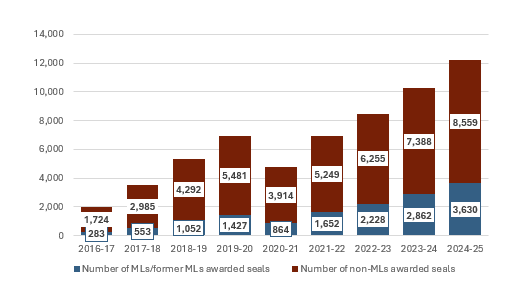
| Year | Number of Non-MLs Awarded Seals | Number of ML and former MLs Awarded Seals |
|---|---|---|
| 2016-17 | 1,724 | 283 |
| 2017-18 | 2,985 | 553 |
| 2018-19 | 4,292 | 1,052 |
| 2019-20 | 5,481 | 1,427 |
| 2020-21 | 3,914 | 864 |
| 2021-22 | 5,249 | 1,652 |
| 2022-23 | 6,255 | 2,228 |
| 2023-24 | 7,388 | 2,862 |
| 2024-25 | 8,559 | 3,630 |
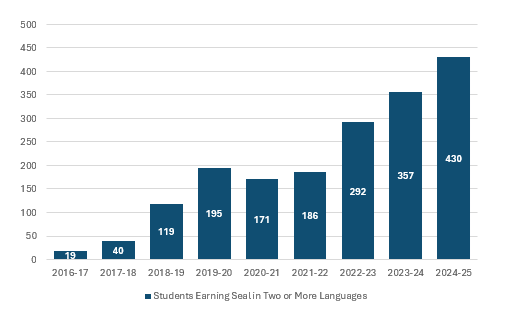
| School Year | Number of Students |
|---|---|
| 2016-17 | 19 |
| 2017-18 | 40 |
| 2018-19 | 119 |
| 2019-20 | 195 |
| 2020-21 | 171 |
| 2021-22 | 186 |
| 2022-23 | 292 |
| 2023-24 | 357 |
| 2024-25 | 430 |
| School Year | Number of LEAs |
|---|---|
| 2016-17 | 85 |
| 2017-18 | 120 |
| 2018-19 | 149 |
| 2019-20 | 188 |
| 2020-21 | 189 |
| 2021-22 | 234 |
| 2022-23 | 240 |
| 2023-24 | 251 |
| 2024-25 | 268 |
- Participation is voluntary and at the discretion of each Local Education Agency (LEA).
- The NJDOE sends an annual broadcast memorandum to schools detailing how to participate.
- LEAs may use local or federal funds to pay the assessment costs or have all or partial costs covered by students.
- The NJDOE offers technical assistance to support LEA implementation.