News & Updates

DHS Logo


May 2026: Key Direct Impacts of H.R. 1: New Jersey 

The New Jersey Department of Human Services has released a new resource analyzing the impact of H.R. 1 in the state, including sweeping, unprecedented cuts to Medicaid (NJ FamilyCare) and the Supplemental Nutrition Assistance Program (SNAP), and new barriers to accessing healthcare and food assistance. Readers can explore these projections that reflect the best available analysis of the federal law’s potential impact at this time. This resource is the latest update in a compilation of data summaries, county-level estimates, and fact sheets to help inform the public and policymakers to support continued engagement on the issue..

image with text: NJ Office of the Secretary of Higher Education

Hunger Free Campus Grants Awarded to 36 Institutions

The NJ Office of the Secretary of Higher Education awarded $1.2 million in Hunger-Free Campus Act grants to 36 institutions of higher education across the state to support campus-based resources, including food pantries and outreach connecting students with the Supplemental Nutrition Assistance Program (SNAP). Explore the awarded institutions in your community. 

images with text: A stronger New Jersey starts with food on every plate

Ending Hunger NJ Website Launched

The Ending Hunger NJ website launched as a resource to helps residents find, and contribute to, food resources in their communities. It provides a comprehensive, user-friendly directory of food assistance across the state, including county-by-county listings of food pantries and community food resources. It also includes information on legislation and State initiatives strengthening food security.

Tools for these times

1/28/2025 Tools for These Times: Resources for NJ Community Orgs Doing Food Security Work

This post by OFSA Executive Director, Mark Dinglasan, reaffirms the commitment to supporting NJ communities amid federal policy shifts. OFSA is actively tracking executive orders, public charge rule changes, and funding pauses, collaborating with state agencies to provide timely updates. The Office of New Americans leads interagency coordination, while OFSA ensures vital information reaches community organizations. Guidance on immigrant student protections and Know Your Rights materials are available—please share with your networks. Stay connected via OFSA’s LinkedIn and reach out with questions. Together, we will navigate these changes to safeguard food security for all.

Nourishing Hope and Heart in Each Other: Continuing this Work

Nourishing Hope and Heart in Each Other: Continuing this Work

Food security work, inspiration and connection with each other are all needed now more than ever. The NJ Office of the Food Security Advocate (OFSA) asks, "What is a quote, meditation, poem, lyric, phrase or thought that you’re adopting as a mantra for your part in this collective work or for your own work/life harmony in 2025?" First to respond are Derek Smith, Executive Director of the Franklin Food Bank (franklinfoodbank.org) and Mark Dinglasan, OFSA Executive Director (nj.gov/foodsecurity). Listen to their offerings, breathe, and take any encouragement and community you need. Come back often, as more videos will be added!

School Meal and Summer EBT Application

Hunger Free New Jersey, in partnership with the Office of the Food Security Advocate, has launched a statewide school meal application outreach campaign to encourage parents to complete and submit the new “School Meal and Summer EBT Application.” Healthy school meals promote good health and better learning.


OFSA’s Recommended Reads

Connect with OFSA in Person at These Upcoming Events

Videos & Podcast

News

Collection of photos showing participants at the 2026 conference

On October 13, 2026, the NJ Office of the Food Security Advocate (OFSA) hosted the Third Annual Garden State Conference on Food Security: Setting a Table for All, for Always. 

This year’s theme, “Food Security Across the Life Course,” inspired presentations, conversations, and networking opportunities for over 300 in-person attendees and a robust livestream community of nearly 600 additional viewers throughout the day. 

Reflections from OFSA’s team and partners in the legislature captured the value of the conference, lessons learned, and the opportunities ahead – from expanding access to nourishing, free school meals for more students, to more closely connecting business opportunities for NJ farmers with the individuals and families who are trying to eat healthier. 

Together, this collection of reflections affirms that: 

  1. It Takes a Village for Food Security at Every Stage of Life 
  2. Honest Communication Leads to a Stronger Community 
  3. A Shared Direction for the Future is Essential, to Build What Comes Next 
  4. We Cannot Do This Work Without Welcoming Student Voices 

 
“I’ve always believed that no one in New Jersey should have to wonder where their next meal is coming from, and it was such a privilege to join a room full of people who share that belief and have dedicated themselves to making it a reality at this year’s Garden State Conference on Food Security,” said Assembly Speaker Craig J. Coughlin. “Over the better part of a decade, we’ve worked to put that belief into practice by expanding access to school meals and finding new ways to reach families who need a little extra help. That’s why I was especially proud to announce our next steps in this fight, including legislation to make school breakfast free for every student in New Jersey, regardless of their family’s income.” 

 
“Sharing best practices and ideas on food security is helpful for us as legislators working to enact policies that will make a difference,” said Assemblywoman Shama Haider, who chairs the Assembly Committee on Children, Families and Food Security.  “I was thrilled to see the conference highlight all of our achievements here in New Jersey, as we lead the nation on our efforts to end hunger.” 

 
"No one in the Garden State should go hungry, and the folks who grow our food are central to the solution,” said Assemblywoman Andrea Katz, who chairs the Assembly Committee on Agriculture and Natural Resources.  “This conference reinforced that when farmers, advocates, and government work together, we can feed more families. I'm committed to making sure our farmers have what they need to keep delivering." 
 

“I’ve been so impressed by the efforts of the State, nonprofits, and other community organizations in the hunger space, and I was thrilled to attend this annual conference to learn about what more can be done,” said Assemblywoman Marisa Sweeney. “I applaud OFSA for putting this event together, for recognizing those making an impact in their local community, and for sharing ideas that will only strengthen our resolve to end hunger.” 

"Responding to the federally mandated changes to the Supplemental Nutrition Assistance Program (SNAP) is an all of government effort, and getting the word out to advocates in the community is really important," said Michael J. Wilson, Deputy Commissioner for Social Services at the New Jersey Department of Human Services. "We appreciate every opportunity to share with food security advocates to work together for the benefit of New jersey's residents." 


It Takes a Village for Food Security at Every Stage of Life 

The theme of food security across the life course compels us to consider how differently lives, conditions, and needs of people change over time, while encouraging how we can connect programs and services that have traditionally operated in silos based on the age group(s) that are their focus. This shift to interconnected, collaborative work can close gaps in services and common thinking that overlooks one life stage or age range for another. 

So, too, does the theme of food security across the life course extend to the partners advancing food security, each of whom bring different experience, expertise, assets and perspectives to the conversation whether they focus on infants and young children, families with students in grades K through 12, adults attending college, or older adults. 

OFSA Project Coordinator, Cassandra Salas, reflected on the value of bringing voices from different sectors together: “The conference successfully united diverse stakeholders, demonstrating that breaking down silos is essential to driving systemic change on this complex issue affecting our residents. The overall energy was remarkable. Keynote speakers, panelists, and breakout sessions sparked genuine collaboration, with attendees sharing expertise and identifying partnership opportunities. State agencies and other stakeholders specifically commended our office for creating this critical platform for cross-sector information exchange.” 

These exchanges are essential to move from shared concern to coordinated action, especially understanding where our collective work intersects, identifying opportunities to partner, and seeking wisdom from residents’ experiences as we work side-by-side with them. 


Honest Communication, Stronger Community 

Alongside the commitment to collaboration is recognition that this work requires openness about the moment we are in, particularly that New Jerseyans with the greatest needs are starting to feel the impact of federal changes to SNAP and Medicaid/NJ FamilyCare. The ripple effect on communities looks like more neighbors turning to the charitable food teams they know and trust for emergency food assistance. The ripple effect also looks like New Jerseyans missing out on access to free school meals and other supports for which they are still eligible, because they are unaware of all that is still available to them or unsure how to navigate forms, or online access to them. Making room for difficult conversations is essential to help understand and respond to change and to weather uncertainty.  

OFSA’s Policy Manager, Dr. Dan Dychtwald, captured this sentiment: “The conference reminded/reinforced two things for me - the need for communication and community.  It was a recurring theme throughout the day in the many presentations and conversations. As an office, as part of the statehouse, we need to focus on communication, be transparent, be open, yet be honest especially in the light of tremendous change and external pressure.  And more than ever, this work takes a community to support, cultivate, and grow it organically.” 

As we head into 2027 and beyond, OFSA will continue lifting up the foundational work of listening, sharing information, convening, and maintaining relationships to move forward with clarity. View the recording of the special presentation, Understanding HR1’s Impact on SNAP and Medicaid. 


Shared Direction for the Future 

Looking toward the future, the conference offered opportunities to consider how food security work happening across New Jersey connects to the shared direction outlined in the Statewide Food Security Strategic Plan.  

OFSA’s Director of Research and Evaluation, Dr. Jenny Schrum, provided insight during her presentation to inform collective efforts: “OFSA’s 3rd Annual Food Security Conference was a reminder that we have to be honest about the moment we are in and the challenges ahead, while also recognizing the strength of the work already happening across New Jersey. The coming year will require resilience, flexibility, and a continued commitment to working together. Our New Jersey Food Security Strategic Plan gives us a shared direction to help navigate uncertainty, bring partners together around common goals, and build on the progress already underway. Even in difficult moments, there is so much good work happening across our state, and it is that collective effort, creativity, and commitment that will keep us strong, agile, and moving forward with success.” 

Knowledge sharing and collection of cross-sector work will continue and expand well into and beyond the coming year. 


A Chance to Pause, Reflect – and Build What Comes Next 

For those immersed in the day-to-day work of serving neighbors, managing farm businesses, managing philanthropic dollars and more, opportunities to pause and reflect are rare and especially meaningful. The conference provided that much-needed space. 

OFSA’s Executive Director, Mark Dinglasan, shared: “The 3rd Annual Conference was an energizing affirmation for me that OFSA is making an impact in New Jersey through the strengthening of relationships, the enhancement of collective impact work, and the continued valuing of evaluation and outcomes tracking that the office uplifts. Every year, the conference continues to be filled with such a positive energy that reminds attendees that there's so much work to do but also that NJ has done and continues to do so much. It's easy to get lost in the muck and not see the forest through the trees in this work, so even for me, it was refreshing and humbling to be reminded of how far we've come as an office and how far we've come as a state.” 

Recognizing both how far we’ve come, and what remains to be done, will sustain the commitment needed to create lasting change. 


Welcoming Student Voices 

The conference also created opportunities to invite and involve students studying nutrition science, public health, data science and more. In addition to contributing to the day’s success, they provided their own reflections from the conference this year. 

OFSA’s Food Security Coordinator and a 2026 Data Science graduate from Rutgers, Flor Velasco-Chavez, shared: “Attending OFSA’s 3rd Annual Conference was a meaningful experience that highlighted the many different perspectives, experiences, and approaches that contribute to addressing food insecurity across New Jersey. What stood out to me most was seeing how the work being done behind the scenes connects to broader efforts and real-world impacts. It was a valuable reminder of the importance of continuing to learn from one another and finding new ways to make food security more accessible for all.” 

For Student Ambassador and third-year Nutrition Science Student at Rowan College South Jersey, Summer Renzulli, contributing the conference created opportunities for personal growth and meaningful relationships: “I have had the opportunity to volunteer as a student ambassador for OFSA for the past two years, and it has been one of the most rewarding and enjoyable volunteering experiences I have had. From this experience, I was able to connect with new people, build meaningful relationships, and expand my network while contributing to a cause that is bigger than myself. Being a student ambassador has allowed me to gain valuable hands-on experience, strengthen my communication and teamwork skills, and better understand the importance of giving back to the community. I would highly recommend becoming a student ambassador to other students who are looking for meaningful volunteer opportunities, Overall, my experience as an OFSA student ambassador has been incredibly fulfilling, and I look forward to continuing to support OFSA’s mission.” 

These experiences underscore not only the importance of welcoming new voices into the work, but also creating a space for them to contribute and see themselves as part of the food security mission from the beginning. 


Looking Ahead 

OFSA is grateful to the speakers, panelists, partners, students, volunteers, and participants – in person and online – who helped shape this year’s conference. 

From these important contributions, we know what it takes to set a table for all, for always.  

It takes commitment to food security at every stage of life; honest conversations about the challenges ahead; and knowledge of the projects and progress already underway.   

Above all, the Conference reinforced a rallying message among food security partners: no single organization, program, policy or sector can do this work alone or must do this work alone. Building a food-secure New Jersey will take continued community building and commitment in the years ahead, and OFSA will continue to do its part to support our ever growing, multisector, statewide community of practice. 

Check out the 2026 Conference recap page for resources, materials, and videos from the day. 

TRENTON –  As more New Jersey families than ever qualify for their students to access free school meals because of expanded eligibility guidelines, yet don’t realize they qualify, eight community and county service providers across the state are each receiving a $30K grant award to help local families in their counties tap into school meals programs in time for the new academic year. A ninth grantee is receiving a $90K award to work with families across three South Jersey counties and a tenth grantee is receiving $98K to do this work statewide, ensuring no county is overlooked.

The New Jersey Office of the Food Security Advocate (OFSA) is awarding the funding through the Building Expanded Access to Nutritious School Meals (BEANS) Program, continuing a milestone year of administering its first-ever grant funding toward reshaping the state’s food system and opportunities for all New Jerseyans to interact with it in ways that honor their dignity and agency, today and well into the future. 

Encompassing county-level departments of health and human services; faith-based organizations, healthcare providers, and other community-trusted organizations, the BEANS grantees will launch county-based initiatives of up to one year to expand access to, and participation in, school meal and childcare meal programs. Each grantee’s work will be county-specific, which means support is not geographically bound to any one school district. Each grantee and their partners are leveraging existing school meal participation data provided by OFSA, socio-economic data, and local knowledge to inform their work. These activities include implementing culturally responsive and multilingual approaches, “edutainment” activities, mobile screening and streamlined referrals with follow-up care, and more. Hunger Free New Jersey, the singular statewide BEANS grantee, will receive a larger award of $98K and also provide technical assistance to the local grantees.

"Here in New Jersey, we believe the work of ending hunger and building lasting food security calls on all of us, because it benefits all of us, and across all of our counties, there exists a range of service programs where neighbors are actively trying to help each other and themselves, whether that be through schools, organizations, healthcare systems, municipal and county offices, food pantries, the private sector or somewhere else entirely," said Speaker Craig J. Coughlin. "School meals continue to be one of the most direct methods we have to actually reach kids and truly ensure the food they're eating is nutritious. That's why I was proud to see my bill, A3882, which will make sure families know about school meals programs signed into law earlier this year. Too often, families qualify for these programs but simply don't know it, and I'm proud to see so much support for something as fundamental as feeding our children." 

BEANS Grantees 

  • Acenda, Inc., Cape May, Cumberland and Salem counties - $90,000
  • AtlantiCare Health Services, Atlantic County - $30,000
  • Burlington County Division of Community Outreach and Special Projects, Burlington County - $30,000
  • Calvary Baptist Community Center, Passaic County - $30,000
  • Greater Newark Conservancy, Essex County - $30,000
  • Hudson County Department of Health and Human Services Office of Food and Health Equity, Hudson County - $30,000
  • Hunger Free New Jersey, Statewide - $98,000
  • Loving Our Cities, Gloucester County - $30,000
  • REPLENISH, Middlesex County - $30,000
  • Somerset County Department of Human Services, Somerset County - $30,000 

“We still have a lot of parents who are not aware of school meals or the school meals application,” said Mark Dinglasan, OFSA Executive Director. “We have yet to see the full impact of the legislation – the Working Class Families Anti-Hunger Act -- that expanded the number of families who qualify for free school meals. OFSA believes in the Working Class Families Anti-Hunger Act and New Jersey’s efforts to expand access to school meals. OFSA’s investment in community and county-led strategies that create greater awareness of the school meal application and the Working Class Families Anti-Hunger Act will catalyze our state’s ongoing efforts to ensure more eligible families are accessing school meals.”

“School meal programs including the National School Lunch (NSLP), School Breakfast Program (SBP), and the Child and Adult Care Feeding Program (CACFP) are an underutilized but essential tool in reducing statewide food insecurity,” said Dr. Dan Dychtwald, OFSA Policy Manager and Team Lead for School Meals Strategy. “Providing as many as three meals a day plus snacks, school meals and childcare meals may be one way in which New Jersey families mitigate the impact of H.R. 1 as many families may face reduced benefits and/or access to programs such as the Supplemental Nutrition Assistance Program and New Jersey Family Care. Additionally, ensuring our students have access to nourishing school and childcare meals reduces the potential burden on the charitable food sector, allowing them to focus outreach and support on families with no school-aged children.”

The grantees will advance New Jersey’s broader food security strategy by building and supporting local partnerships to advance community-driven food security approaches as described in Focus Area 3 of the Statewide Food Security Strategic Plan. Their community activities will resemble tailored education, outreach and awareness efforts; coordination at the county level; valuing two-way community engagement channels; providing closed-loop referrals to services; and more. More detailed profiles of each grantee’s work through BEANS will be published on the OFSA website.

Learn more about these grantees and follow their work: NJ.gov/FoodSecurity/GrantInitiatives

View the new series of school meals-themed public service announcements for the 2026-27 school year on OFSA’s newest YouTube playlist. The first two videos focus on the questions New Jersey parents might have: “A How-to/Step-by-Step Guide to the School Meals and Summer EBT Application,” and “FAQ about the School Meals and Summer EBT Application.” 

TRENTON – The New Jersey Office of the Food Security Advocate (OFSA) is announcing the selection of grantees for two funding opportunities totaling $685,000: the New Jersey Food System Enhancements Program (FSEP) and the Research, Outreach, and Organizing for Trusted (Community) Engagement and Data (ROOTED) Program. Both funding pools support local implementation efforts identified in the New Jersey Food Security Strategic Plan, which was released in February 2026. Together, these funding initiatives are providing a path for community-led, data-informed efforts to reshape our state’s food system so it works better for all New Jerseyans, today and well into the future.

Through FSEP  – which is designed to enhance the provision of food supplied by New Jersey-based agricultural producers to New Jersey residents, while ensuring those producers and growers receive fair and sustainable prices for their products – OFSA is awarding a total of $625,000 to five grantees. These grantees were selected, in part, for their service areas and reach, meaning there is at least one FSEP-funded effort underway in the Northern region, Central region and Southern region of the state.

ROOTED, which supports the expansion of local partnerships and information access, is awarding a total of $60,000 to three grantees strengthening coordination, outreach, and community-informed efforts to advance lasting food security.

"Every New Jersey family deserves to know where their next meal is coming from, and every farmer who grows our food deserves a fair return for the work they do," said Governor Mikie Sherrill. "These grants will help bolster New Jersey's food security efforts investing in the growers, the community partners, and the local infrastructure that connect our residents with the nutritional resources they need to thrive. I'm proud that my Administration is backing the people and organizations already doing this work in their communities, and I look forward to seeing what these partnerships build in the months ahead." 

“In the Legislature, we have proudly recognized the importance of investing in the organizations that help New Jersey families find their way when life knocks them off course. We know that food insecurity is felt most acutely at home, and that lasting solutions come from investing in the people and partnerships that know their communities best,” said Speaker Craig J. Coughlin. “We may not be able to sit at every family's kitchen table, but we still have to make sure we’re doing everything we can so that families have healthy, nutritious food to put on it. That’s why, in a state as rich in agriculture as New Jersey, lasting solutions begin with the farmers who grow our food, the organizations that deliver it, and the neighbors who never wait to extend a helping hand. These grants strengthen each link in that chain, and I’m proud to see our state once again rising to meet the moment.”

“Both the FSEP and ROOTED programs mark the first grant initiatives of this office, and New Jersey’s first investments in local food security efforts through the six dimensions of food security that acknowledges the importance of innovation, collaboration, and listening to constituents and stakeholders as we do this work. Building true food security calls on all of us, in every sector,” said Mark Dinglasan, Executive Director of the NJ Office of the Food Security Advocate. “These grant awards breathe life into the vision outlined in the statewide Food Security Strategic Plan – one of a sustainable New Jersey food system where all people, at all times, have continual and resilient access to foods that meet their needs and preferences now and for generations to come, and where every sector and community member sees themselves as integral to the collective effort necessary to achieve this shared vision.”

FSEP Grantees

For up to 18 months, FSEP funding will support the following grantees’ work to expand community-based food infrastructure and market channel creation, as aligned with Focus Area 2 of the New Jersey Food Security Strategic Plan.

●       City Green, “Good Food Bucks Expansion to Farmers’ Market Nutrition Program Nutrition Benefits” — $131,250

●       Communities Revolutionizing Open Public Spaces (C.R.O.P.S.), “The Food Hub on Farmer’s Row: Community-Rooted Food Infrastructure and Market Expansion in Atlantic City” – $131,250

●       Move for Hunger, Inc., “New Jersey Shared Cold Storage Infrastructure Pilot”  – $100,000

●       Northeast Organic Farming Association of New Jersey (NOFA), “Increasing NJ Value-Added Processing Capacity for Local Food Security and Farm Sales” – $131,250

●       Table to Table, “Full Circle Kitchen” – $131,250

ROOTED Grantees

ROOTED funding will support the following grantees, each selected to enhance information exchange and access and build and support local partnerships for community-driven food security approaches, aligned with Focus Areas 1 and 3 of the New Jersey Food Security Strategic Plan.

●       Food & Health Equity Coalition of Essex County (FHEC), fiscally sponsored by Meeting Essential Needs with Dignity (MEND), “Rooted in Essex: A Community-Centered Coalition Data Hub” – $20,000

●       New Brunswick Tomorrow (NBT), “New Brunswick Emergency Food System Strategic Coordination” – $20,000

●       Passaic County Department of Human Services, “Passaic County Food Security Data Hub” – $20,000

The selected grantees and projects will help progress the State’s broader food security strategy by increasing access to locally produced foods, supporting community coalitions, and improving information sharing. OFSA will serve as the primary evaluation partner for the ROOTED grantees. The office’s national partners, the Center for Nutrition & Health Impact, will serve as the primary evaluation team for the FSEP grantee cohort. More detailed profiles of each grantee’s work through FSEP and ROOTED will be published on the OFSA website this summer.

Learn more about these grantees and follow their work: NJ.gov/FoodSecurity/GrantInitiatives

June 10, 2026

Today, the New Jersey Office of the Food Security Advocate (OFSA), is announcing an inaugural Call for New Jersey Commitments for Food Security and inviting organizations and coalitions to submit New Jersey Commitments for Food Security (Commitments) for their NJ-based programs that advance the New Jersey Food Security Strategic Plan (Strategic Plan). OFSA will accept Commitments for review via its website: NJ.gov/FoodSecurity/Commitments.

Continuing New Jersey’s intentionally broad approach to food security work, OFSA encourages a wide range of entities to consider their programmatic work through the lens of the Strategic Plan and submit a Commitment by August 1, 2026, including:

  • Schools, school districts, and childcare centers
  • Local, county, and regional coalitions
  • Community and advocacy organizations
  • Charitable food networks and food access organizations
  • Food producers, including farmers, ranchers, fishers, and other producers
  • Agriculture and economic development agencies
  • Food retail and food supply chain organizations
  • Healthcare systems and health-focused organizations
  • Philanthropic partners and funders
  • State, county, tribal, and local agencies
  • Community-based organizations and resident-led initiatives
  • Industry and private-sector partners
  • Academic and research organizations

The cohort of 2026 Commitments will have the opportunity to participate in optional implementation learning activities with OFSA and its partners to support knowledge sharing across industries and sectors, identify implementation successes and challenges, and strengthen statewide coordination and collaboration on a day-to-day basis. These efforts will ultimately help OFSA better understand and document New Jersey’s collective progress to building food security for everyone, every day, and everywhere.

“OFSA is launching this inaugural Call for Commitments and will do so on an annual basis going forward, to connect local and regional initiatives to a broader statewide vision for coordinated action, shared learning, and collective impact,” said OFSA Executive Director Mark Dinglasan. “My team and I are eager to partner alongside communities in this way, and as our state receives ongoing national attention for this work, I will continue to help my state-level counterparts along the Mid-Atlantic region and across the nation lean on New Jersey’s approach to build and energize solutions that make sense to their own communities and constituents.”

The New Jersey Office of the Food Security Advocate (OFSA) was established through legislation in 2022 to reshape the state’s approach to food security through systems change, collaboration, and data-driven action. Guided by its mandate to coordinate statewide efforts and address unmet needs, OFSA convened partners across sectors to co-develop the New Jersey Food Security Strategic Plan to ensure all New Jerseyans can better access, afford, and utilize nutritious food with dignity, stability, and choice now and for generations to come.

The Strategic Plan is a three-year framework designed to guide coordinated, cross-sector action to advance food security for all New Jerseyans. It is an intentionally flexible framework that allows counties, municipalities, organizations, coalitions, and sectors to select Strategies most relevant to their needs and design solutions suited to their unique strengths, partnerships, resources, and local contexts, such as geographical context. The Strategic Plan outlines focus areas and strategies, which together provide a structured yet flexible roadmap for advancing food security across its six dimensions statewide, reinforcing a collaborative, coordinated approach. There are five focus areas in the plan:

1. Enhance Information Exchange and Access to Improve Public Awareness, Optimize Programs, and Support Data-Driven Decision-Making

2. Expand Community-Based Food Infrastructure and Market Channel Creation for Enhanced Ongoing Food Access, Utilization, and Availability

3. Build and Support Local Partnerships to Advance Community-Driven Food Security Approaches

4. Collaborate Across Sectors and State Agencies to Streamline and Strengthen Federal and State Food Security–Related Program Access and Delivery

5. Strengthen Food Systems Resiliency to Enhance Long-term Stability That Withstands Disruptions and Ensures Future Sustainability

“A number of OFSA’s multisector partners and colleagues have collaborated with us to inform, develop and disseminate the Strategic Plan so all New Jerseyans can see their role in strengthening our shared food ecosystem to benefit us all,” said OFSA Director of Research and Evaluation Dr. Jenny Schrum. “The Commitments that local food security advocates, collaboratives and resident leaders choose to send in are key to the final step outlined in the corresponding Strategic Plan Implementation Planning Toolkit. Anecdotally, we know a number of existing and potential programs in New Jersey already align with the Strategic Plan, and also, new programs are being designed. Through the Commitments, OFSA can document local implementation across sectors, regions and the five focus areas in the plan.”

The Call for New Jersey Commitments for Food Security comes in the same quarter OFSA has issued its first-ever Requests for Applications and Notices of Funding Availability for holistic food security work aligned with the focus areas in the Strategic Plan. Applicant organizations and coalitions selected to receive OFSA funding through the initiatives announced this year will automatically have their projects accepted as Commitments. Together, the larger Commitments cohort will provide expanded opportunities for knowledge sharing and elevate their respective profiles among decision makers in Trenton and beyond.

With the ardent support of Speaker Craig Coughlin, additional legislative champions, and OFSA’s station in the Governor’s Office, OFSA’s funding initiatives, public-private partnerships with the philanthropic sector, and the Call for New Jersey Commitments for Food Security are harnessing the momentum of efforts that may have historically operated in silos, and moving everyone forward together.

“One of the most important things we’ve done in the fight against food insecurity has been bringing this challenge into the public consciousness and helping people understand that hunger exists in every community,” said Speaker Craig J. Coughlin. “When people recognize that the families struggling to put food on the table are their neighbors, that the senior skipping meals to afford medication lives down the street, or that the child arriving at school hungry could be sitting in their own community, they feel called to do something about it. That's why it's so encouraging to see so many likeminded people lending their voices to this cause and I’m so proud knowing this issue has become one that so many New Jerseyans have embraced.”

Organizations and coalitions interested in submitting a Commitment can do so for a program active within the 2026 calendar year. Future Commitments calls will capture programs active in 2027 and 2028.  Programs of all sizes and aligned with one or multiple strategies from the Strategic Plan are encouraged to submit a Commitment. The OFSA team is available to provide technical assistance to help interested organizations and coalitions determine the best way to submit a Commitment for consideration.

OFSA will publicly announce and celebrate the cohort of accepted 2026 Commitments as part of the 3rd Annual Garden State Conference on Food Security: Setting a Table for All, for Always this fall.

FRAC 2026 panel

Planning with Purpose in session at the Food Research and Action Center (FRAC) National Anti-Hunger Policy Conference. From left to right: Dwayne Wharton, Founder & Principal, Just Strategies; Mark Dinglasan, OFSA; Dr. Jenny Schrum, OFSA; Brett Nedelkoff, Philadelphia City Council; Mark Edwards, Food Trust; George Matysik, Share Food Program.

On Monday, April 27, the New Jersey Office of the Food Security Advocate (OFSA) was proud to join advocates, government officials, and resident leaders at the 2026 Food Research and Action Center (FRAC) National Anti-Hunger Policy Conference in Washington, DC.

The cross-sector conference brought together food security, nutrition, community and anti-poverty advocates from all around the country, including a sizable delegation from New Jersey. Even as policy changes out of our nation’s capital are disrupting the everyday lives of families, farmers and neighbors, OFSA and all of these colleagues are still focusing on strengthening the quality and reach of federal nutrition programs including SNAP, WIC, and school meals, learning best practices for community outreach and programs, and identifying innovative and collaborative solutions to end, and ultimately prevent, hunger.

Returning to this national platform for a third consecutive year, this time, OFSA co-presented the Conference session, “Planning with Purpose: Case Studies of Coordinated, Cross-Sector Food Security Strategic and Action Planning Efforts.” Additional presenters included representatives from Hunger Solutions Consulting, the Share Food Program, Just Strategies, Philadelphia City Council, and The Food Trust.

Session participants heard about inspiring model examples from New Jersey and our neighboring state of Pennsylvania, showcasing how collaboration, data, and community voice can shape stronger food security systems at both city and statewide levels.

OFSA also shared the New Jersey Food Security Strategic Plan to support food security strategic planning efforts statewide, and the Implementation Planning Toolkit designed to help partners move from strategy to action.

Dr. Jenny Schrum, OFSA, presenting on the Six Dimensions of Food Security

Dr. Jenny Schrum, OFSA, presenting on the Six Dimensions of Food Security as part of the New Jersey Food Security Strategic Plan during the Planning with Purpose session.

For OFSA team members, the experience was energizing, affirming, and deeply collaborative.

Dr. Jenny Schrum, OFSA Director of Research and Evaluation shared, “The FRAC conference was a great opportunity to connect New Jersey’s work to the shared national goal of ending hunger through stronger policy and systems change. It was exciting to see so much enthusiasm for the six dimensions framework and for a toolkit that helps turn strategy into practical, community-driven action. The conversations reinforced that people are looking for approaches that are both evidence-based and immediately usable.”

Dr. Dan Dychtwald, OFSA Policy Manager, reflected on the value of learning from nationwide peers: “Attending the FRAC conference for me is all about learning from the experiences and insight of colleagues from around the country. I was fortunate enough to attend sessions on food insecurity specific to military families, older adults, and school-aged children. And from each session, I gleaned new ideas, renewed and reignited my passion for this work, and gained connections to new colleagues and mentors. It is this expanded network I will cherish and continue to connect with as I seek new ways of addressing food insecurity among specific populations across the Garden State.”

Mark Dinglasan, Executive Director of OFSA, underscored the importance of the office’s national relationships and the strong response to the presentation: “Being at the FRAC conference this year was both energizing and affirming for me. OFSA has continued to devote time and effort to bringing together our national partners so that we can all learn from each other and grow together. A unique role that OFSA continues to have on the national stage is to provide insight into what state-level policy execution can look like when informed by food security research & evaluation and strong communities of practice. I went to two affinity group sessions, one meeting with state level employees regarding HR1, and several receptions where people came together to debrief and talk about next steps. In each one of those sessions, I was able to share about OFSA's work, but also offer assistance and encouragement to our partners from other states that are doing similar work. It was also inspiring to see the level of response to OFSA's presentation on Monday morning. It was incredibly affirming to see the amount of interest in the presentation and I take that as a sign, and a reminder, that OFSA is not alone and that there are many champions out there that are striving just as hard as we are and want to learn in partnership with us.”

The FRAC Conference bolsters a powerful message for food security and nationwide program work: strategy led with clear implementation and grounded in lived and living expertise can create meaningful progress anywhere.

OFSA’s participation in the 2026 National Anti-Hunger Policy Conference provided renewed momentum, stronger connections, and a reinforced commitment to building food security systems that are practical, equitable, and community-driven, to benefit all New Jerseyans now and into the future.

Katie Jacobs and Dr. Jenny Schrum
  
Katie Jacobs from Hunger Solutions Consulting with Dr. Jenny Schrum, OFSA at the FRAC National Anti-Hunger Policy Conference entrance. 

March, 17, 2026

At a September 2025 listening session convened with Speaker Craig Coughlin, farmers and food system leaders, the New Jersey Office of the Food Security Advocate (OFSA) was asked to keep an important conversation going: why is it still so difficult to move fresh food grown in New Jersey to all of the communities that want it?

In keeping with that commitment, OFSA facilitated a breakout conversation at the 2026 New Jersey State Agricultural Convention and Tradeshow in January, bringing together farming operations of all sizes — including small, mid-size, large, and urban, peri-urban and rural growers — alongside distributors, policymakers, and food system advocates.

What emerged was a shared understanding: 

New Jersey is striving to create, pilot and support innovative infrastructure ideas that support our local food production. 

OFSA Executive Director Mark Dinglasan shared that the session was intentionally designed  to engage farmers whose perspectives have not always been reflected in statewide agricultural conversations  — those who are Black, Indigenous, and people of color; women-owned operations; LGBTQIA+ farmers; and younger and emerging producers in urban and rural communities alike. 

Across the room, inclusion was framed as a strength. Participants underscored how lived experience, innovation, and community-rooted knowledge strengthen conversations about infrastructure, market access, and long-term farm viability. 

Over 90 minutes, nearly 40 participants spoke candidly about what is and is not working, and areas where OFSA can support them. Despite varied roles and perspectives, there was strong alignment around the need for coordinated investment, policy alignment, and market conditions that recognize all of our farmers as essential economic actors and partners in building a resilient food system for everyone in our state.

Where Progress Can Be Made  

The conversation reflected growing alignment, increasing political will, and the presence of pilot models already demonstrating how infrastructure and coordination can work together.  

Areas identified for continued focus included: 

  • Regional aggregation and cold storage 
  • Long-term institutional purchasing agreements 
  • Policy frameworks that better support urban and underrepresented growers 
  • Tax incentives and liability protections that support local sales and food donation 
  • Food systems education that builds demand and familiarity over time 

Logistics — Not Food — Is the Bottleneck 

Farmers and distributors consistently pointed to transportation, equipment, storage, and coordination as key pressure points between farms and local tables. 

Smaller and urban operations in particular, described how shared infrastructure and aggregation models could reduce individual burden while helping expand market reach. The role of such aggregation systems could collect, store, and combine products from multiple farms, enabling consistent food deliveries to schools, hospitals, food banks, and other buyers at scale. 

As one participant put it, “The food is there.” The challenge is that existing supply chains often default to what is easiest for the bottom line, not what is local or equitable for communities. 

Farmers in New Jersey Face Different Barriers 

The breakout group spoke candidly about structural conditions that shape their participation in New Jersey’s food ecosystem. In their experience, zoning policies, access to land and capital, workforce constraints, and definitions of what qualifies as “agriculture” are all areas where updated frameworks could better reflect the realities of modern farming in the state. 

For some of the farmers in attendance, logistics are inseparable from cultural recognition and equity. One grower described their work as not only food production, but a form of community health intervention — regenerating soil, improving air quality, and creating spaces of cultural relevance where food, education, and healing intersect. 

Designing systems that reflect these additional realities was seen as essential to ensuring that improvements in aggregation and distribution benefit all growers. 

Farmers Need Markets, Not Moments 

Short-term grants and emergency purchasing programs were acknowledged as helpful, but unreliable for long-term planning. Farmers emphasized that viable businesses depend on consistent markets that allow for reliable crop planning, staffing, and investment over time.  

One grower shared how entering the WIC Farmers’ Market program increased demand for their produce, but without access to wash-and-pack space, storage, staffing, or mentorship on scaling production, the added opportunity quickly became unsustainable. This experience highlighted the importance of pairing market access with technical assistance, infrastructure, and workforce support. 

Meanwhile, schools, hospitals, food banks, and other institutions were identified as promising partners for stable purchasing relationships, particularly given that a significant share of institutional food procurement currently occurs outside the state. Participants agreed that predictable demand and fair pricing would strengthen both farm viability and local food access. 

As another grower noted, “It’s a luxury to be able to go to a market.” In response, they began bringing food directly into communities through mobile and pop-up markets, recognizing how critical transportation, work schedules, and convenience are in contrast to supply. 

Recognizing Farmers as Businesses, Not Nonprofits 

A consistent theme throughout the session was the need to align food security strategies with economic reality. Farmers carry real costs — labor, distribution, storage, and compliance — and most emphasized opportunities to align food security goals with business realities through incentives, inclusive pricing structures, and institutional partnerships. 

Several growers also discussed the interest in mentorship and technical assistance for farmers moving beyond early-stage operations. While introductory resources exist, additional intermediate-level support for scaling operations, managing pests, improving soil health, or entering institutional markets is integral to meeting both business goals and community needs. 

Food Must Be Familiar and Relevant 

Demand for fresh food was closely linked to familiarity and cultural relevance. Participants shared that food can go unused not because it lacks value, but because people may not recognize it or know how to prepare it. At the same time, many small and urban farms are already growing culturally meaningful foods that reflect the diversity of New Jersey’s communities. Strengthening connections between these crops and appropriate buyers is a way to reduce waste, build demand, and deepen community connections. 

Schools were highlighted as places where food literacy, culturally relevant meals, and local procurement, can reinforce one another and strengthen existing efforts while educating and engaging our younger New Jerseyans.  

Collaboration and Coordination Matter 

An out-of-state dairy producer and ally to New Jersey farmers reflected on the breadth of strong work already happening across sectors, noting the value of better connecting efforts that would otherwise take place in a vacuum. The conversation reinforced the importance of frequent and intentional collaboration and coordination among farmers, educators, advocates, and policymakers. 

Participants described flexible funding as a practical tool that allows farmers to respond to immediate operational needs, while also discussing how value-added production and shared processing spaces can support long-term farm viability and ease common logistics challenges. Food security in New Jersey is inextricably linked to how well the state supports its farmers and food businesses. As OFSA continues to engage farmers, distributors, and food systems leaders, these insights will help guide coordinated efforts to strengthen the systems that move food from where it is grown to where it is needed — equitably, sustainably, and at scale.

Looking Ahead

Reflecting the themes of the breakout session and multiple conversations with the agricultural sector over the past three years, the New Jersey Food Security Strategic Plan names the expansion of community-based infrastructure and creation of market channels for enhanced and continual food access, utilization and availability as areas of focus for the state. As a living framework offering a shared direction for strengthening food security work across policies, programs, funding, data, and partnerships, the Strategic Plan lays out how emphasizing community-led solutions that strengthen the systems that move nourishing food from producers to communities, and ensure producers receive fair, sustainable prices for their products, can advance the six dimensions of food security. OFSA is optimistic that organizations, agencies, counties, municipalities, healthcare, philanthropy and farmers will continue to be strong adopters of New Jersey’s food security goals and the Strategic Plan itself.  

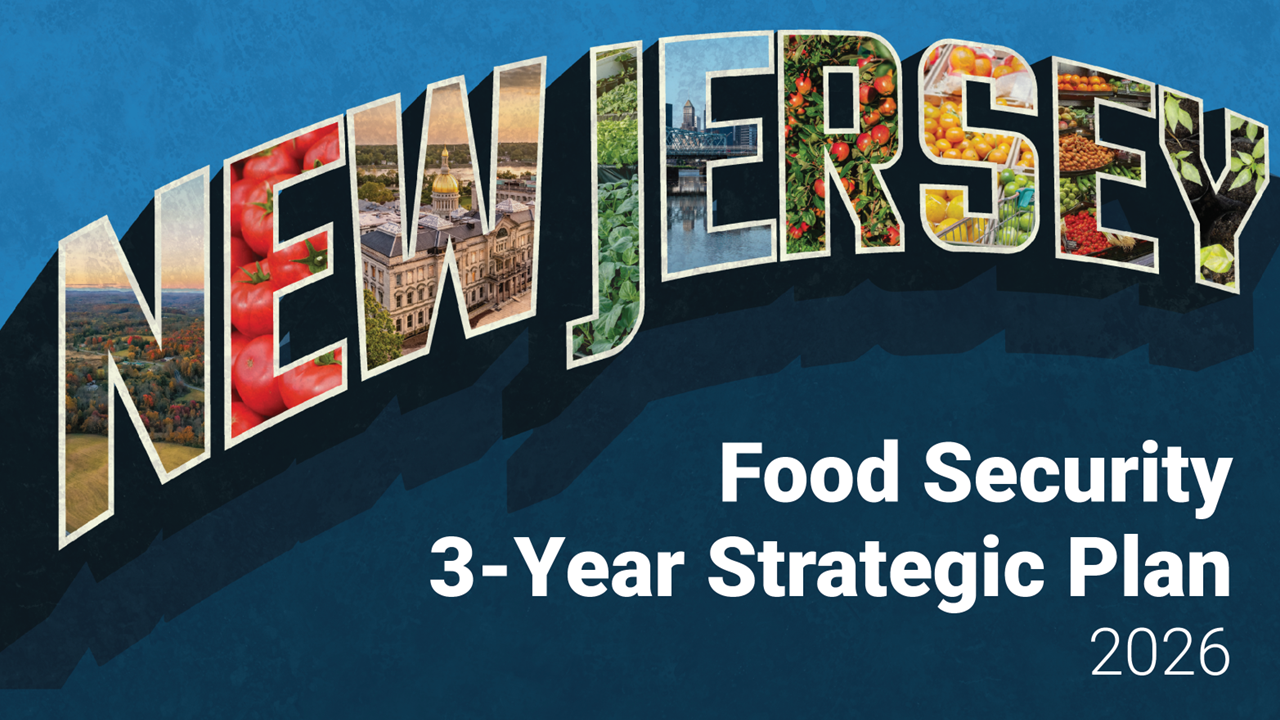
New Jersey Food Security 3-Year Strategic Plan

The Strategic Plan Framework Advances Food Security in the Garden State

2/13/2026

Today, the state of New Jersey released its first-ever New Jersey Food Security Strategic Plan (Strategic Plan). This three-year, statewide framework is designed to align partners, guide action, and accelerate progress toward food security for all New Jerseyans.

Developed through a state-facilitated, community-informed process, the Strategic Plan reflects the voices, expertise, and lived and living experiences of neighbors across sectors and regions of the state. It recognizes that food security is a shared commitment that requires coordinated action across programs, organizations, and levels of government.

We use a Multi-Dimensional Approach to Food Security

Food security exists when all people, at all times, have physical, social, and economic access to sufficient, safe, and nourishing food that meets their dietary needs and food preferences for an active and healthy life. 

Six Dimensions and the Definition of Food Security

This definition grounds New Jersey’s work in the six dimensions of food security and serves as the foundation for the Strategic Plan. The six dimensions include:

  • Availability: Is food present and reliably supplied?
  • Access: Can people physically and economically obtain food?
  • Utilization: Can food be prepared, stored, and used in ways that support health and dignity?
  • Stability: Are food security conditions consistent over time?
  • Agency: Do people have power, choice, and voice in their food and food system?
  • Sustainability: Are food systems resilient, equitable, and viable for future generations?

Together, these dimensions move the conversation beyond short-term responses and toward systems-level solutions that address root causes, structural imbalances, and long-term resilience.

The Vision

A sustainable New Jersey food system where all people, at all times, have continual and resilient access to foods that meet their needs and preferences now and for generations to come, and where every sector and community member sees themselves as integral to the collective effort necessary to achieve this shared vision.

The Strategic Plan Offers a Shared Direction

The Strategic Plan offers a coordinated set of focus areas and strategies that collectively establish a unified direction for New Jersey’s food security efforts over the next three years. The Strategic Plan is not a prescriptive checklist or a one-size-fits-all mandate. Instead, it provides:

  • A shared direction and common language for food security work in New Jersey
  • Focus areas and strategies that can be adapted locally
  • A framework to align funding, policy, programs, and data
  • A platform for accountability, learning, and collaboration

Success depends on how the Strategic Plan is leveraged by state agencies, local governments, community-based organizations, philanthropy, researchers, advocates, businesses, residents, and all of New Jersey.

Pyramid of Strateig Plan Tiers

Explore more on the New Jersey Food Security Strategic Plan webpage.

January 6, 2026

The U.S. Department of Agriculture (USDA) released its Household Food Security in the United States in 2024 report, its final publication in a three-decade-long series that shaped how our nation measures and understands food security. This report provides a state-level food insecurity prevalence rate, averaging the data from years 2022, 2023, and 2024.

Under USDA’s definition, households are considered food insecure when they have difficulty, at some time during the year, providing enough food for all their members because of a lack of money or other resources. In 2024, 13.7% of U.S. households experienced food insecurity at least some time during the year. This is a measure of economic access to food, a crucial part, but only one aspect of the six-dimension food security framework in which the New Jersey Office of the Food Security Advocate (OFSA) grounds its work.

Key Takeaways for New Jersey from this Report

According to the 2024 report:

  • The Garden State recorded the 5th lowest prevalence of household food insecurity in the nation.
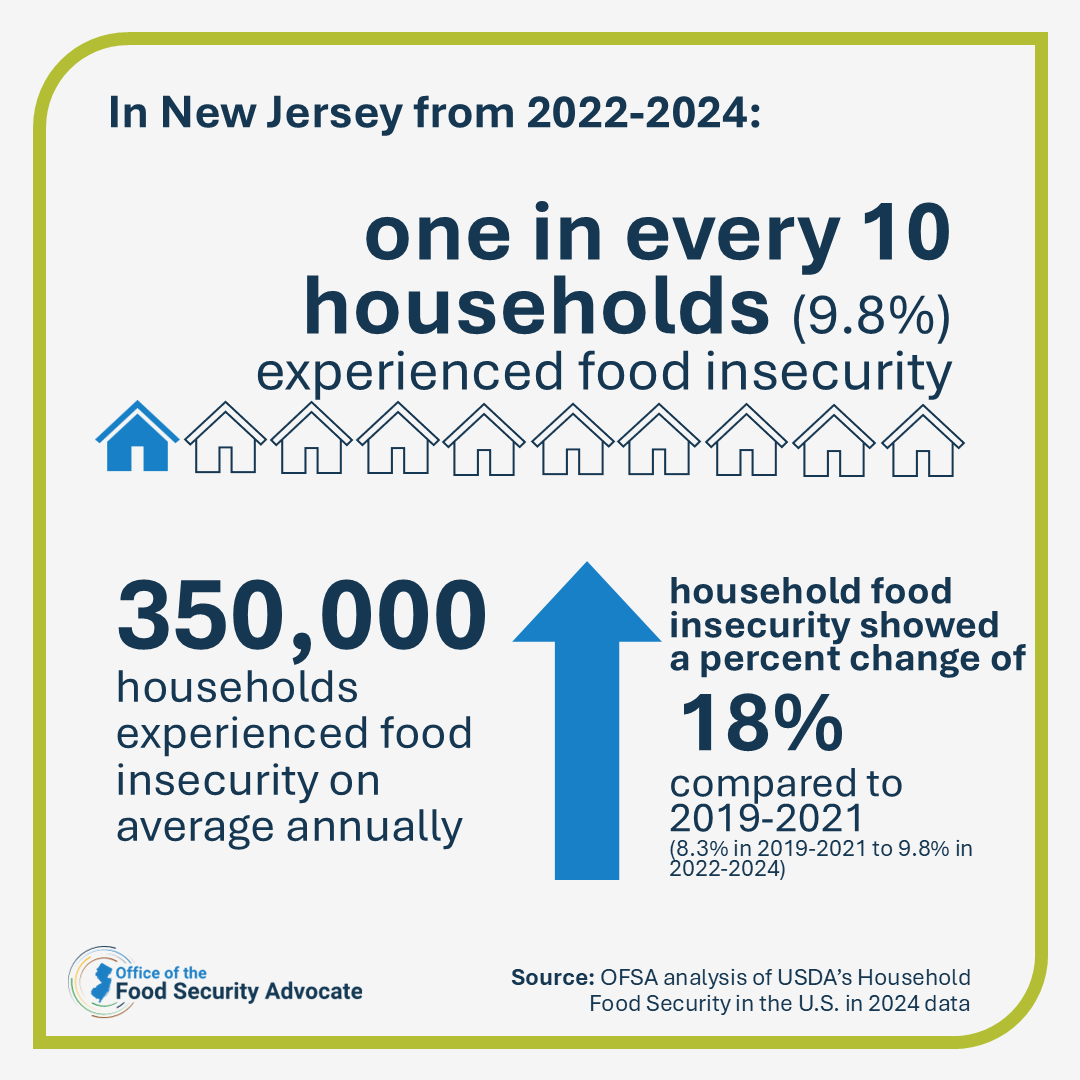
  • Still, one in every ten households (9.8%, or about about 350,000 households each year) experienced food insecurity in New Jersey between 2022 and 2024 (annual average).
  • The prevalence of food insecurity is increasing in New Jersey. Food insecurity increased from 8.3% of households in 2019-2021 to 9.8% in 2022-2024, a percent change (increase) of 18%.
  • Although New Jersey’s overall food insecurity prevalence remains below the national average (13.3% in 2022-2024), any amount, and increases to, food insecurity is unsuitable for a state with our strong resources, partnerships, and commitment to ensuring food security for all.

infographic: 1 in 10 households experienced food insecurity from 2022 to 2024

Why the Data Matters
For thirty years, USDA’s Household Food Security Report served as an essential public resource for tracking trends and evaluating progress in food security. This report provides the most consistent national and state-level data on household food insecurity. It grounds research, informs policy decisions, and helps advocates, agencies, and communities identify where people may struggle to afford enough food.

“In the last 12 months, did you ever eat less than you felt you
should because there wasn't enough money for food?” -
question in the USDA Food Security Survey

What the Data Leaves Out
The USDA household food security measure reflects just one part of a broader, interconnected system of factors that contribute to a household’s overall food security. Food security depends not only on access, but also on availability, utilization, stability, agency, and sustainability of food. Together, these six dimensions help us understand the full picture of how people navigate food security in their daily lives.

The data is also presented as state-level averages. To make progress, we must look beyond averages and ask where and for whom food insecurity is most deeply felt, across counties, communities, and demographic groups.

infographic: 6 dimensions of food security

Building a More Complete Data Picture
The 2024 data release marks the final year of USDA’s Household Food Security Report. While its discontinuation represents a loss for research and policy making, it also underscores the importance of state-led data systems that can fill critical knowledge gaps.

OFSA is advancing that work. Through a growing portfolio of data tools and resources, we are helping New Jersey communities, advocates, and policymakers continue to access, interpret, and apply data to inform local action.

These resources, and the data they contain, help strengthen evidence-based decision-making and elevate community-informed solutions.

How We Keep Progressing Toward Food Security for All
New Jersey’s leadership in food security reflects years of collective effort and demonstrates what’s possible when data, collaboration, and compassion align.

New Jersey’s ability to remain a leader depends on sustained action. To keep building a future where every community can reach its full potential, we must continue to:

  • Consistently and intentionally evolve approaches to addressing the problem
  • Build county and municipal coalitions
  • Advance innovative efforts and proven solutions
  • Invest in coordinated data systems to measure progress
  • Foster creative and effective funding

Every sector and organization has a role to play in food security. Determine which actionable strategies you’ll pursue in the preview of the Strategic Plan for Food Security in New Jersey. 

Even as national measures shift, New Jersey’s commitment remains steady. We strive  to ensure that every New Jerseyan, in every corner of the Garden State, has reliable access to appropriate and preferred, local food, today and for generations to come.

December 9, 2025 

When the federal government shutdown disrupted SNAP benefits for hundreds of thousands of New Jersey residents this fall, our state’s food system faced a moment that tested both readiness and resolve. Yet as uncertainty swelled, our view from here in the NJ Office of the Food Security Advocate (OFSA) allowed us to witness and facilitate something powerful: state agencies, community partners, volunteers, and neighbors mobilized with a shared purpose. Through a rapidly assembled interagency task force, daily updates, and strong coordination by our partners in the Office of Emergency Management (OEM) and including retiring New Jersey State Police Superintendent Colonel Patrick J. Callahan, New Jersey’s response emerged quickly and collaboratively. From expediting state funding to the charitable food sector, to placing AmeriCorps members at some of the larger food banks to increase their operating capacity, our state stood together to ensure no one was left behind.

Across the state, community-based organizations that already fill a critical role for neighbors every day, showed up for this moment instead of shying away.

three men standing in front of produce

  • MEND Hunger Relief Network of Essex County expanded its distributions of fresh, Jersey-grown produce to its network of pantries and all five Newark Ward Food Hubs in partnership with the City of Newark, and shared clear, compassionate updates with residents who were understandably concerned about how they would nourish themselves and their families. See more photos from that effort here. 
  • In Morris County, the Interfaith Food Pantry Network and Nourish NJ purchased additional food and staffed special distribution sessions, with the Morris County Department of Human Services relaying details on these coordinated efforts so residents could plan as needed.  

workers posing for a picture

  • Farther south, Somerset County and the Food Bank Network of Somerset County co-hosted an emergency drive-through food distribution for impacted SNAP families and furloughed federal employees. According to this post from Somerset County, nearly 80 County staff and volunteers provided nourishing meals to 1800+ Somerset County residents who arrived in more than 500 cars throughout the day.  
  • In service to those who serve, the New Jersey State Veterans Chamber of Commerce, Farmers Against Hunger, the American Red Cross of Southern New Jersey, the Food Bank of South Jersey and State Senator Troy Singelton’s office collaborated with leaders at Joint Base McGuire-Dix-Lakehurst to distribute food to more than 500 families who call the base and its surrounding area home.

These highlights come nowhere close to capturing the full picture of the caring collaborations that emerged across the state. They also only begin to reflect the exhaustingly long hours and days that resident leaders and community advocates put in to keep New Jersey’s charitable food sector operating in ways that were both strategic and responsive to the people who needed them. Together, these partners illustrated how a connected network becomes a lifeline in moments of crisis.

Working closely with OEM, OFSA supported real-time decision-making using the New Jersey Statewide Food Insecurity Index, a collaborative tool developed with the Trenton Health Team to identify where the risk of unmet food needs and resource shortages is highest across our 21 counties. Using this index, then overlaying the locations of our 13 largest food banks and using predictive analysis, OFSA helped OEM and our partners anticipate which communities would feel the impact first and worst, focusing resources accordingly.

With OFSA’s Executive Director Mark Dinglasan embedded at OEM to support emergency operations, OFSA Director of Research and Evaluation Strategy Dr. Jenny Schrum guided our multisector partners through real-time data, while OFSA Policy Manager Dr. Dan Dychtwald strengthened coordination across state agencies, relayed community-level insights and served in a greater liaison capacity to our colleagues at the NJ Department of Education to anticipate which school districts’ families were most likely impacted by the federal pause in SNAP benefits.

The learnings from this emergency and response will support continual improvement and service to the public. Dr. Jenny and Dr. Dan also emphasize that emergency response must move from reactive to proactive efforts. Furthermore, even the best emergency response is not the same as a long-term solution. The focus and commitment of this office is to lift the burden of food insecurity, and also the looming threat of it, off of all New Jerseyans so every community has a fair opportunity to thrive.

Read more about some of New Jersey’s efforts during the shutdown:

November 13, 2025 | New Jersey’s Office of Volunteerism Leads AmeriCorps Effort at Community FoodBank Amid SNAP Disruption 
By: NJ Department of State  

November 7, 2025 | Statement from Governor Murphy on Issuance of Full SNAP Benefits 
By: NJ Department of State 

November 7, 2025 | Human Services Commissioner Adelman: New Jersey Issues Fully Funded November SNAP Benefits 
By: NJ Department of Human Services 

November 3, 2025 | NJEDA Provides $900K to Support Food Banks Across NJ Amid SNAP Benefits Crisis 
By: NJ Economic Development Authority 

November 3, 2025 | Governor Murphy Announces Deployment of National Guard to Support Food Banks 
By: NJ Office of the Governor 

October 31, 2025 | Governor Murphy Signs Executive Order Establishing Task Force on the Federal Suspension of SNAP Benefits 
By: NJ Office of the Governor 

October 30, 2025 | Governor Murphy, Senate President Scutari, and Assembly Speaker Coughlin Announce Accelerated Delivery of $42.5 Million in Food and Hunger Grants 
By: NJ Office of the Governor 

October 28, 2025 | Attorney General Platkin Sues Trump Administration for Illegally Suspending SNAP Benefits
By: Office of the Attorney General

Photo credits: Meeting Essential Needs with Dignity (MEND); Somerset County Department of Human Services

November 4, 2025 


Greetings, New Jersey Food Security Partners,

As you all now know, news reports yesterday indicated the Trump administration will partially fund SNAP benefits for November. Amid the uncertainty that New Jersey’s SNAP families are facing, compounded with the everyday pressures that were chipping away at their stability, I am sharing this update on emergency response efforts and what you can expect from the New Jersey Office of the Food Security Advocate (OFSA).

On Friday, October 31, Governor Murphy signed Executive Order No. 402, declaring that New Jersey will enter a State of Emergency effective at 12:00 a.m. on November 1, 2025, due to the suspension of federal Supplemental Nutrition Assistance Program (SNAP) benefits by the Trump Administration. Executive Order No. 402 also established a coordinated statewide response to ensure food access for vulnerable residents by empowering state agencies to take emergency actions to protect public health and welfare. It has been a privilege to represent OFSA as part of this coordinated effort and partner closely with various state agencies and our Office of Emergency Response.

Leveraging my tenure as a food bank executive during the height of the pandemic, Speaker Coughlin and I also quickly convened the several of our state’s largest food banks in the past week to discuss how they have prepared for a surge in demand for dignified access to nourishing food, and gather feedback and ideas that can be informed by what community data is telling us in real time. OFSA has been in constant contact with all of the coalition and community partners that we have engaged these last three years and we are working to ensure the Office of Emergency Management (OEM) is directly linked to these partners and their work, so we have a clearer, dynamic understanding of our charitable food partners’ food supply levels, number of shopping appointments per day, extended hours, their food purchasing and vendors’ delivery timeframes, and financial or equipment needs. One point is already clear – the compassion of New Jerseyans has never waned, meaning our community-based organizations already have the number of volunteers they need from their long-time volunteers, corporate groups, and neighbors who are already contacting them directly to offer their time.

We are working to consolidate as much information as we can at nj.gov/snapshutdown. Please continue to check the website for additional details as we update it.

The OFSA team, as always, is here to support you. If you there is additional information or feedback that you would like to share, please email us at OFSA@ag.nj.gov.

The Task Force is routing much of our response through OEM and as such, have instructed the 13 food banks to connect or reconnect with the OEM coordinators in their county. We will also be working closely with our food bank partners so that OEM and OFSA can stay in regular communication with them.

OFSA will continue to trace patterns from the data that is already available, and from community-level updates to support the local emergency food organizations welcoming a wave of first-time shoppers and returning shoppers. OFSA will continue to collaborate with our state colleagues to relay information to help reach more NJ SNAP families.

In addition to the State expediting $42.5 M in Food and Hunger grant funds to six of the 13 food banks, the NJEDA has also directed $900K to these food banks to serve NJ families who are also navigating school closures and loss of access to school meals this week. This additional aid comes at a crucial time and I’m grateful to the NJEDA for their swift action and support.

OFSA will also be working side by side with OEM to deploy volunteers as needed. From staff safety, to moving food and packing food, and assisting clients, or even helping with things like stuffing envelopes for fundraising. We will be staying in close contact with our community partners to assess their volunteer needs and communicate those up to OEM as needed.

Again, the way New Jerseyans are coming through for each other restores and uplifts us all. As the charitable/emergency food sector is front and center in this moment, and understandably so, I have directed my team, and encourage us all, to stay the course in building food security for every community. As Dr. Jenny Schrum, OFSA Director of Research and Evaluation says, a response is not a solution. You can expect OFSA to continue:

●       the development of a Food Security Strategic Plan for the state,

●       traveling across the state and convening partners to support multisector, locally led efforts,

●       strengthening the connections between our farmers, growers and communities, especially our community organizations who have allocated their budgets and designed their operations to prioritize purchasing Jersey fresh food, and

●       connecting and lifting up funding opportunities to support holistic, “more than food” work.

I see the good and necessary ways in which you all show up for all New Jerseyans, and I deeply appreciate each of you for it. I will continue to support the Interagency Task Force and my office will continue to be an everyday and strategic resource and partner for communities and colleagues alike, now and always.

 
Your Food Security Advocate,  
Mark Dinglasan
 
Reach out with questions or updates: OFSA@ag.nj.gov.  
Follow OFSA's
 Facebook and LinkedIn pages for real-time updates. 

October 17, 2025

TRENTON, NJ - At this time, New Jersey’s SNAP and WIC participants continue to receive benefits and services are open. Participants can continue to access food and other necessities throughout October; however, we are deeply concerned that federal actions may compromise access in November.

If the federal funding delay continues, there could be interruptions to full and on-time benefit payments in November. This could make it harder for families across New Jersey to buy the food they need. More than 800,000 residents rely on SNAP each month, and nearly 165,000 women and children count on WIC for healthy foods and nutrition support. At this point in time, benefits for SNAP are guaranteed through October 31, 2025, and for WIC through November 10, 2025, and the State will continue to provide updates if those timeframes can be extended.

No Federal Fiscal Year (FY) 2026 funds for benefits or administration have been appropriated at this time. Federal guidance and contingency plans continue to evolve. Over the past week, the Trump Administration clawed back and reallocated a fraction of remaining federal FY2025 WIC funds and has provided additional non-appropriated funds for WIC. The Trump Administration also advised states to delay transmitting November SNAP benefit issuance files to electronic benefit transfer (EBT) vendors until further notice. Historically, when the federal government reopens, all federal programs are funded retroactively, but no such assurances have been made to-date. 

Federal uncertainty is also placing significant strain and anxiety on local partners who serve as lifelines for nourishing foods in New Jersey communities. The NJ Department of Human Services alerted retailers that accept SNAP, which includes more than 5,000 stores, grocers, and farmers markets, of the USDA directive to hold monthly benefits and daily transaction files for November. Community-based food banks, food pantries, and other organizations that provide SNAP navigation support to neighbors applying or recertifying for benefits have been alerted of the same directive, along with the county social service agencies that administer SNAP. 

The NJ Department of Health is in close contact with all 16 WIC agency sponsors who serve all 21 counties and are delivering services despite the federal shutdown. There are approximately 900 WIC retailers across New Jersey who would be impacted by continued federal funding disruptions. 

State agencies will continue to provide updated information as it becomes available. 

For SNAP, information will be updated at njsnap.gov and on the NJ Department of Human Services’ social media channels.

For WIC, notices will be updated at nj.gov/health and on the NJ Department of Health’s social media channels (@njdeptofhealth).

These SNAP and WIC notices will also be shared on the NJ Office of the Food Security Advocate’s social media channels (@NJOFSA) and at nj.gov/foodsecurity. 

Residents can locate food pantries and community kitchens via NJ 211 here and information about the School Meal Application here.

About SNAP

New Jersey’s Supplemental Nutrition Assistance Program (NJ SNAP) provides vital food assistance to help lower income individuals and families afford nutritious groceries, improve food security, and support their overall health and well-being. Funded by the U.S. Department of Agriculture and administered by the New Jersey Department of Human Services, NJ SNAP serves as the state’s primary safety net against hunger, empowering households to purchase healthy food while contributing to local economies through participating retailers. 

About WIC

The New Jersey Supplemental Nutrition Program for Women Infants and Children (“WIC”) is a federally funded program that provides nutrition and breastfeeding education, nutritious foods, and improved access to regular health care and social services to low and moderate-income pregnant, postpartum and breastfeeding women and young children with, or at risk of developing nutrition-related health problems.

Legislative Reviews Developed by OFSA -- OFSA Summarizes Federal Proposed Actions that Could Impact Everyday Food Security in New Jersey in this Policy Brief Series

Amid the current pace of potential policy change and in response to communities expressing a need for more resources to help them keep track of proposed actions that can influence their day-to-day work and neighbors’ day-to-day needs, the New Jersey Office of the Food Security Advocate (OFSA) is introducing food security-focused policy briefs on a regular basis. The briefs, primarily compiled and analyzed by OFSA Policy Manager Dr. Dan Dychtwald, will provide a legislative review for those who are following proposed changes and other actions with the potential to impact food and nutrition programs and policies directly, or to indirectly impact everyday food security for individuals and families. OFSA openly acknowledges the sources presented in the briefs are not an exhaustive list or a full representation of perspectives on the topic. It is vital to consider these compilations not in a vacuum, but together with your existing practices and preferences for following news and legislative updates.  
 
The inaugural issue, released on March 10, 2025, is available below. Future issues will be added to this post. Please allow a few days’ time for updates to appear. If you would like to add your contact information to the distribution list to receive these briefs in your inbox, click here. 
 
Thank you for continuing to show up for your teams and your neighbors, every day. 
 
Issues by Date:  

September 23, 2025

This week, U.S. Department of Agriculture (USDA) announced it will end its longstanding Household Food Security Report after the upcoming release of the 2024 report. For three decades, this annual survey provided the nation’s most trusted and consistent measure of food security in America. With the end of the Report, we all lose an essential public resource for understanding food security trends at the national and state levels.

This survey mattered.

“In the last 12 months, did you ever eat less than you felt you should because there wasn't enough money for food?”

Household food security data from the USDA has been the foundation for research, policymaking, and advocacy for over 30 years. Having trend data at a generalizable, national scale is crucial because it:

  • Tracks meaningful progress and setbacks over time, allowing us to see the effects of economic shifts, public policies, and program changes.
  • Enables comparisons across different populations and regions, making it easier to identify variations in experiences and target solution strategies more effectively.
  • Guides policymakers and program leaders to direct resources efficiently to where they are most needed.
  • Provides a unifying, trusted benchmark that decision-makers across sectors have relied on to ground conversations and investments.
  • Ensures accountability by showing whether dollars and programs are making a measurable difference.
  • Protects against ill-informed policymaking–without these data, decisions risk being made on assumptions, anecdotes, or less reliable substitutes.

Loss of the report will result in negative impacts.

Without this survey, we lose more than a data point — it’s the erasure of a platform that centered households’ voices and perspectives at the national level. We also lose the ability to consistently compare across groups, regions, and time. Collecting similar data independently would be costly, piecemeal, and risk producing results that are not comparable across datasets. The absence of this report will change the way future trends in food security are tracked in the U.S.

Continued work is essential and NJ is positioned well.

Despite this setback, our shared work to promote food security for all must continue. At the New Jersey Office of the Food Security Advocate (OFSA), we have always believed a single metric has never told the full story of food security. In New Jersey, we have been working towards a more holistic understanding of this complex social issue by investing in broad, nuanced measures of food security – measures that communities can use and own to develop solutions for long-term change, and are not going away. We have:

These efforts position New Jersey to continue leading in data-driven, evidence-led food security planning even as the national picture becomes less clear.

OFSA has data resources for you. 

We encourage partners, decision-makers, and residents to explore The State of Food Security in New Jersey: A Data Chart Book and OFSA’s Public Data Catalog. These resources provide a guided summary of a variety of food security-related metrics, offering a more complete picture of the issue. This fall, OFSA will release an updated edition of the Chart Book with the latest datasets, including the final 2024 USDA Household Food Security Report — continuing to ensure that New Jersey has access to timely, public data to guide collective action.

September 18, 2025
By Mark Dinglasan

This summer, I had the pleasure of traveling to Washington, D.C. to witness one of the fiercest leaders fighting for food security in our state be recognized for his team’s boundless efforts.

Derek Smith, Executive Director of Franklin Food Bank, accepted the 2025 Community Champion Hunger Leadership Award presented by the Congressional Hunger Center. It’s a national recognition that comes with a simple truth: the work we’re doing right here in New Jersey is not just meaningful—it’s shifting long-held beliefs about anti-hunger and anti-poverty work, and the power of everyday people and policy to build systems that work better for all of us –and in doing so, leading the way.

At the New Jersey Office of the Food Security Advocate (OFSA), we are incredibly thrilled to see the Franklin Food Bank receive this level of acknowledgment. We also see this as an opportunity to reflect on the lessons our field can learn from the Franklin Food Bank and the ways those lessons can take root in communities across the state. While I’m at it, I’d be remiss if I didn’t say NJ has at least 12 other charitable food bank organizations working at a similar scale and with similar practices and partnerships.

Members of a town hall panel speaking

What makes Franklin Food Bank different?

Let’s be clear—this isn’t just about pounds of food. Though Franklin Food Bank distributed 3.1 million pounds last year and logged over 30,000 client visits, those numbers only tell part of the story. Derek and his team are building food security with dignity, strategy, and intention.

Their work goes beyond food. They maintain a brightly lit, festive shopping atmosphere with fresh produce, glass-door reach-in coolers, and kind faces restocking items throughout the day. At check-in, shoppers can meet privately with a Somerset County Human Services Navigator who can assist them with the information and support they need to access social services, housing support, behavioral health resources, and more. Through partnerships with local health providers, they offer wellness screenings. They partner with schools to build food pantries and fresh food programs for families. They guide neighbors through the Supplemental Nutrition Assistance Program (SNAP) process. They run workshops on nutrition. They convene faith-based partners to share information and local data about the neighbors whom they all serve. But most importantly, they listen.

One of the most telling stats? Franklin Food Bank helps 94% of families to afford essentials like medicine, rent, and diapers. Franklin Food Bank has solidified its status as more than a food bank. They are a community anchor.

Why it matters for all of us

I often say that the most effective food security work happens closest to the ground. That’s where trust lives. That’s where flexibility exists. And that’s where innovation thrives.

Franklin Food Bank is a case study in what happens when leadership embraces that mindset.

They leverage every resource—from local volunteers (who clocked over 17,000 hours last year) to national partnerships like Yield Giving. They operate with a client-choice model that centers dignity. And they collaborate across sectors to meet essential needs with care.

What’s your Franklin?

Franklin Food Bank’s award is a celebration and recognition —it’s a challenge to all of us. Every town, county, and community-based organization in New Jersey has the potential to lead.

So, what would it look like to build your version of Franklin Food Bank?

  • Can your team build in processes and workflows to offer wraparound services that make food access a pathway to broader wellbeing?
  • Are you making space for your neighbors to share honest feedback—and designing or updating service delivery  based on what you hear? If you already do this, do you also communicate to your neighbors and shout them out for inspiring your changes?
  • Have you explored new partnerships with county administrators, local health departments, school principals and superintendents, or mutual aid groups?
    Leadership isn’t about doing it all. It’s about being willing to do something—and calling in community partners to join you. The holistic definition of food security OFSA has adopted as a rallying point for our state is intentionally broad because no one neighborhood block, census tract, organization, industry or sector can do this work alone. 

Let’s scale local leadership

At OFSA, we’re here to help communities scale what works. We believe in food systems that are dignified, equitable, and rooted in local leadership.

Whether you’re a school administrator, municipal leader, farmer, community-based organization, or someone who eats, you have a role in our food ecosystem and in this collective work. Learn from Franklin Food Bank’s model to start or continue a conversation in your neighborhood.

Derek Smith will be the community emcee at OFSA’s upcoming Garden State Conference on Food Security: Setting a Table for All, for Always on Monday, September 29. Franklin Food Bank is a trusted and dependable partner for many organizations in New Jersey’s food ecosystem, and we invite you to connect with Derek and his team before, during and following the conference and explore opportunities for collaboration. More information about the conference can be found on OFSA’s conference registration page.

When one of us is honored, all of us are reminded: a food secure future for everyone  is in our grasp if we reach for it together.

March 24, 2025

Hello Food Security Friends and Colleagues,  
 
Please know The Emergency Food Assistance Program (TEFAP) has not changed in New Jersey aside from an increase in the cost of food. I am aware some might have seen a news report last week stating the USDA has stopped millions of dollars’ worth of deliveries through TEFAP to food banks in other states. I want to reassure you that New Jersey’s thousands of farms, plus fisheries, producers and aggregators growing and harvesting food, together with the state-level administration of TEFAP, mean there is an abundance of nourishing food here.  
 
In New Jersey, six state-designated food banks currently support hundreds, if not thousands, of community-based pantries and other food banks by directly receiving and redistributing purchased government commodities through TEFAP, with administrative support from our colleagues at the New Jersey Department of Agriculture Division of Food and Nutrition. They are Community Food Bank of NJ, Food Bank of South Jersey, Fulfill, Mercer Street Friends, Norwescap and Southern Regional Food Distribution Center. Together, their warehouse teams coordinate logistics in compliance with food handling safety guidelines to get these commodity foods to other agencies, whether by delivery or by offering direct pickup to those agencies who have available vehicles.

From there, organizations open their doors to welcome neighbors to shop for themselves and their families. Larger receiving agencies and other food banks with the space and equipment to further customize food orders for their hyperlocal community partners who are state-approved to distribute TEFAP foods directly to neighbors, do so.  

Food security work is intentionally broader in the 21st Century because the challenges that existing systems and practices place on people, interconnect. Still, the reality is the day-to-day work of food banks and food pantries is very much needed in every community and each of our 21 counties. 
 
We are in a time where changes are happening very quickly. For weeks, I have been in regular communication with the Governor’s office, our partners in the legislature, New Jersey Department of Agriculture Secretary Wengryn, other partners at the federal level, and both Senator Booker’s and Senator Kim’s offices to anticipate whether this stoppage is likely to affect New Jersey, and convey what such an act would mean for locally led emergency food providers that neighbors across the state look to and trust. TEFAP foods nourish our communities by helping New Jerseyans stretch their household food budgets farther everyday. As of this writing, there has not been any indication or confirmation New Jersey is slated for a similar or other stop in TEFAP order fulfillment. 

I remain committed to working alongside all of these partners, united in message and in belief, that a pause or reduction in TEFAP food deliveries to our state will be a significant step backwards for community health and for New Jerseyans working to stabilize their lives. 
 
Your Food Security Advocate,  
Mark Dinglasan
 
Reach out with questions or updates: OFSA@ag.nj.gov.  
Follow OFSA's Facebook and LinkedIn pages for real-time updates. 

February 26, 2025

New Jersey may officially be known as "The Garden State," but our status as an agricultural producer deserves wider recognition. There are approximately 10,000 farms across the state, operating across nearly 700,000 acres of land. New Jersey is also a National Top 10 Producer of Fruits and Vegetables, as reported by the NJ Department of Agriculture in its 2024 agricultural report, excerpted here: 

Table showing NJ produce in which NJ is a top producer of (View the full chart and report via link)

View the full chart and report. 

The New Jersey Office of the Food Security Advocate (OFSA) focuses on the six dimensions of food security to define our state’s collective work. These dimensions encompass critical components of the food production, harvesting and distribution system, as well as stability and sustainability in agriculture. As producers, farmers are an essential part of this food supply ecosystem. To get a better sense of their irreplaceable work, we participated in the conference together as a team for the first time. Held in Atlantic City earlier this year, the event was a whirlwind of new faces, eye-opening conversations, and pointed reminders on the important role of production and farmers in our state's food security strategy. See a few photos here.

OFSA Presented During a Pre-Convention Session for the NJDA Underserved Farmers Network

We were invited to participate in a pre-convention session for the state's Underserved Farmers Network. The event served as a resource seminar and idea-sharing session. 

During the event, New Jersey Secretary of Agriculture Edward Wengryn reiterated that the NJ Department of Agriculture is about both food and people. Farmers, therefore, need to be a critical part of the conversation about food security, particularly in New Jersey.

Top Things We Learned From New Jersey's Farmers at This Year’s State Agricultural Convention

Some of the most important things we learned, saw, heard, and experienced from our interactions at the convention include:

  1. Farmers can greatly benefit from a model of aggregation points, where multiple farms can bring together harvests to have them distributed from a centralized point. OFSA is following regional efforts to build aggregation hubs in the state, which can mean less transportation logistics and shorter routes for farmers to move their product, and create a market where smaller farms can add their products to others’ harvests to fill large orders they could not otherwise fulfill on their own.

  2. Passion and the ability to offer communities high-quality, locally grown, and nutritious foods drive most NJ’s farmers as much as the economic opportunity. 

  3. Farmers deserve opportunities to connect and build markets with organizations, institutions, and programs in the state because it allows them to scale more easily and contribute more directly to local and regional food systems. They can supply food directly to food banks, school meals programs, hospitals, correctional facilities, and other places that need and deserve fresh, nutritious food just as much as families do. Food security is also about economic stability, and these opportunities can create revenue sources for farmers and stimulate the growth of the producer side of the equation. 

  4. Farmers across New Jersey are thinking about how to continue to make a living amid the current uncertainty of shifting federal policies, and they were looking for reassurance at the state level.
    • Note: The U.S. Department of Agriculture's decision to eliminate the Local Food for Schools Cooperative Agreement Program and the Local Food Purchase Assistance Cooperative Agreement Program in March has meant the New Jersey Department Agriculture will not receive $9.9M in Local Food Purchase Assistance funding and over $16.2M in Local Food For Schools Cooperative Agreement funding for Fiscal Year 2025. In all, there were 46 producers across New Jersey participating in these programs, 32 of which are underserved producers. Governor Murphy and Speaker Craig Coughlin condemned the USDA’s decision the same day it was announced. Get details.

  5. When the food supply network is smaller, it can cost less to transport food and results in food maintaining its quality because it has a shorter distance to travel. On a larger scale, it can also be less damaging to infrastructure and the environment. Not to mention: when food is closer to harvest, the flavor and nutrition is improved. Being able to produce and distribute food locally can also matter in the case of regional emergencies.

  6. New Jersey agriculture can involve many products you don't necessarily associate with the state, like collard greens and Scotch bonnet peppers. Our favorite unexpected aspect was a farmer who was raising Nigerian dwarf goats for specialty milk and cheeses. These offerings don't just represent variety for variety's sake; they're meeting the needs of local palates with products they are likely to enthusiastically consume, providing farmers with financial security while reducing food waste. 

  7. The Future Farmers of New Jersey demonstrated what the next generation of farming can look like, building a pipeline of knowledge and career training to cultivate a new crop of eager agricultural producers. As OFSA Program Manager Dan Dychtwald puts it: "We saw the passion that these emerging farmers bring to the table, their passion for doing things differently, their passion for the environment, for soil conservation, for thinking outside the box. I think that was probably the most gratifying part for me, was to sort of meet what I guess I'd call the next generation of pioneers in agriculture."

  8. Urban agriculture can repurpose and reclaim space, leveraging it to grow food for communities and making urban areas a viable and important piece of the food security equation in the state.

  9. Programs that provide food-based assistance, like emergency food programs, aren't zero sum! These programs are often supplied by surplus inventory or resources produced specifically for them. They don't have to be thought of as trading off something that would normally go on a store shelf or somebody else's plate. There's plenty of supply and plenty of demand from all sides; it just becomes a matter of finding solutions that join the two efficiently. 

    The Hard Work of Farmers Is All Around Us, and It's Helping Make New Jersey More Food Secure

    The conference actively uplifted agency for farmers, food producers, and other stakeholders in the sector to lend their perspectives, opinions, and experiences. The sessions and conversations in which they participated provided a critical opportunity for policymakers and decision-makers to learn about farmers' priorities and share their perspectives. These moments centered the voices of hardworking individuals who have a crucial role in our food ecosystems, with the potential for their ideas and observations to impact decision-making at the local and state policy level.

    In the words of Dr. Jenny Schrum, OFSA Director of Research and Evaluation Strategy: 

    "What was most evident to me was the importance of creating opportunities for communication not only between policymakers and agriculture but also across sectors in the state. For example, brainstorming collaboration between farmers and school nutrition programs. OFSA holds community collaboration as a significant value in our work. We are stronger when we are all sharing language, experiences, and trying to row in the same direction, whether that be upstream or downstream." One amazing example we saw of local food production was from Camden City School District. They are directly allocating some of their budget to buy locally grown and harvested food to serve in their cafeterias and community farmers markets. 

    While striving to serve a bigger role within the local food system, farmers also hope to feel visible and valued. They want the people of New Jersey to think of them when they see fresh, enticing produce, meat, eggs, dairy, and other agricultural products — whether it's on the shelf at a high-end supermarket, in a bin at a local farmer's market, or on their children's plate at school.

    Suffice it to say: there's no scarcity of food currently being produced in New Jersey. By listening to one another and working together with other critical points of the food supply chain, we can help achieve alignment and ensure that everyone's plate is full throughout the Garden State.

    February 12, 2025

    Dear Friends and Colleagues,

    I wanted to share with everyone that OFSA is aware of the statement released today by the USDA regarding SNAP. I remain steadfast in my commitment to partner with Governor Murphy and all our state agencies and our partners in the legislature as we monitor any actions at the federal level.

    Please continue to refer to the following documents from our Department of Education and from our Office of New Americans for guidance.

    Your Food Security Advocate,
    Mark Dinglasan

    These resources can help community-based organizations, including food pantries, and community kitchens, and the neighbors they serve prepare as best they can.
    - Guidance materials for School-Related State and Federal Requirements Pertaining to Immigrant Students and Families from the NJ Department of Education
    - Know Your Rights documents for individuals and organizations from the Office of New Americans

    Reach out with questions or updates: OFSA@ag.nj.gov. Follow OFSA's Facebook and LinkedIn pages for real-time updates.

    January 28, 2025 

    A Message from OFSA Executive Director Mark Dinglasan Regarding Executive Orders and Federal Policies
     
    Thank you, everyone, for your continued partnership and enthusiasm for the food security efforts in New Jersey. Our coordinated efforts and partnership are definitely needed as we collectively support New Jersey’s communities and the trusted organizations that communities and families look to in their time of need. I would like to share these updates with you:  
     
    Coordinated response among New Jersey State Departments 
    The Governor's office is ensuring that our state departments have a coordinated response and are sharing resources and strategies. We are tracking everything from executive orders to changes in things like the public charge rule to funding. Commissioner Adelman and her teams at the New Jersey Department of Human Services, specifically the Office of New Americans, will be leading the coordination.  
     
    OFSA's role will be using our networks and platforms to share out the most pertinent and updated information available that we are developing here at the state. To date, here are the most updated resources we have:  

    Please share these helpful materials with your networks and your teams. Please continue to check the OFSA LinkedIn and Facebook pages, our website, or reach out if you have any questions.  
     

    Updates regarding the 1/27/2025 directive from the Office of Management and Budget (OMB) 

    We are also tracking the directive from OMB yesterday evening regarding the pauses on federal funding. I have met with Secretary Wengryn from the New Jersey Department of Agriculture, and his chief of staff as OFSA will join the department's coordinated response.  

    OFSA will share out information as soon as we get it 

    Please watch for alerts from my team and also our posts on social media. Please forward any information OFSA shares to your networks and colleagues. I will ensure that the needs of the communities you serve are top of mind as we go through this process and will share out information when I am able.  
     
    Be well everyone.  

    Reach out with questions or updates: OFSA@ag.nj.gov 
     
    Mark Dinglasan 
    Executive Director 
    New Jersey Office of the Food Security Advocate (OFSA) 

    January 27, 2025

    OFSA is sharing resources to help community organizations navigate federal policy changes affecting food security work. This alert highlights NJDOE’s recent guidance on supporting immigrant students and families, covering school safety protocols, legal requirements, trauma-informed care, and family preparedness planning. OFSA remains committed to working with state agencies and community partners to safeguard New Jerseyans’ well-being. Organizations can reach out to OFSA leadership to share challenges, strategies, and questions as they adapt to policy shifts. Read more and share with your networks.

    View the Alert Here.

    December 2024

    As we close out 2024, we’re proud to look back at the incredible milestones we achieved together with our community and partners. This year has been a testament to the power of collaboration and innovation in the work to make food security a reality for every New Jerseyan. Here are six key achievements that highlight the collective impact of our efforts this year and illuminate our path forward in the new year:

    1. Hosted the Inaugural Garden State Conference on Food Security: Setting a Table for All, for Always

    Hosted the Inaugural Garden State Conference on Food Security: Setting a Table for All, for Always

    On October 4, we convened nearly 500 participants in person and online for the inaugural Garden State Conference on Food Security: Setting a Table for All, for Always. This first-of-its-kind event brought together local community advocates, policy trailblazers, farmers, and researchers to discuss solutions to hunger in New Jersey and beyond. Keynote speakers included Speaker Craig J. Coughlin, national experts Katie S. Martin, PhD, Principal of More than Food Consulting, LLC, and the author of Reinventing Food Banks and Pantries: New Tools to End Hunger, and Eric Calloway, PhD, RD, Senior Research Scientist at the Center for Nutrition & Health Impact, and Executive Director of the NJ Office of the Food Security Advocate (OFSA), Mark Dinglasan, who unveiled New Jersey’s Action Plan and shared insights on advancing food security through collaborative approaches.

    Participants held meaningful cross-sector conversations and built connections that will drive change in the coming years. The impact of this event was profound, laying the groundwork for future coordinated efforts to address the root causes of food insecurity.

    -> Access highlights and session recordings here.

    2. Introduced a Tool for the Field - the First Iteration of The State of Food Security in New Jersey: A Data Chart Book

    Introduced a Tool for the Field - the First Iteration of The State of Food Security in New Jersey: A Data Chart Book

    This summer, we unveiled “The State of Food Security in New Jersey: A Data Chartbook”, a comprehensive resource offering a nuanced understanding of food security metrics. Organized into three categories—social determinants, measures, and impacts of food security—the chartbook provides county-level data, trend analyses, and demographic breakdowns.

    This vital tool has equipped policymakers, community-based organizations, researchers, and advocates with the insights needed to craft evidence-based strategies. By spotlighting disparities and trends, the chartbook has become a cornerstone for informed decision-making.

    -> Dive into the data by exploring the chartbook here.

    3. Launched the Tri-County Food Insecurity Index in Partnership with the Trenton Health Team

    Launched the Tri-County Food Insecurity Index in Partnership with the Trenton Health Team

    In October, with support and funding from OFSA, the Trenton Health Team launched the Tri-County Food Insecurity Index, offering a detailed look at food security in Mercer, Middlesex, and Somerset counties. This interactive tool is an expansion of the initial Mercer County index released in 2022 and functions as a customizable map, equipping local service providers, community leaders, and coalitions to explore real-world data and craft targeted solutions that address the specific needs of each community using a more holistic understanding of food insecurity. The index has already sparked additional collaborations, validating local knowledge and identifying actionable insights. It serves as a model for future localized approaches to promoting food security. An expanded version providing the same functionality for each of the state’s 21 counties is slated for release in 2025.

    -> Experience the index and its features here.

    4. Honored on the Assembly Floor for Summer EBT Outreach Efforts

    Honored on the Assembly Floor for Summer EBT Outreach Efforts

    In September, Hunger Free New Jersey, the NJ Association of School Business Officials, and the NJ School Nutrition Association were recognized on the Assembly floor with a Ceremonial Resolution for our collective work implementing the Summer EBT program. In its first year, Summer EBT brought in over $70 million in federal benefits to almost 600,000 eligible students across 722 participating school food authorities, ensuring children had access to nourishing food during the summer months.

    Our support of outreach efforts, including promotion of a redesigned website and development of multilingual outreach toolkit, made it easier for families to access these critical benefits. The program’s success highlights the importance of clear communication and cross-sector community engagement.

    -> Learn more about Summer EBT and outreach efforts you can get involved with here.

    5. Secured a Competitive Grant to Support Summer EBT Efforts

    Secured a Competitive Grant to Support Summer EBT Efforts

    In March, OFSA secured a grant from the New Jersey Food Security Initiative to expand Summer EBT outreach. This funding supported the development of accessible materials and outreach campaigns that reached thousands of families across the state.

    The grant allowed the state to scale this multi-agency effort, ensuring that more children had access to nutritious meals when schools were closed. It exemplifies the impact of investing in targeted, data-driven programs.

    -> Read about our grant and how it’s driving change here.

    6. Featured in the "Feeding Hope in New Jersey" Documentary Series

     Featured in the "Feeding Hope in New Jersey" Documentary Series

    During Hunger Action Month, the New Jersey Assembly Democrats’ documentary series, “Feeding Hope,” spotlighted New Jersey’s progress in promoting food security. The series showcased initiatives like the establishment of OFSA, innovative responses to “food deserts,” and the role of schools in addressing student food insecurity.

    Through compelling stories and actionable insights, the series underscored the power of public-private partnerships in creating a food secure future. It has inspired viewers to join efforts to address food insecurity.

    -> Watch the full series and share it with your network here.

    Looking Ahead

    2024 was a year of progress, partnerships, and promise. As we look forward to 2025, we’re excited to continue this journey with you. Together, we can build a future where everyone has equitable access to nourishing food.

    Get Involved: Stay connected with us and support our initiatives by following us on social media @NJOFSA www.linkedin.com/company/njofsa | https://www.facebook.com/NJOFSA

    September, 2024

    September is Hunger Action Month. The New Jersey Office of the Food Security Advocate (OFSA) informs community action by conducting and sharing data and research, including community learnings.

    The U.S. Department of Agriculture (USDA) released new data last week, the Household Food Security in the United States report for 2023. Under the USDA definition of food insecurity, households that experience food insecurity have difficulty, at some time during the year, providing enough food for all their members because of a lack of money or other resources (economic access metric). Food insecurity and hunger are not equivalent. Hunger is an individual-level physiological condition that may result from food insecurity.

    Key Takeaways for New Jersey:

    • Although New Jersey has a lower rate of food insecurity than the U.S. overall, food insecurity is unacceptably high. Throughout the state, one in every 10 households (9.8%) experienced food insecurity on average from 2021-2023 in New Jersey.
    • Over 347,000 New Jersey households experienced food insecurity each year from 2021-2023 on average.
    • The rate of food insecurity is increasing in New Jersey. Food insecurity increased from 8.4% of households in 2018-2020 to 9.8% in 2021-2023,an increase of 16.7%.1

    In NJ From 2021-2023 one in every 10 households (9.8%) experienced food insecurity. 347,000 households experienced food inssecurity on average annually. Food insecurity increased 16.7% compared to 2018-2020

    1 This increase does not meet the requirements for statistical significance with a 90-percent confidence interval.

    This USDA annual measure provides valuable information at the national- and state-level on households’ food security status related to their economic access to food. However, this data only tells part of New Jersey’s food security story as there are many ways to define and measure food security. OFSA has adopted a definition and approach to food security work that takes into account six dimensions of food security: availability, access, utilization, stability, agency, and sustainability. 

    “Food security exists when all people, at all times, have physical, social, and economic access to sufficient, safe, and nutritious food which meets their dietary needs and food preferences for an active and healthy life.”

    Food insecurity may result from limitations in any of the six dimensions because each depends on and interacts with the others. 

    Leverage OFSA Resources to Inform Your Action:

    1. Learn more about the six dimensions of food security and explore existing New Jersey work across each dimension in OFSA’s Food Security in New Jersey: A Primer on the Six Dimensions of Food Security. 
    2. Explore additional food security measures in OFSA’s Food Security-Related Public Data Catalog
    3. Catch up on the energy and inspiration of the inaugural Garden State Conference on Food Security: Setting a Table for All, for Always! Browse highlights from the day, presenters’ slides, the recording and more on the OFSA Conference web page.

    OFSA continues to utilize data coupled with the lived experiences of all New Jerseyans to support systems and policies to bolster each dimension of food security. OFSA is bringing together the best of the non-profit, academic, governmental, and corporate worlds, and will continue to promote innovation, best practices, and collaboration across the state of New Jersey to advance our collective work to make comprehensive food security a reality. Watch OFSA’s resource library page for upcoming county-by-county analysis of public data sources related to food security in our new data chart book!

    June 2024

    Some photos from the conference:

    National Anti-Hunger Conference speakers National Anti-Hunger Conference attendee National Anti-Hunger Conference  attendees  


    This year is a significant one in terms of efforts to ensure food security for everyone in New Jersey and the nation. This year marks:

    • the 50th anniversary of the federal WIC Program, which currently provides nutritious foods to nearly half of all infants born in the United States along with nutrition education (including nursing promotion and support) and referrals to health and other social services, and

    • the launch of Summer EBT (also referred to as SUN Bucks outside of NJ), a new and permanent nutrition program intended to reduce food insecurity for children during the summer break. New Jersey is one of 37 states, along with the District of Columbia, all five U.S. territories and two Tribes that have committed to bringing Summer EBT benefits to children to help replace the school meals that families count on during the school year. New Jersey will send families $120 per eligible child on an Electronic Benefit Transfer card to buy healthier foods like fruits, vegetables, meats and other protein sources, whole grains, and dairy at authorized stores and farmers’ markets. Although summer is in full swing, New Jersey parents and guardians can and should, still contact their child’s school to complete or update the safe and secure school meal application form to determine if their child is eligible. Get details on NJ Summer EBT.
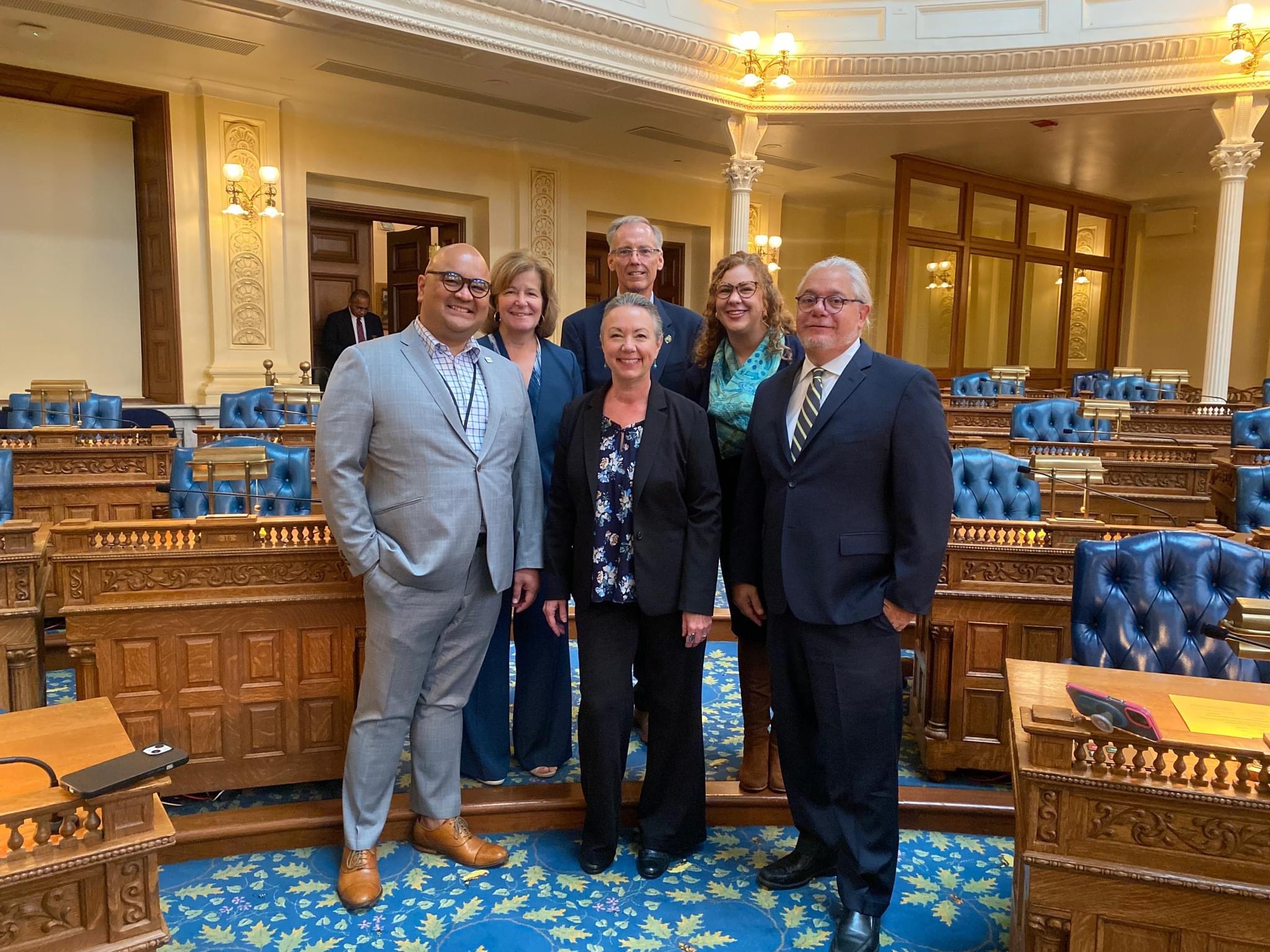
      According to the Food Research & Action Center, Summer EBT will bridge the gap and help stabilize summertime household food budgets for nearly 21.3 million children nationwide, including more than 500,000 of New Jersey’s children.

    With this in mind, three members of the NJ Office of the Food Security Advocate (OFSA) team traveled to Washington, D.C. to attend the 2024 National Anti-Hunger Policy Conference. Now back and unpacked, Rosemarie Loughlin, OFSA Program Coordinator, Dr. Jenny Schrum, OFSA Research and Evaluation Strategy Manager, and Jemmell’z Washington-Rock, OFSA Program Manager have compiled their list of top moments from the convening.

    Top 5 moments from the 2024 National Anti-Hunger Policy Conference:

    • Celebrating NJ’s Summer EBT efforts by participating in a panel, “Unlocking the Full Potential of Summer EBT: Supporting Implementation and Expanding Access.”  We learned that other states implementing the program face similar challenges on outreach and enrollment. Many states use approachable and culturally diverse outreach strategies to connect with eligible children and families. Panelists:

      Jessica Deitrich (she/her/hers) – Hunger Free Oklahoma
      Itzúl Gutiérrez – California Association of Food Banks
      Matt Stienstra (he/him/his) – Feeding America Eastern Wisconsin
      Jenny Schrum, PhD, MSW, MPH (she/her/hers) – NJ Office of the Food Security Advocate
      Kelsey Boone, MPP (she/her/hers) – Food Research & Action Center

    • Learning that current concepts of medically tailored meal emerged from 1980s-era food security efforts that focused on providing nutrition to individuals living with HIV. Will Thomas of Conduit Government Relations shared that history moment with a full room during the LGBTQIA2S+ Food Insecurity, Outreach, and Advocacy panel conversation that also featured:

      Houa Xiong, Gay, Asian, Lived/Living Experience, Advocacy, Non-Profit (he/him/his) – Hunger Free Oklahoma
      Lisa M. O'Brien (she/her/hers) – MAZON: A Jewish Response to Hunger, and
      Fleurian Filkins (they/them/theirs) – Feeding America National Organization

    • The presentation that offered an understanding of Kosher and Halal Food Equity within USDA Programs dietary requirements with education on the communities they support, training schools on how to meet student’s religious dietary and expanding outreach and technical assistance for kosher and halal meat processors, and the need of equity at USDA. Panelists:

      Dickran Jebejian – USDA Center for Faith Based and Neighborhood Partnerships, New York
      Ammar Ahmed – USDA
      Ben Marcus – USDA's Food and Nutrition Service, Virginia
      Alex Cordova – USDA

    • The Feeding Hope: Creating Protective Factors to Support Food Security and Mental Health session that underscored how the signs and symptoms of food insecurity or “Food and Mood” are often a natural and necessary adaptive response to stress and trauma. Signs can include trouble concentrating, hyperactivity, trouble socially and academic decline. Often a side effect of hunger can cause a boost of cortisol which is the body’s natural fight or flight response.  The fight or flight response in a child can result in hyperactivity and a child experiencing hunger may have negative behavior in school. Hunger can cause issues with mental health and wellness on multiple levels. Session panelists:

      Madeline Mortisch, MS, RDN – Alliance for a Healthier Generation
      Malissa G. Martin, BA, Same Houston State University, Executive Education, Kellogg School of Business, Northwestern University, New York University, SparkWheel
      Brittny L. Leowtewa, Zuni Youth Enrichment Project

    • Meeting colleagues engaged in housing services and connecting the intersection of housing and food security. The two social issues can have a significant impact on the other, so it is important to bridge that gap at conferences regarding policy change. This included a lunch panel with housing content. The speakers for this plenary session: 

      Christine Going, EdD, MPA, RD, FACHE, Senior Advisor, Food Security Office at U.S. Department of Veterans Affairs
      Dr. Ruth Jones Nichols, Senior Advisor to the Secretary of the U.S. Department of Housing and Urban Development
      USDA Deputy Under Secretary Stacy Dean

    Rose, Dr. Jenny and Jemmell’z also recorded a series of interviews and conversations across the three-day event. Watch the videos here.

    Plus: New Logo Celebrates the Power and Resilience of Communities, and the Spirit of Multi-Sector Collaboration in New Jersey

    May 2024

    The NJ Office of the Food Security Advocate (OFSA) is rooted in the ways we value community, and the visionary charge and mission of our office. Our new logo and website, www.nj.gov/foodsecurity, reflect the intentionality with which we approach our work.

    About the OFSA website: The website was developed with residents and neighbors, including youth, students, working families, and older adults, plus communities, researchers, grant makers and decision-makers all in mind. It serves as a convenient place to: 

    • Browse food security-related public data sources and funding opportunities, 
    • Follow original research coming from OFSA and its partners and leverage findings to inform local efforts and make the case for support, 
    • Reference the definition of food security and framework OFSA has adopted as a rallying point for our state, 
    • Navigate available emergency resources for New Jerseyans to get help with food for themselves or their families.

    OFSA logo

    About OFSA’s new logo: The concentric circles represent the energy and necessity of partnership and inclusion, the ongoing nature of collaboration and the broader, more comprehensive dimensions of food security that OFSA and a growing number of community organizations and coalitions across the state, the nation and in the international community are embracing.

    Like the six dimensions of food security, the colors emphasize that everyone has a part and a place in the food security conversation, even if they don’t understand their role yet. Together, we have:  

    • A warm brown, to honor the resourcefulness and resiliency of every New Jerseyan and uphold everyone’s dignity and agency. People are so much more than their past or present predicaments. 
    • Green, to celebrate NJ’s farmers, growers and food producers, and remember the sustainability of our food is intertwined with the environment. 
    • The official shades of blue associated with State of NJ government entities as a throughline to our peer agencies, departments and offices, and a callback to OFSA’s placement in the highest level of state government, the Governor’s Office. 
    • Yellow, for the optimism and opportunities to build and redesign systems and policies alongside residents so our current and future generations have what they need to thrive each day.  

    The silhouette of our great state is at the center of the circles, with the name of our office emerging from it. This speaks to our relentless pursuit of opportunities for informed innovation, such as reimagining what farm (and fishing net) to fork looks like in New Jersey, and bridging conversations across the food system, across industries and across state and local agencies so every resident personally feels, understands and determines their connection to our beloved nickname, the Garden State.

    Together, the circles are opening a path to an equitable future where food security is a reality for every individual, every family, every household, every community, municipality, borough, township, county, state and nation, regardless of their income level, zip code, age, ethnicity, abilities, educational background or employment status.

    This equitable future is also where… 

    …There is no stigma around accessing support for basic needs, such as transportation or utilities assistance, and 

    …Communities have greater capacity to build resiliency, reclaim their agency in advocating for themselves and their neighborhoods, promote positive childhood experiences and ultimately, heal themselves. 

    December 2023

    Having demonstrated a commitment to going above and “beyond food,” like-minded pantry leaders whose teams also help neighbors access clothing programs, legal services and job training programs, and whose facilities also double as ESL classrooms and health screening sites, met in Trenton in December 2023 to launch a series of interactive peer learning days with the More Than Food: NJ Community Food Hub Capacity Project. 

    Thirteen community-based, anti-hunger organizations that have agreed to participate in this project, some of the state-designated food banks, and the New Jersey Office of the Food Security Advocate (OFSA) team explored an initial analysis of existing opportunities within NJ’s food pantry and food bank landscape conducted by More Than Food Consulting (MTFC). Recognized as national experts on charitable food and emergency feeding approaches, the MTFC team of principal Katie S. Martin, Ph.D. and Malarie McGalliard will provide individualized technical assistance to each pantry to build their capacity for enhancing their operations in three particular areas: a welcoming culture, healthy choice and community connections – all with neighbors’ input guiding their work. By the end of this project, the state will have established a baseline that can move this collective work forward so every current and future New Jerseyan is food secure everyday, regardless of their income, age, educational attainment or neighborhood.

    November 2023

    It’s affirming to know that student success officers, campus pantry directors, Deans, Provosts and colleagues at community colleges, four-year universities and technical programs are having conversations that parallel those that best-in-class anti-hunger organizations are having about food security work and basic needs supports. Jemmell’z Washington-Rock, OFSA Program Manager, participated in the Basic Needs in Higher Education conference that focused on older students, parenting learners, low-income students, Pell grant recipients and others, with a keynote by Dr. Sara Goldrick-Rab, Senior Fellow at Education Northwest. 
     
    The day included breakouts and share outs of innovations that campuses have piloted such as meal scholarship/voucher initiatives and messaging/faculty engagement campaigns. Also, the NJ Office of the Secretary of Higher Education facilitated conversations and sought these committed administrators’ input about the tools, funding and information they still need to help students enroll in SNAP, find safe, stable, humane housing in a crisis or even afford their textbooks and receive them in a timely manner. 

    According to the Hunger Free campus report of 8600 NJ students that was presented at the convening, 44% of first-generation students self-identified as food insecure. Also, genderqueer students, those from other historically marginalized backgrounds and non-traditional students face higher levels of food insecurity. 

    Ultimately, it’s going to take all of us to link scholars to the resources they’re telling us they need to change the trajectory of their lives and communities by completing their educational goals. 

    Visit the OSHE website and the Basic Needs.gov site. 

    October 2023

    "Historically, in child welfare circles, all too often, allegations of ‘neglect’ are a coded way of saying that a family is dealing with the effects of poverty. The issue isn't that a parent is withholding some physical or emotional need from their child, but that the family has an unmet material need resulting from having little to no income.  
     
    The intention of child welfare is to uplift the child, youth, and the entire family. In New Jersey, we're looking for ways to do that in a healing-centered, trauma-informed way." 

    -- Excerpted from the 2023 The Intersection of Race, Poverty & Neglect in Child Welfare conference program 
     
    During the 2023 Intersection of Race, Poverty & Neglect in Child Welfare conference presented by the New Jersey Taskforce on Child Abuse and Neglect and the New Jersey Department of Children and Families, OFSA and The Franklin Food Bank partnered in discussing how holistic food security work can be an entry point to serving families’ basic needs and possibly helping them avoid system involvement.  
     
    Derek Smith, Executive Director of the Franklin Food Bank and Dr. Jenny Schrum, OFSA Research and Evaluation Strategy Manager, held one-on-one “connecting conversations” with social workers, family advocates and representatives from youth-serving organizations and other service providers who attended the conference. They also shared forward-thinking language regarding food security and how food pantries like the Franklin Food Bank are operationalizing their “beyond food” efforts and building multi-sector partnerships to contribute to this broader, shared work of helping communities heal themselves.  
     
    View an interview here.