 Official Site of The State of New Jersey

About Food Security in New Jersey
Food security is a complex social condition with continually changing and interacting factors and underlying causes. There are multiple ways to define and measure food security. The New Jersey Office of the Food Security Advocate (OFSA) has adopted a definition from the United Nations’ High Level Panel of Experts (HLPE) on Food Security and Nutrition found in the Food Security and Nutrition: Building a Global Narrative Towards 2030 report.
“Food security exists when all people, at all times, have physical, social, and economic access to sufficient, safe, and nutritious food which meets their dietary needs and food preferences for an active and healthy life.”
This definition takes into account six dimensions of food security that ground the work and research of OFSA. The six dimensions are availability, access, utilization, stability, agency, and sustainability. Food insecurity may result from limitations in any of the six dimensions because they all depend on and interact with each other.
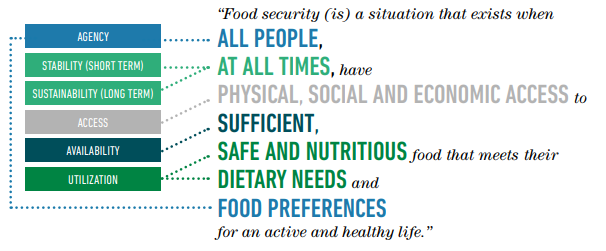
Source: HLPE. 2020. Food security and nutrition: building a global narrative towards 2030. A report by the High Level Panel of Experts on Food Security and Nutrition of the Committee on World Food Security, Rome.
The Six Dimensions of Food Security
Focusing on a single indicator or dimension of food security can give an incomplete picture of this complex and dynamic social issue, therefore understanding and measuring the different dimensions of food security is an important step to having a more holistic understanding of the food security status of different populations and therefore can provide better guidance in decision-making. Learn more about the six dimensions of food security and explore existing New Jersey work across each dimension in OFSA’s Food Security in New Jersey: A Primer on the Six Dimensions of Food Security.
Availability is the physical presence of foods - Availability refers to individuals having enough quantity, sufficient quality, and nutritional foods physically present in a person’s environment. This includes the supply and distribution of foods at stores, markets, gardens, and other places where individuals obtain food.
Access is the resources and means to obtain foods - Access refers to individual or household resources and means needed to obtain appropriate and nutritious foods. This includes both economic and physical resources. This dimension also takes into account the level of resources needed to ensure that access to food does not compromise satisfactory access to other basic needs like housing or health care.
Utilization is the intake of sufficient and safe foods - Utilization refers to the intake of sufficient and safe food and water to meet nutritional needs. This includes individuals' knowledge, skills, and confidence to plan meals and buy, prepare, and cook foods. It also includes their access to food safety knowledge, skills, tools, and resources.
Stability is the reliable supply of foods over time - Stability in food security refers to maintaining adequacy in food availability, access, and utilization over time. Stability includes the ability to ensure the other dimensions of food security are maintained in the event of sudden, short-term shocks, and through cyclical or seasonal changes. For example, the ability to maintain food availability, access, and utilization during a seasonal job layoff, onset of a health condition, periods of inflation, or through a natural disaster. Stability differs from the dimension of sustainability in that stability refers to shorter-term disruptions rather than the long-term sustainability of the food system.
Agency is the power to make decisions about foods eaten and produced - As a dimension of food security, agency refers to individuals’ and communities’ capacity to make decisions and take actions to shape their own relationships with food and food systems. This includes making choices about what they eat, the foods they produce, and how that food is produced, processed, and distributed. Agency also includes the power to engage, in their own terms, in governance structures and policy processes that shape the food system, as well as the ability to address power imbalances within the system.
Sustainability is the food system’s ability to provide long-term food security - Sustainability refers to food system practices that contribute to long-term regeneration of natural, social, and economic systems, ensuring the food needs of the present generations are met without compromising food needs of future generations. Sustainability encompasses the connections between the environment, the economy, society, and the political landscape to maintain food systems and support food security into the distant future.
Explore New Jersey Food Security Information in our Resource Library
Learn more about food security in New Jersey in our resource library.
The State of Food Security in New Jersey
Food insecurity is defined by the U.S. Department of Agriculture (USDA) as a household having a lack of access, at times, to enough food for an active, healthy life for all members of a given household, and limited or uncertain availability of nutritionally adequate foods. USDA measures food insecurity in the U.S. and for each state at the household level.
This USDA measure provides valuable national- and state-level information on households’ food security status related to their economic access to food.
USDA Household Food Security in the United States in 2024
Averaging 2022-2024 data:
- New Jersey recorded the 5th lowest prevalence of household food insecurity in the U.S.
- New Jersey’s prevalence of household food insecurity (9.8%) is lower than the U.S. (13.3%).
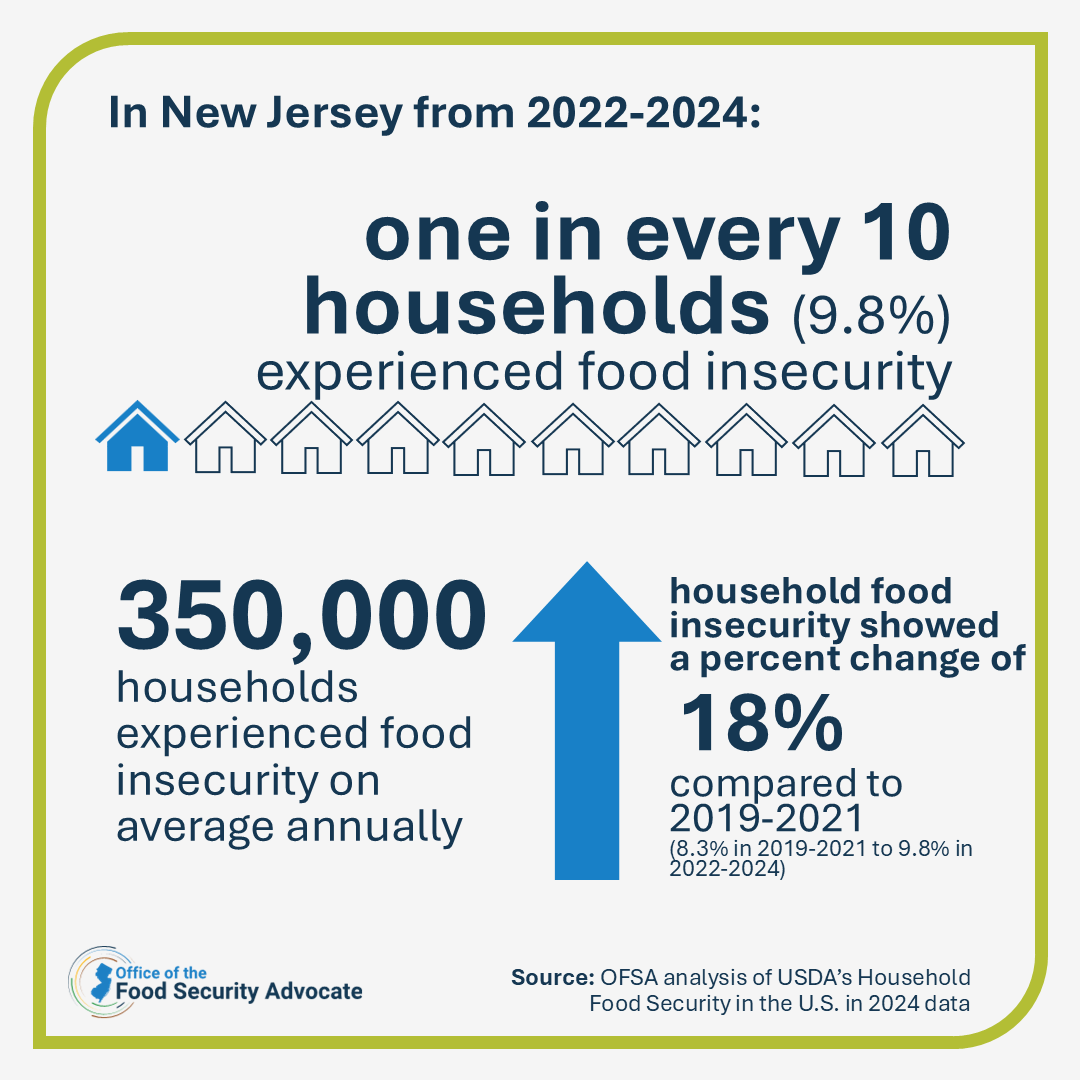
- Yet, one in every ten households, about 350,000 households, experiences food insecurity in New Jersey.
- The prevalence of food insecurity is increasing in New Jersey. Food insecurity increased from 8.3% of households in 2019-2021 to 9.8% in 2022-2024, an increase of 18%.
- As evidenced by national trends, the rate of food insecurity is higher in households with children compared to households without children and higher among Black and Hispanic households compared to White households.
Quick Facts
Definition: Households having a lack of access, at times, to enough food for an active, healthy life for all members of a given household and limited or uncertain availability of nutritionally adequate foods
Prevalence in New Jersey: 9.8%
Latest Year of Data: 2024 data
Trends: Getting Worse. Food security increased by 18% from 8.3% in 2019-2021 to 9.8% in 2022-2024.
Associated Food Security Dimensions: Access
Methodology
Methodology: The household food insecurity rate is a percentage. It is an analysis of household-level survey data collected by the US Census Bureau’s Food Security Supplement to the Current Population Survey.
Numerator: The number of households reporting three or more food insecure conditions, weighted to account for nonresponse bias.
Denominator: The total number of surveyed households.
Data source: USDA Household Food Insecurity in the United States in 2024