Official Site of The State of New Jersey
Strategic Plan for Food Security in New Jersey
Food insecurity is a complex social condition with broad implications for public health, economic mobility, equity, and long-term resilience. Since beginning its work in 2022, the New Jersey Office of the Food Security Advocate (OFSA, the Office) has strengthened collaborative efforts to address New Jerseyans’ every day and long-term food needs.
Guided by its mandate to coordinate statewide efforts and address unmet needs, OFSA convened partners across sectors to co-develop the New Jersey Food Security Strategic Plan (Strategic Plan) released on February 13th, 2026. This Strategic Plan is a three-year framework designed to guide coordinated, cross-sector action to advance food security for all New Jerseyans.
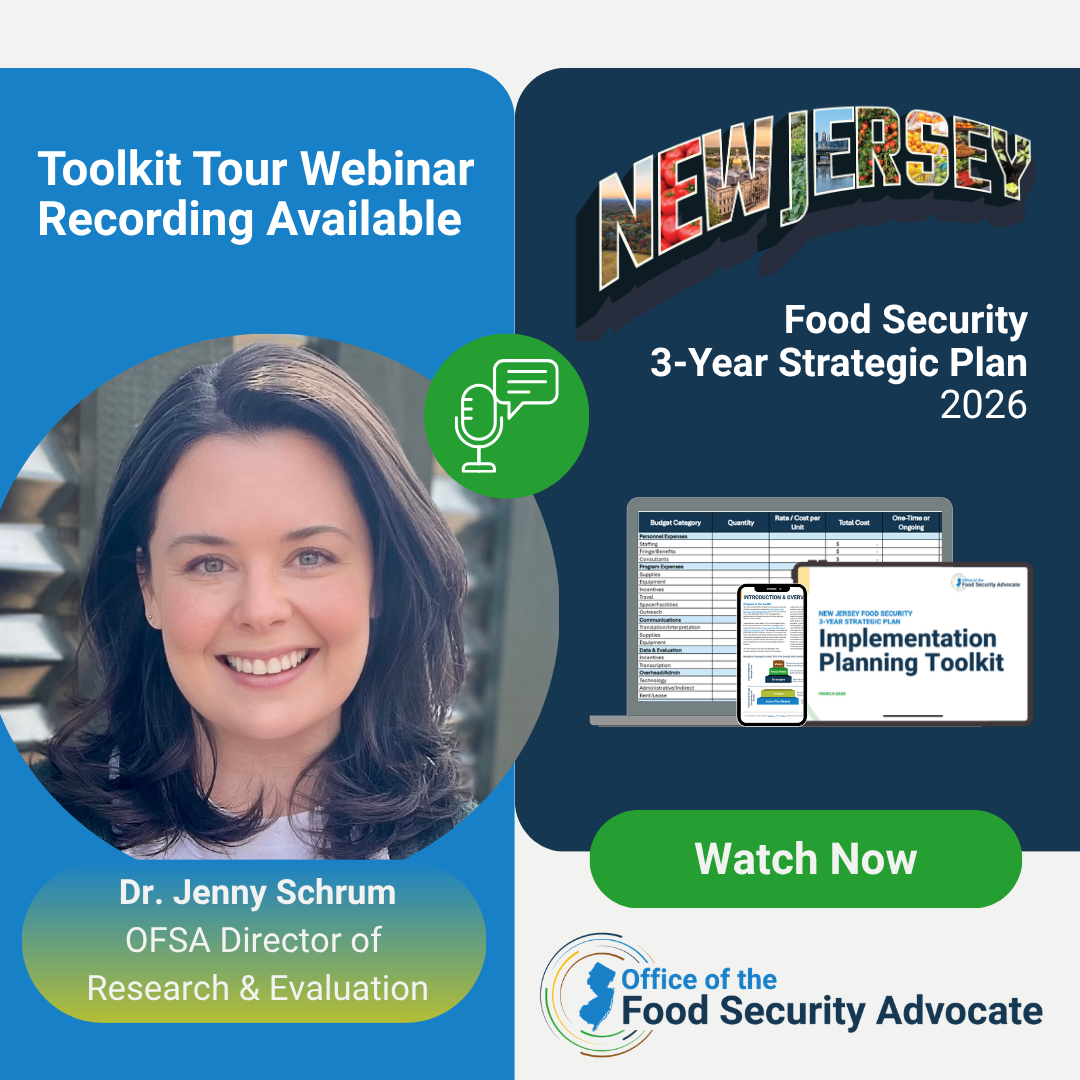
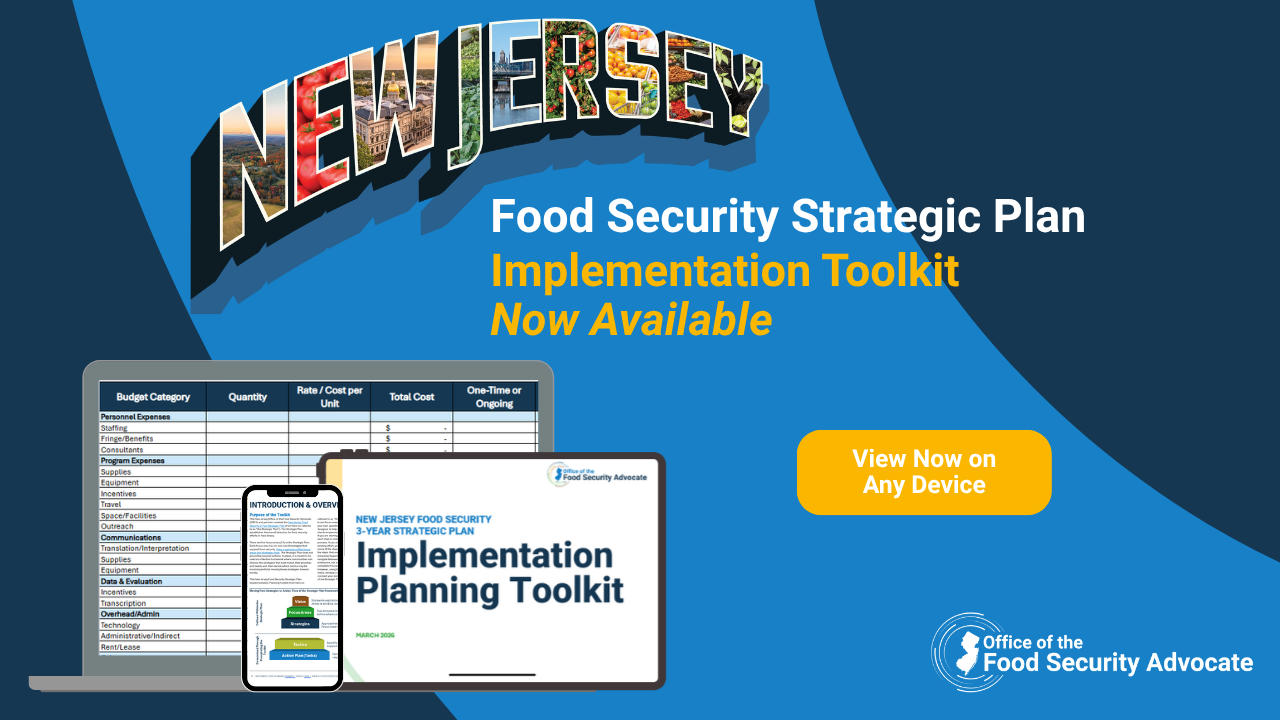
Released on March 24, 2026, the Strategic Plan Implementation Planning Toolkit (Toolkit) contains a step-by-step process and customizable templates to help communities move from the focus areas outlined in the Strategic Plan to specific, coordinated action plans. It is designed to help users think through a program from idea to implementation. OFSA designed and released the Toolkit to support a statewide, multi-sector movement from the shared vision in the Strategic Plan to collective action.
On Tuesday, October 13, OFSA will host the third annual 2026 Garden State Conference on Food Security to share updates on OFSA initiatives (including the Strategic Plan, 2026 Commitment submissions, and more) and deepen understanding of food security across the life course through plenary sessions, cross-sector networking, and breakout panels. This signature event will convene people, organizations and sectors dedicated to improving food security across the state now and well into the future.
OFSA received NJ Commitments for Food Security (Commitments) for 2026 programs that advance the Strategic Plan. Submissions document and celebrate how organizations are activating the Strategic Plan and help strengthen alignment, communication, and visibility across New Jersey. This Commitments process will re-open and continue next year (2027).
Dive Into the Strategic Plan & Implementation Resources
Inside the Strategic Plan

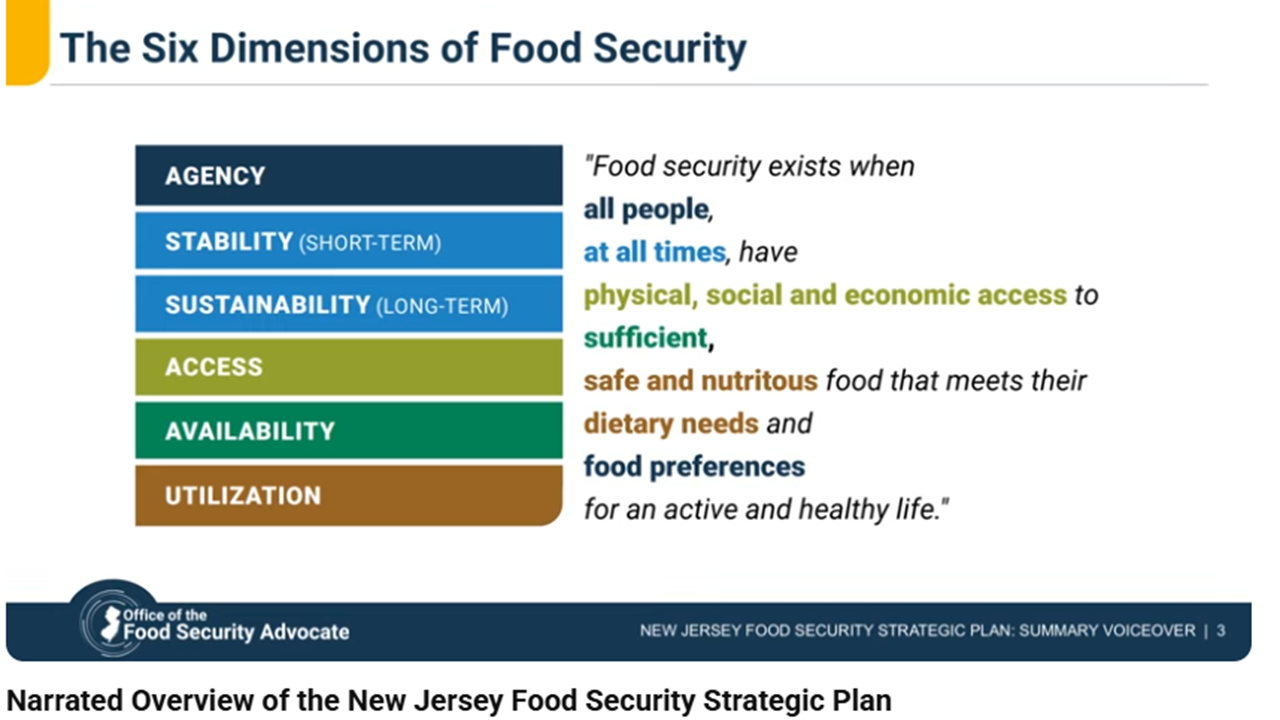
Establishes a shared understanding of food security across the state, introduces the Six Dimensions of Food Security Framework, and outlines OFSA’s legislative mandate and the broader context shaping New Jersey’s food security work.

Describes the guiding principles and evidence base that informed the Strategic Plan. Documents the inclusive development process and summarizes key findings from foundational research, including Exploring the Six Dimensions of Food Security in New Jersey report.

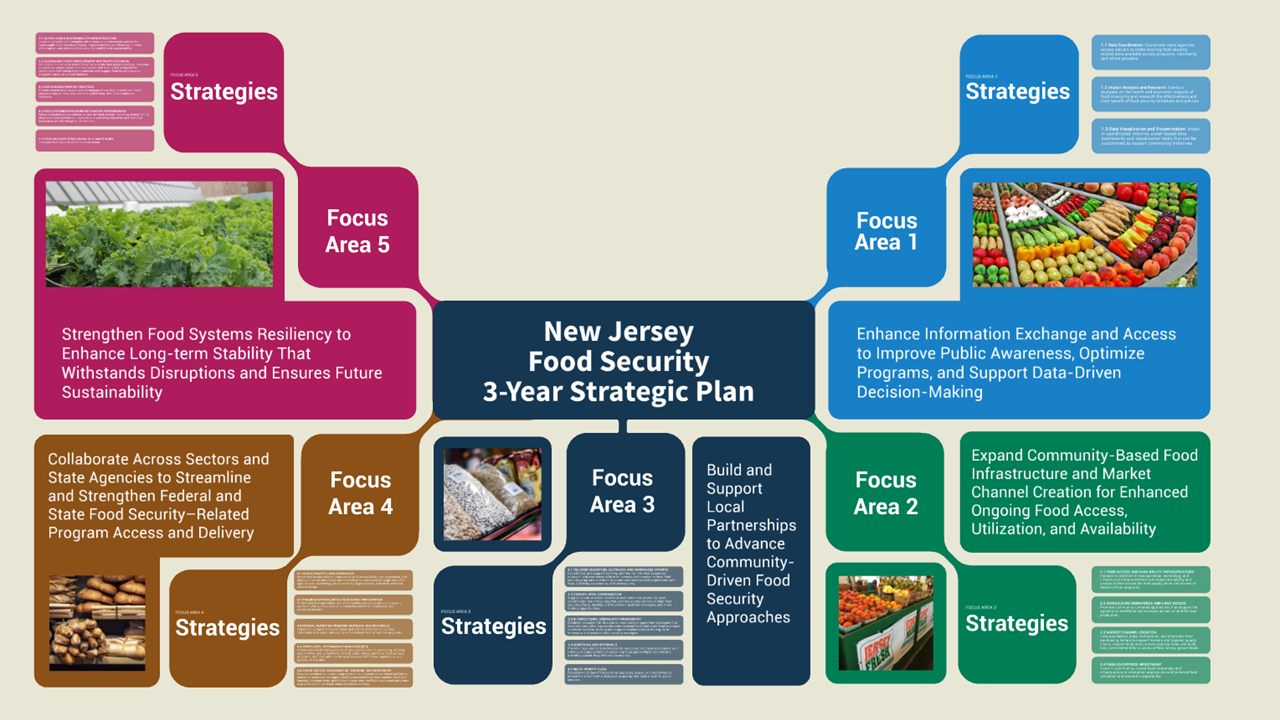
Outlines the Strategic Plan’s focus areas and strategies, which together provide a structured yet flexible roadmap for advancing food security across its six dimensions statewide, reinforcing a collaborative, coordinated approach.

Defines what success looks like for the Strategic Plan and emphasizes shared responsibility across sectors to use the Strategic Plan as a guiding framework for coordination, planning, policy development, and investment.
- Data Coordination: Coordinate state agencies across sectors to make existing food security–related data available across programs, voluntarily and where possible.
- Impact Analysis and Research: Conduct analyses on the health and economic impacts of food insecurity and research the effectiveness and cost-benefit of food security initiatives and policies.
- Data Visualization and Dissemination: Invest in coordinated, intuitive, asset-based data dashboards and visualization tools that can be customized to support community initiatives.
- Food Access and Availability Infrastructure: Increase investment in transportation, technology, and infrastructure improvements to increase availability and access to food across the food supply chain and access to food/nutrition programs.
- Agriculture Workforce and Land Access: Promote community-centered approaches that support the agricultural workforce and increase access to land for food production.
- Market Channel Creation: Leverage federal, state, institutional, and charitable food purchasing dollars to support farmers and regional supply chains, expand local procurement opportunities, and build long-term demand for a variety of New Jersey-grown foods.
- Food Enterprise Investment: Invest in community-rooted food enterprises and infrastructure to strengthen appropriate and preferred food utilization and economic opportunity.
- Tailored Education, Outreach, and Awareness Efforts: Launch new, and support existing, community-informed education, outreach, and awareness efforts to increase participation in local food security programs and build trust and partnerships with populations with lived and living experiences of food insecurity.
- County-level Coordination: Support action-oriented local food coalitions through county-level coordination that brings together partners across sectors to align food security efforts, develop and implement localized strategies, and share funding opportunities.
- Bi-directional Community Engagement: Establish consistent bi-directional community engagement strategies that feed into strengthening coordination between local and state food coalitions to inform decision-making and support implementation of long-term innovative and scalable food security strategies.
- Screening and Referrals: Provide cross-sector data integration, resources, technical assistance, and training to organizations on screening for program eligibility/need and providing closed-loop referrals to services.
- Multi-benefit Hubs: Establish multi-benefit hubs of various sizes, scales, and modalities to streamline enrollment and access to appropriate food and other social services.
- Public Benefit User Experience: Implement locally tailored improvements in accessibility, user experience, and dignity in benefit enrollment and recertification processes through simplified applications, technology advancements, digital access, and client-centered service design.
- Program Opportunities to Enhance Participation: Protect and leverage federal and state funding and policy options to expand outreach efforts, modernize and streamline enrollment processes, and maximize benefits.
- Federal Nutrition Program Outreach and Referrals: Implement comprehensive outreach and referral initiatives to connect individuals with state- and county-administered federal nutrition programs.
- State-level Interagency Work Group(s): Create state-level interagency work group(s) focused on protecting, aligning, coordinating, and streamlining federal, state, county, and local food security programs, and their administrative processes, definitions, regulations, and policies, where able.
- Cross-sector Coordination, Training, and Resources: Provide coordination, cross-program training, interconnected digital platforms, and other resources to support staff across workforce development, Medicaid, housing, transportation, public health programs, and food assistance programs to provide client-centered, comprehensive services.
- Supply Chain Sustainability Infrastructure: Invest in tangible and intangible infrastructure improvements across the food supply chain to reduce waste, improve distribution efficiency in times of disruption, and enhance food security stability and sustainability.
- Sustainable Food Procurement and Waste Diversion: Educate and incentivize institutional, large-scale food generators (e.g., hospitals, universities, corporations, and businesses with food retail) to implement sustainable food procurement practices and support food waste diversion programs, prioritizing food donation.
- Sustainable Farming Practices: Promote incremental sustainable farming practices that improve soil health, conserve natural resources, and strengthen long-term food production resilience.
- Food Distribution Network Disaster Preparedness: Enhance disaster preparedness across the food system, including strengthening charitable food distribution networks and providing education and technical assistance on risk mitigation for farmers.
- Food Security Positioning in Climate Work: Integrate food security within climate action.
Open Call: New Jersey Commitments for Food Security
OFSA invites organizations, agencies, coalitions, institutions, businesses, and community partners to submit NJ Commitments for Food Security (Commitments) for their programs that support the Strategic Plan.
Commitments help connect individual program efforts to a broader statewide vision for coordinated action, shared learning, and collective impact.
Commitments build off the final action-planning step as part of the Toolkit and are intended to support implementation across sectors, regions, and the five Strategic Plan focus areas.
Submissions will document and celebrate how organizations are activating the Strategic Plan and help strengthen alignment, communication, and visibility across New Jersey.
Submissions for the inaugural call for Commitments are now due August 7, 2026. Accepted Commitments will be notified and publicly announced and celebrated as part of OFSA’s Annual Conference in October 2026.
OFSA will announce a call for Commitments annually.
- Learn more about the New Jersey Commitments for Food Security
- Explore Questions and Answers about the Commitments process
- Submission will re-open for the 2027 Call for Commitments
- Write to OFSA@ag.nj.gov for support or assistance related to the Commitments process
Join the Movement toward New Jersey Food Security
Advancing food security is about more than food, it is about dignity, equity, health, resilience, and opportunity. This Strategic Plan will only succeed if every sector sees themselves in it and takes action.
- Explore the full Strategic Plan to inform and strengthen your food security work.
- Use the Implementation Planning Toolkit to coordinate your work with the multi-sector, statewide food security work in the coming year.
- Watch an informational webinar here to learn more about the Implementation Planning Toolkit.
- Sign up for Strategic Plan updates and implementation tools.
- RSVP to the Garden State Conference on Food Security
Together, we can build a more coordinated, equitable, and resilient food system, one that ensures all New Jerseyans have access to adequate food, now and in the future.