Official Site of The State of New Jersey
Fusion is distinct from the fission process used in most existing nuclear power plants.
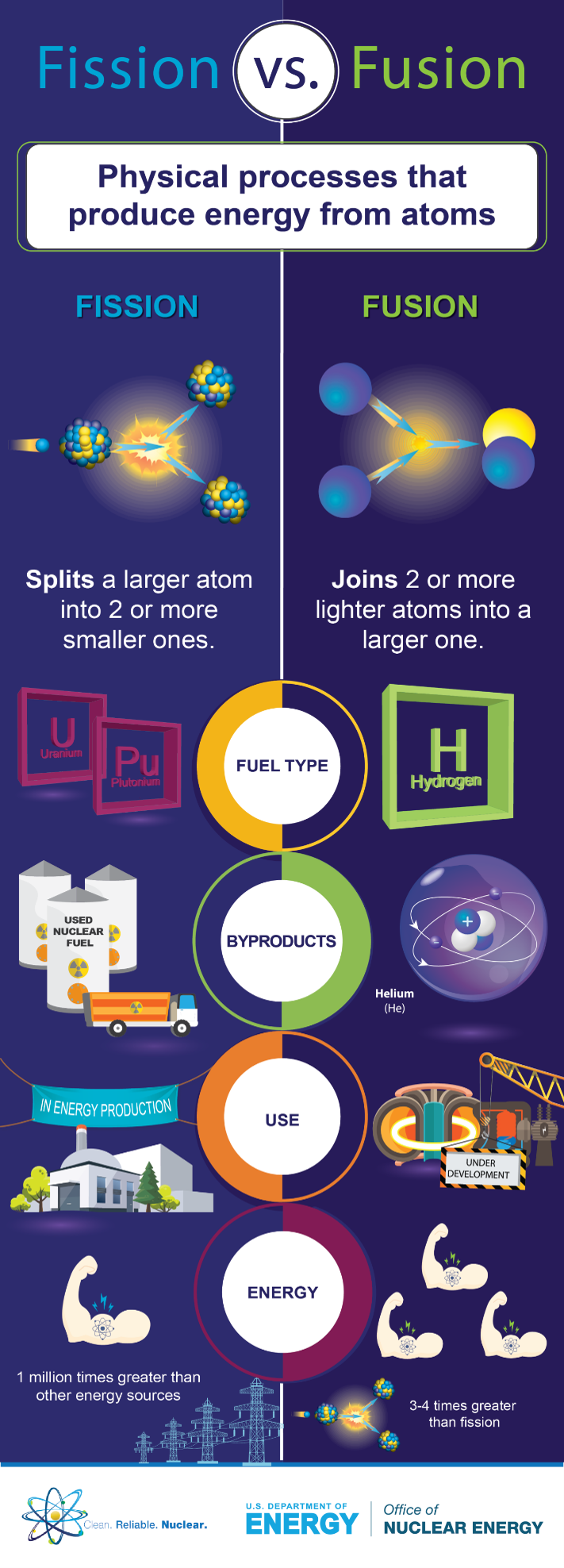
- Fission releases energy by splitting heavy atoms, while fusion releases energy by joining light atoms together—the same process that powers the sun.
- Fission reactors use a controlled chain reaction involving uranium fuel, while the leading fusion concepts use forms of hydrogen as fuel and require carefully maintained conditions for the reaction to continue. If those conditions are interrupted, the fusion reaction stops.
Both fission and fusion can produce large amounts of energy without carbon emissions during operation. Unlike fission, fusion does not produce highly radioactive by products.
Fusion is still in the research, demonstration, and early commercialization stage and is not yet available for electricity generation, but it is an important emerging energy technology with significant long-term potential.
To sustain fusion reactions on Earth, the fuel must be heated to extremely high temperatures, creating a state of matter called plasma. Plasma is a hot, electrically charged gas. Sophisticated technologies are needed to heat, confine, and control this plasma long enough for fusion reactions to occur.
Source: U.S. DOE
Fusion in New Jersey
New Jersey is home to leading fusion research, development, and manufacturing capabilities. Its research institutions, technical workforce, and growing fusion supply chain position the State to support opportunities in fusion research, demonstration, manufacturing, and commercialization alongside its work on advanced nuclear fission.
- Right in Central Jersey, the U.S. Department of Energy’s Princeton Plasma Physics Laboratory (PPPL) is a national lab with more than 600 employees focused on tackling the toughest science and technology challenges using plasma.
- NJEDA has partnered with venture capital firm SOSV and PPPL to create a new Strategic Innovation Center in the Princeton area. The NJ HAX Plasma Forge will leverage the world-class research conducted by PPPL and SOSV’s robust investment experience to bolster plasma-focused startup creation and acceleration, promote industry collaboration, and commercialize groundbreaking technologies in an emerging economic sector.
The HAX Plasma Forge will include up to 10,000 square feet of lab and co-working space close to PPPL’s facility in the Princeton area, with equipment, staff and infrastructure suitable for low-temperature plasma research, which is essential to semiconductor manufacturing processes, and fusion supply chain development. Princeton-based SOSV will operate the SIC in collaboration with PPPL, providing up to $24.5 million in seed funding to startup companies located in the SIC and engaging with established industry leaders to work alongside entrepreneurs and researchers.
Events
New Jersey Economic Development Authority supported the Fusion Supply Chain Workshop, which was organized by the Fusion Industry Association, PPPL and the Stellar Energy Foundation. More than 100 experts from around the world joined the conference, hosted by Rutgers University on June 17-18, 2025 to talk about current challenges and to propose solutions for developing a robust supply chain.
- A full summary of the workshop is available here.
- Subsequently, PPPL received an award from the Federal Laboratory Consortium recognizing the Fusion Supply Chain Workshop for Innovation in Tech Transfer.
In April 2026, Governor Sherill joined Acting Labor Commissioner Kevin Jarvis at Princeton Plasma Physics Laboratory to kickoff National Apprenticeship Week. PPPL's groundbreaking registered apprenticeship program is focused on fusion energy and engineering, a first of its kind in the nation. Launched in 2019 with support from the US Department of Energy and the New Jersey Department of Labor’s (NJDOL) Growing Apprenticeship in Nontraditional Sectors (GAINS) grant program, the initiative trains technicians to build and operate fusion reactors, the leading edge of clean, carbon-free energy development. PPPL's inaugural apprenticeship class graduated in November 2023, with the New Jersey Department of Labor and Workforce Development (NJDOL) providing critical GAINS funding to PPPL for the fifth consecutive year.