 |
 |
| MOTORISTS
in New Jersey MUST
stop for pedestrians in a marked crosswalk.
Failure to observe the law may subject you to
one or more of the following: |
|
 |
2
POINTS |
|
|
$200
FINE
(plus court costs) |
|
|
15
DAYS COMMUNITY SERVICE |
|
|
INSURANCE
SURCHARGES |
|
|
NEW
JERSEY STATUTE 39:4-36
Driver
to stop for pedestrian:
exceptions, violations. penalties. |
| |
| |
A.
The driver of a vehicle
must stop and stay stopped for a pedestrian
crossing the roadway within any marked
crosswalk, but shall yield the right-of-way
to a pedestrian crossing the roadway within
an unmarked crosswalk at an intersection,
except at crosswalks when the movement
of traffic is being regulated by police
officers or traffic control signals, or
where otherwise prohibited by municipal,
county, or State regulation, and except
where a pedestrian tunnel or overhead
pedestrian crossing has been provided,
but no pedestrian shall suddenly leave
a curb or other place of safety and walk
or run into the path of a vehicle which
is so close that it is impossible for
the driver to yield. |
|
|
| |
Whenever
any vehicle is stopped to permit a pedestrian
to cross the roadway, the driver of any
other vehicle approaching from the rear
shall not overtake and pass such stopped
vehicle. |
|
|
| |
Every
pedestrian upon a roadway at any point
other than within a marked crosswalk or
within an unmarked crosswalk at an intersection
shall yield the right-of-way to all vehicles
upon the roadway. |
| |
|
| |
B.
A person violating this
section shall, upon conviction thereof,
pay a fine to be imposed by the court
in the amount of $200. The court may also
impose a term of community service not
to exceed 15 days. |
| |
|
| |
C.
Of each fine imposed and
collected pursuant to subsection B. of
the section, $100 shall be forwarded to
the State Treasurer who shall annually
deposit the moneys into the “Pedestrian
Safety Enforcement and Education Fund”
created by section 1 of PL 2005, c 84
(C.39:4-36.2) |
| |
|
|
PEDESTRIANS
MUST obey pedestrian signals
and use crosswalks at signalized intersections.
Both carry a $54.00 fine for failure to observe
the law.
(C.39:4-32 and 33) |
| |
|
| |
| New
Jersey experiences a disproportionate number
of pedestrian injury crashes and fatalities
compared to the nation as a whole. To combat
the problem, the Division of Highway Traffic
Safety assists local and county agencies in
the development of comprehensive pedestrian
safety programs involving Education, Enforcement,
and Engineering. |
|
| The
Education component of the pedestrian program
involves getting the pedestrian safety message
to all members of the community, with a special
emphasis on three high-risk groups: children,
senior citizens and non-English speaking residents.
|
|
| The
Enforcement component involves targeted police
patrols at high pedestrian-crash locations in
the community. During these patrols warnings
and summonses are issued to motorists and pedestrians
whose actions put pedestrians at risk. Stop
for pedestrian and jaywalking laws are emphasized. |
|
| The
Engineering component provides traffic engineering
assistance such as enhanced crosswalk striping
and signs. |
|
| Comprehensive
Pedestrian Safety Grants funded by the Division
have been very successful. On average, participating
municipalities have seen a [20-percent first
year] reduction in crashes involving pedestrians. |
|
| The
most important pedestrian safety message for
New Jersey residents is: Pedestrian Safety is
a Shared Responsibility |
|
| There
is no one cause of crashes involving pedestrians.
Pedestrians and motorists must both do their
part to keep pedestrians safe. |
|
| Pedestrians: |
|
|
|
| Motorists:
|
|
|
|
| Children
and senior citizens are at a higher risk of
being struck by a motor vehicle. Special emphasis
must be made to educate children and seniors
about the importance of walking safely. |
|
| Children: |
|
|
|
| Seniors: |
|
Walk
on sidewalks and cross only at corners,
within marked crosswalks where available.
|
|
|
If
crossing in other locations, yield the
right of way to vehicles. Failure to obey
the law carries a $54 fine (court costs
additional; C.39:4-32, 33) |
|
|
|
Always
walk facing traffic. |
|
|
|
Wear
bright-colored or reflective clothing,
especially at night. |
|
|
Look
left, right and left again before crossing
and be on the lookout for turning vehicles.
|
|
|
Make
eye contact with the driver before crossing
in front of a vehicle. |
|
|
Learn
the proper use of “Walk/Don’t
Walk” signals. |
|
|
Use
the buddy system. Walk and cross with
others when possible. |
|
|
If
possible do not walk at night or during
bad weather such as snow, rain or ice. |
|
|
| Links: |
|
 |
Be Street Smart
Street Smart is New Jersey’s pedestrian safety program. Their comprehensive web site contains information, resources, education and news that focuses on reducing pedestrian/motor vehicle crashes in New Jersey.
|
|
|
|
Crosswalk
Warning Palm Card - This palm card is being used throughout New Jersey by law enforcement officers to educate motorists and pedestrians about the pedestrian law. |
|
|
|
How to Implement the Street Smart NJ Pedestrian Safety Campaign in Your Community
Developed for use by municipalities statewide, this booklet provides information to help communities create a pedestrian safety campaign targeting both pedestrians and drivers. It covers all facets of implementing the campaign from data analysis and selection of pedestrian safety hot spots to grassroots community outreach and evaluation. |
|
|
|
NJ
Walks and Bikes -
Bicycle and Pedestrian Newsletter |
|
|
Pedestrian
Safety Crosswalk Law video -
A
30-second TV PSA providing information
on pedestrian safety, including
the "Stop and Stay Stopped"
law, which became effective in New
Jersey on April 1, 2010.
English l Español
|
|
|
Pedestrian Safety Palm Card
Developed as part of Street Smart, New Jersey's pedestrian safety program, this palm card contains pedestrian law information for both motorists and pedestrians as well as a tip section that will help keep "Garden State" residents safe while traveling on foot. |
|
|
|
Railroad
Crossing Safety -
Safety tips, links and sign information
for motorists, pedestrians and bicyclists
about how to safely pass through
a railroad crossing |
|
|
|
Safe
Routes Scoop - A newsletter
that promotes safe and healthy walking
and biking to school in New Jersey. |
|
|
Safe
Routes to School for Law Enforcement
- A
website launched by NHTSA aimed
at providing local law enforcement
with the information and resources
necessary to help support or start
a successful Safe Routes to School
program. |
|
|
|
School
Zone...Danger Zone
-
Developed by the Municipal Exchange
Liability Joint Insurance Fund (MEL),
this 10 minute 48 second video points
out how important it is for parents
to know and follow their school's
student drop off plan, understand
and convey to their children the
function of school crossing guards,
and serve as positive role models
by adhering to and reinforcing traffic
safety laws. English
l Español
|
|
|
|
"School
Zone...Danger Zone" Tip Sheet
-
Parents can print out this one-page
tip sheet, designed to accompany
the School Zone..Danger Zone"
video, and use it to facilitate
a discussion about traffic safety
with family members.
English l Español |
|
|
|
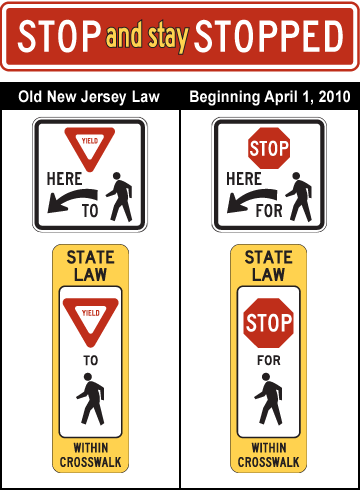
Stop
and stay Stopped Flyer - At
8.5" x 11", this flyer
illustrates the signage differences
brought about by the new "Stop
and stay Stopped" law. |
|
|
| |
|
|
| |
|
|
|




