 Official Site of The State of New Jersey
NJSLA-Adaptive and NJGPA-Adaptive Frequently Asked Questions (FAQs)
The following FAQs provide guidance and information based on common questions the Office of Assessments has received from local educational agencies (LEAs) and approved private schools for students with disabilities (APSSDs) following the announcement of the state’s new statewide assessments in English language arts (ELA) and mathematics.
This FAQ will be updated as additional questions are received and additional information becomes available.
-
What are the new statewide assessments?
The New Jersey Student Learning Assessments-Adaptive (NJSLA-A) and New Jersey Graduation Proficiency Assessment-Adaptive (NJGPA-A) are New Jersey’s updated platform for measuring student learning, supporting instructional improvement, and meeting State and federal assessment requirements.
-
Why is the State implementing a new assessment?
New Jersey has implemented new adaptive assessments to provide a more personalized testing experience for students, more timely data, and to align the assessments more closely with the 2023 New Jersey Student Learning Standards (NJSLS) for English Language Arts (ELA) and Mathematics.
-
What accommodations are available to students for the NJSLA-A and NJGPA-A administrations?
The accommodations available on the new test are consistent with the supports that were available prior NJSLA and NJGPA tests. Students will have access to a variety of digital tools and accommodations, including, but not limited to:
- American Sign Language*
- Braille*
- Extended time
- Highlighting and digital notetaking
- Paper versions of the assessment*
- Text-to-speech
- Speech-to-text response
- Zoom/magnification
*Indicates that the accommodation is not adaptive.
The accommodations available on the new test are consistent with those used on prior NJSLA and NJGPA tests.
A list and description of the available accommodations (referred to as Testing Attributes) can be found in the Testing Attributes Reference Manual (TARM) or on the New Jersey Assessments Portal Resources page by searching “attributes.”
-
How will the test be presented to my student who requires the American Sign Language (ASL) accommodation?
Students with the ASL accommodation will be able to open and play an embedded ASL video for all aspects of each item on the non-adaptive accommodated form, consistent with prior statewide assessments.
-
Do accommodations change whether a student is taking a computer-adaptive assessment?
All accommodations—except when a student uses a paper test—work within the computer-adaptive test. Students who use supports such as text-to-speech, ASL videos, color contrast, or extended time still take the adaptive assessment. The paper version is not adaptive.
-
Are mathematics assessments available in Spanish or other languages?
The mathematics assessment will be available in English and Spanish.
-
What is an adaptive test, and what are the benefits to students?
A computer-adaptive test (CAT) is an assessment tool that determines future questions based on a student's responses to prior questions, creating a more personalized experience for each learner. This approach can help reduce testing anxiety by presenting students with questions closer to their current level, encouraging confidence and focus. An adaptive assessment measures each student’s knowledge with greater precision since students receive more items closer to their current level.
Many students have participated in adaptive testing. While used for different purposes, the NWEA MAP and i-Ready assessments are two examples that families may be familiar with.
-
How do I know the test is fair if students don’t see the same questions?
Even though students don’t see the same questions, an adaptive test is fair because:
- Everyone is tested on the same standards.
- The test difficulty adjusts, but the content does not.
- Only grade-level items count toward the score.
- All items are pretested and calibrated.
-
How does the computer adaptive test work?
The adaptive assessment adjusts the difficulty of questions based on a student’s responses to groups of questions. The test begins with items of medium difficulty and becomes more or less challenging depending on how the student answers each set. The assessment does not adjust after a single item; this grouping allows for a more precise estimate of student performance while still measuring grade‑level standards.
-
How do the adaptive features of the NJSLA‑A and NJGPA‑A compare to other adaptive assessments such as i‑Ready or NWEA MAP?
The NJSLA‑Adaptive (NJSLA‑A) and NJGPA‑Adaptive (NJGPA‑A) are fully computer‑adaptive statewide assessments. They adjust question difficulty based on student responses, similar to i‑Ready and NWEA MAP. However, i‑Ready and NWEA MAP are instructional diagnostics used multiple times a year to pinpoint student levels across a wide continuum of skills and are not tied to a single state’s grade‑level standards.
The NJSLA‑A and NJGPA‑A determine students’ grade‑level proficiency in the NJSLS and are not designed for frequent progress monitoring or instructional adjustments.
-
How is the difficulty level determined for each item?
Item difficulty is determined after field testing. Items with a higher percentage of correct responses are labeled easier, while those with lower correct response rates are labeled more difficult. For additional information, see Test Development Section.
-
Are there open-response or extended-response questions on the assessments?
The Reading test includes a range of item types, including multiple choice, multi‑select, or other interactive items. The Writing test consists of a single extended‑response item. The Mathematics tests will include only machine‑scorable item types and will not include extended‑response items. These item types allow the assessments to measure a variety of skills aligned to the New Jersey Student Learning Standards.
-
What are the different types of test items?
Below is a listing of the various types of items available on the new statewide assessment systems. Sample item types may be found on the Practice Tests.
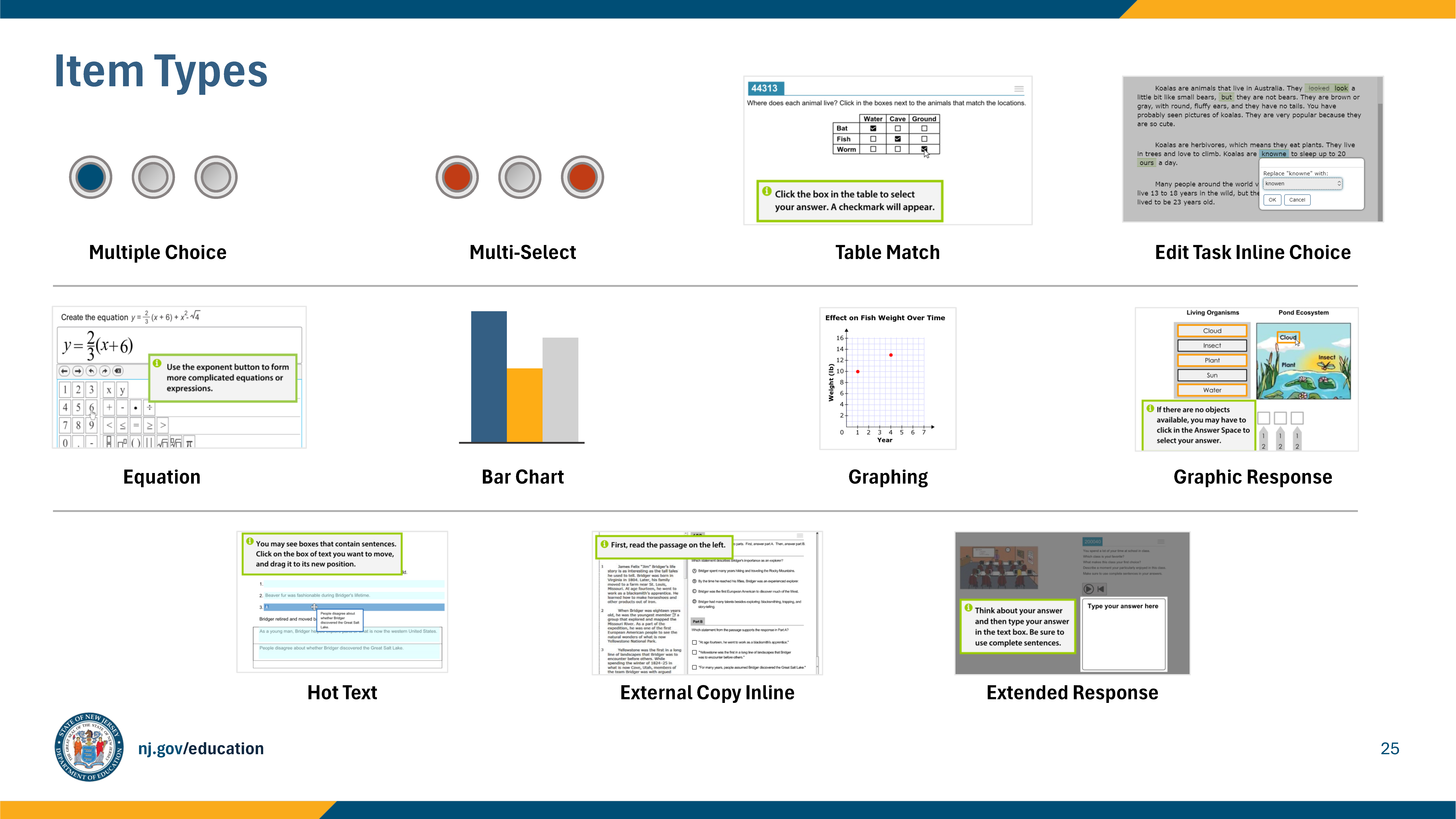
Item Types:
- Multiple choice
- Multi-select
- Table match
- Edit task inline choice
- Equation
- Bar chart
- Graphing
- Graphic Response
- Hot text
- External copy inline
- Extended response
-
What is the calculator policy for the mathematics assessment?
Students use different types of calculators depending on their grade level and the assessment they are taking. In grades 3 through 5, calculators are not permitted. Beginning in grade 6, students have access to basic four-function calculators—specifically the Desmos four-function and TI108—embedded within the testing platform. Students in grade 8 use more advanced tools, including the Desmos scientific and TI34 scientific calculators. Middle school students who are enrolled in and taking a high school end-of-course mathematics assessment will have access to the appropriate high school-level calculator for that course. For all end-of-course assessments and the NJGPA-A, students have access to Desmos graphing calculators and the TI84+ graphing calculator within the testing platform. For additional information, please see the Calculator Policy for Mathematics and Science.
-
Is the writing portion of the assessment adaptive?
The writing unit is not adaptive because it includes only one extended writing task.
-
How will writing be scored?
The writing test will be scored using a holistic rubric with two dimensions: Conventions and Composition. For additional information, please see the NJSLA-A and NJGPA-A Writing Rubrics.
-
Will all students within a grade level receive the same type of writing prompt?
Students may receive an opinion/argumentative, informative/explanatory, or narrative writing task, depending on grade level. Each student completes one extended writing task designed to assess on‑demand writing skills. This approach allows the assessment to measure a range of writing skills aligned to the standards across student groups.
-
With the changing of the statewide assessments, will median Student Growth Percentiles (mSGP) still be calculated for the 2025-2026 school year?
Yes, mSGP can still be calculated regardless of the assessment administered because Student Growth Percentiles (SGPs) measure a student’s relative growth compared to their “academic peers” over prior years. A student’s “academic peers” are other New Jersey students in the same grade and subject who had similar historical assessment performance.
SGPs range from 1 to 99. Higher numbers represent greater growth; lower numbers represent lesser growth. For example, if a student has a growth percentile of 80, it means the student scored better than 80 percent of their academic peers on that year’s NJSLA‑ELA assessment. Because students are compared only with peers who performed similarly in the past, all students—regardless of their scale scores—can show high or low growth.
More information can be found on the NJDOE’s Educator Evaluation Median Student Growth Percentiles webpage.
-
How can a Student Growth Percentile (SGP) be calculated when the state assessment has changed?
To answer this question, it is helpful to understand what a Student Growth Percentile (SGP) measures. A Student Growth Percentile (SGP) measures a student's academic growth compared to other students who had similar performance on prior state assessments.
There are two important points to keep in mind:
- An SGP is not based solely on a student's test score. It does not compare the change in an individual student’s performance from one year to the next. Instead, it compares a student's performance on the current assessment to the performance of other students who have taken the same assessment in the current year and prior years and had similar prior scale scores (“academic peers”).
- Because SGPs measure growth relative to academic peers, they can still be calculated when assessments change. Differences in score scales, scoring methods, or test formats do not prevent growth from being measured.
Students who took the assessment in spring 2025 were taught the standards in effect during the 2024-2025 school year and took the same assessment as other students statewide that spring. Likewise, students who took the assessment in spring 2026 were taught the standards in effect during the 2025-2026 school year and took the same assessment as their peers that spring.
Although the state assessment changed between spring 2025 and spring 2026, student growth can still be measured from one year to the next. This is because each assessment was aligned to the content standards used for instruction during the school year in which assessment was administered, allowing students' growth to be evaluated relative to their academic peers.
-
Who is required to participate in the NJSLA-A?
All public school students in required tested grades, including students with disabilities and multilingual learners, consistent with State and federal regulations.
-
Who is required to participate in the NJGPA-A?
The NJGPA-A was first administered to students in the Class of 2027. Students first participate in their junior year (Grade 11). Participation in the NJGPA-A is required to satisfy the graduation assessment requirement.
Students who do not demonstrate graduation readiness on the assessment may utilize the second pathway (menu of alternate assessments) or the third pathway (Portfolio Appeals Process) to fulfill their graduation assessment requirement. More information is available on the Graduation Assessment Requirements website.
-
Can seniors in the class of 2026 sit for the NJGPA-A this spring?
No, the Spring 2026 administration of the NJGPA-Adaptive is available only to grade 11 students. Students participating in the NJGPA-A in the spring of 2026 will not receive results until after the performance level standard setting procedures are concluded and the State Board of Education adopts cut scores for the new assessment. When factoring in the deliberative and time-intensive performance level standard setting activities and the current adoption process, it is possible that students will not receive their scores until the fall. Students who complete their graduation requirements after August 31, 2026 are considered to be in the cohort for the Class of 2027.
Districts were informed of these circumstances in the August 13, 2025 broadcast that stated, “All grade twelve students who do not have a valid score on one or both components of the NJGPA must test during this fall 2025 administration.”
Please refer to the following documents for more information:
-
How will a student who entered New Jersey after the fall NJGPA administration satisfy their graduation assessment requirement?
Students who entered the State after the fall 2025 administration of the NJGPA may satisfy their graduation assessment requirement through the second pathway (menu of alternate assessments) and third pathway (Portfolio Appeal Process).
Please refer to the following documents for more information:
-
How can students familiarize themselves with the new assessments?
Students are strongly encouraged to review the free online practice tests. These tests are designed to help students become familiar with the testing platform, item formats, and available tools and features they will use during the NJGPA-A or NJSLA-A.
While the practice tests include grade-level content aligned to standards, they are not intended for content preparation or instruction. Their primary purpose is to help students feel comfortable navigating the system and understand how the assessment tools work before test day.
-
Are there specific test strategies that students should use when taking an adaptive test?
Students must answer each question before progressing to the next item. Because the test adapts to performance, students should make their best effort on each item as they move through the test.
Responses may be changed during the session, but answered items will not readapt. Students should not rush through the test with the intention of returning later, because this prevents the assessment from adapting appropriately.
It is recommended that students familiarize themselves with practice tests to reacquaint themselves with the platform and navigation features.
-
Can test administrators observe student progress during testing?
Test Administrators may observe the progress of their test session through the TA Interface. Individual student progress is shown by a blue progress bar, and administrators can view the number of items a student has responded to in real time. Site and District Coordinators may also access real-time progress reports in TIDE to view testing progress across a school or district.
-
Can students flag an item and move forward without answering it?
The “Mark for Review” tool is provided on all New Jersey computer‑based tests and allows students to flag an item they would like to review later after providing their best answer. Students select “Mark for Review” from a drop‑down menu on the item, and a flag is placed on that item on the item review screen to remind them to return to it later.
-
What is the difference between a unit and a session?
A unit refers to the subject area and grade‑level test. A session refers to the time allotted for students to complete that unit. For example, the NJGPA‑A Math unit is 150 minutes long and is divided into two sessions of 75 minutes each. Students progress at their own pace, and the second session begins where they stopped at the end of the first session.
Students may change answers only within the same session. Once in the second session, students cannot change answers from the first session—even if an item was previously marked “Mark for Review.”
-
What happens if a student is in the middle of a reading passage when a session break occurs?
Students will return to the last unanswered question. If that question is part of a set associated with a passage, the student will also see the items they answered earlier in the previous session, but those answers cannot be changed.
-
How much time do students need to complete the test?
Testing times are shown on the NJGPA-A and NJSLA-A Units Testing Times for ELA and Mathematics page. The listed unit/session times do not include the recommended 25 to 30 minutes needed for logging students on, reading directions from the test administrator script, and logging students off.
-
How will the NJSLA-A and NJGPA-A be administered?
Each test will consist of three units:
- ELA‑Reading
- ELA‑Writing
- Mathematics
Both the ELA‑Reading and Mathematics units will be administered in two sessions, while the ELA‑Writing unit will be administered in a single session.
-
What content will the NJSLA-A and NJGPA-A tests include? How many questions will each student see?
The blueprints for the NJGPA‑A and NJSLA‑A provide information on the structure and content of the assessments.
-
What is the purpose of standard setting?
Standard setting is the technical process of determining thresholds for student performance levels, so families and educators can understand whether students are meeting grade-level learning expectations. Educators review and analyze test questions to categorize student performance meaningfully and consistently under the supervision of psychometric experts. This process ensures that results are fair and consistent across the State. Standard setting is not a yearly event and only occurs when major changes are made to a test or when a new assessment is implemented.
-
Were New Jersey educators involved in the test design process?
Yes. Educators are involved many times and extensively throughout the assessment development process. As shown in the overview of item development, each item undergoes a thorough review before appearing on the assessment administered in the spring. Educators directly review assessment items at multiple stages in this process, which are highlighted in gold in the development figure.
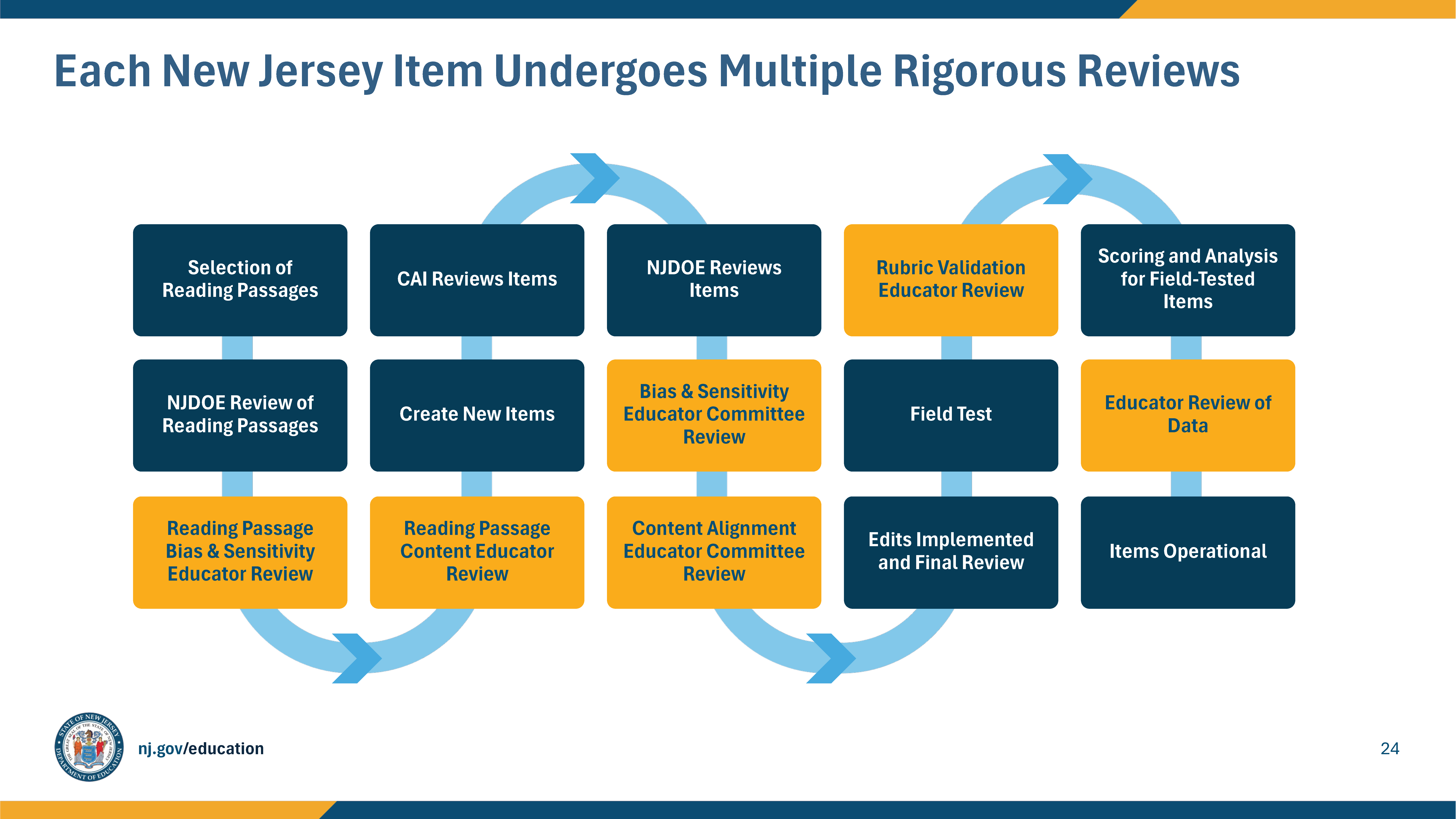
Each New Jersey item undergoes multiple rigorous reviews:
- Selection of reading passages
- NJDOE review of reading passages
- Reading passage bias and sensitivity (educator review)
- CAI reviews items
- Create new items
- Reading passage content (educator review)
- NJDOE reviews items
- Bias and sensitivity educator committee review
- Content alignment educator committee review
- Rubric validation (educator review)
- Content alignment educator committee review
- Field test
- Edits implemented and final review
- Scoring and analysis for field-tested items
- Educator review of data
- Items operational
- 1. When can we expect the results for the 2026 NJSLA-A and NJGPA-A?
- Results from the Spring 2026 administrations will be released later than in previous years. This additional time is needed because Spring 2026 marked the transition to the new computer-adaptive versions of the NJSLA and NJGPA, which required the establishment of new performance standards and cut scores before results could be reported. As described during the 2026 NJGPA-A and NJSLA-A Standard Setting State Board of Education Presentation delivered to the State Board of Education on July 6, 2026, this process is required for new assessments to ensure that results are meaningful, comparable, and aligned to expectations for grade-level, course-level, or graduation-ready performance.
-
The State Board of Education adopted the NJGPA-A cut scores on August 5, 2026. The NJGPA-A Standard Setting Summary and Cut Scores is available for review. Below is an overview of the anticipated digital results release for the Spring 2026 administration:
- Spring 2026 Results:
- NJGPA-A: August 17, 2026
- NJSLA-A and NJSLA-S: Fall 2026
Pursuant to N.J.A.C. 6A:8-4.3(b), local school districts are required to provide results, usually Individual Student Reports (ISRs), to parents and guardians within 30 days of receiving those score reports from the New Jersey Department of Education.
- 2. When can we expect the results for upcoming administrations during this school year?
-
Results for the upcoming administrations will be able to be released to districts earlier than previous years. Below is the schedule for digital reports to be released in the Centralized Reporting System (CRS) for districts:
Upcoming administrations:
- Fall 2026 NJGPA-A: December 9, 2026
- Fall Block 2026 NJSLA-A: January 20, 2027
- Spring 2027 NJGPA-A: April 23, 2027
- Spring 2027 NJSLA-A: June 30, 2027
- 1. What is the purpose of NJGPA-A and NJSLA-A score reports?
- Score reports are designed to show how well a student demonstrated grade-level knowledge and skills on the NJGPA-A or NJSLA-A compared to the expectations for their specific grade level. They are most useful when viewed alongside classroom performance and other indicators of student learning. The reports highlight strengths and areas for continued growth in English language arts (ELA) and mathematics.
- 2. What is an overall performance level?
- A performance level shows how well a student demonstrated the knowledge and skills expected for their grade level on a statewide assessment.
- The NJGPA-A has two performance levels:
- Graduation Ready
- Not Yet Graduation Ready
- The NJSLA-A for ELA and Mathematics has five performance levels:
- Did Not Yet Meet Expectations
- Partially Met Expectations
- Approaching Expectations
- Met Expectations
- Exceeded Expectations
- The NJSLA-Science has four performance levels:
- Below Proficient
- Near Proficient
- Proficient
- Advanced Proficiency
- For additional information about performance levels and other assessment results, please refer to each assessment’s respective score interpretation guide. These guides help educators, parents, and district staff understand score reports, performance levels, and content-area strengths and areas for growth, and support the appropriate use of assessment data to inform instructional decision-making.
- The Centralized Reporting System (CRS) User Guide and the NJGPA-A Score Interpretation Guide can be accessed on the New Jersey Assessments Portal under Resources.
- 3. What are reporting categories?
- Reporting categories are groups of related knowledge and skills measured on the assessment. They help show how a student performed in specific academic areas rather than providing only one overall score. For example, under Reading, there are three reporting categories: Reading Literary Text, Reading Informational Text, and Language. These categories can identify areas of strength and areas where additional learning opportunities may be beneficial. The reporting categories for each assessment can be found in the test blueprints:
- 4. What do the reporting category performance levels mean?
- There are three performance levels within each reporting category:
- Above Expectations: The student demonstrated skills and knowledge beyond those typically expected for their grade level and showed a strong understanding of the concepts and skills measured.
- Within Expectations: The student demonstrated the skills and knowledge within a range expected for their grade level, either slightly below or slightly above the level associated with meeting expectations.
- Below Expectations: The student has not yet consistently demonstrated the skills and knowledge expected for their grade level and may benefit from additional support.
- The Centralized Reporting System (CRS) is the online system where educators can view state assessment results and student performance reports. Both within the CRS and on individual student reports (ISRs), a description of what students must know and be able to do to meet expectations is provided for each reporting category. These descriptions will vary by reporting category, content area, and grade level or course. For example, the Geometry reporting category for the mathematics component of NJGPA-A indicates that students meet expectations by demonstrating an understanding of similarity, trigonometric ratios, congruence, geometric measurement, and theorems about circles. The reporting categories for each assessment can be found on the test blueprints:
- NJGPA-A Blueprints for ELA and Mathematics
- NJSLA-A ELA Blueprints
- NJSLA-A Mathematics Blueprints
- For more information, please refer to the Centralized Reporting System (CRS) User Guide.
- 5. Why can a student score differently across categories?
- Students often perform better in some skills than others. For example, a student may excel in reading comprehension but perform at a different level in writing or mathematics. Category scores provide a more detailed picture of performance than an overall score alone.
- 6. What is the “Just Proficient Mean”?
- For ELA writing, the student’s composition rubric score is provided as well as a reference point called the “Just Proficient Mean.” The Just Proficient Mean is the average writing rubric score earned by students who scored exactly at the Graduation Ready cut score (450) on the ELA component of the NJGPA-A. This value can help parents and educators better understand a student’s writing performance by providing a comparison point. For example, if the “Just Proficient Mean” is 3 and the student earned a 4 on the composition rubric score, that student’s writing score was higher than students who scored at the Graduation Ready cut score of 450 on the ELA component of the NJGPA-A. This allows for a comparison of a student's writing score to the Just Proficient Mean to understand how their writing performance compares to students who met the ELA graduation-ready benchmark.
- 7. Can a student be “Within Expectations” in all reporting categories, but demonstrate “Not Yet Graduation Ready” performance?
- Yes. Since the Within Expectations level of the reporting category accounts for students who are slightly above meeting expectations and slightly below meeting expectations, a student may be slightly below meeting expectations in all categories which would designate their performance as Not Yet Graduation Ready.
- 8. Is there any automatic rescoring of the ELA Writing?
- Yes. To ensure accurate results, ELA Writing responses for students who are within two scale score points of the proficiency cut score (450 on the NJGPA-A) and who received the lowest possible score on both writing rubrics are reviewed by an additional human scorer. For reference, a scale score point is one point on the assessment's reporting scale. For example, scores of 448 and 449 on the NJGPA-A are within two scale score points of the proficiency cut score of 450.
Some potential questions that LEAs and APSSDs may receive from families after they receive their reports are included in this section.
- 1. What is the Family Portal and how do I get access to it?
-
The Family Portal gives parents and guardians the ability to view their students’ test results online and includes the following information:
- Their student’s assessment results
- A glossary of assessment terms
- A list of frequently asked questions (FAQs) with answers
- Performance-level indicators including explanations of what they mean
- Resources for families to use with their students
- Parents and guardians will need an access code to enter the Family Portal. This access code is available on their child’s ISR. Families may use the access code as soon as they receive them; however, NJGPA-A results will not display in the Family Portal until August 31, 2026.
- 2. Should I focus more on the overall performance level or the individual reporting categories?
-
Both are important:
- The overall performance level provides a general picture of your child’s achievement.
- The individual reporting categories help identify specific strengths and areas for growth.
- Together, they provide the most complete understanding of student performance.
- 3. Can one test score fully describe a student's abilities?
- No. Statewide assessments are only one measure of student learning. While they provide important information about student performance relative to statewide expectations, each assessment is designed for a specific purpose and should be considered alongside other measures of student achievement and progress.
- The NJSLA-A is designed to measure the New Jersey Student Learning Standards (NJSLS) at a specific grade or course for a specific subject. This is a one time “snapshot” of student performance and may not be representative of their student’s full ability. Because of this, the data should be combined with local assessments, classroom assignments, teacher observations, projects, and other measures to get a better understanding of the student’s academic progress.
- The NJGPA-A is given to all 11th graders to measure if they are graduation ready in English Language Arts (ELA) and Mathematics. The ELA component is aligned to Grade 10 standards, and the mathematics component is aligned to Algebra I and Geometry standards. The NJGPA-A satisfies New Jersey’s graduation assessment requirement while maintaining multiple pathways for students who do not pass, including retesting, approved substitute assessments, and the portfolio appeals process.
- 4. How can parents use this report to support their child?
-
Parents can:
- Celebrate areas where expectations were met or exceeded.
- Discuss areas for continued growth.
- Set academic goals with their child.
- Communicate with teachers about strategies and resources to support continued growth.
- Encourage regular reading, writing, and problem-solving practice.
- 5. What should I do if I have questions about the results?
- Contact your child's teacher, school counselor, case manager, district test coordinator, and/or or school administrator. These staff members can help explain the results, provide additional context, and discuss the next steps.
- 6. Why did my student receive “Within Expectations” in all reporting categories but “Not Yet Graduation Ready” overall?
- Reporting category labels describe performance on specific groups of skills, while graduation readiness is determined by a student's overall assessment score in English language arts and mathematics. Because the "Within Expectations" category represents a range of performance, a student may earn that designation in each reporting category and still not meet the overall score required for a "Graduation Ready" designation. For additional information about available graduation pathways, please visit the NJDOE Graduation Assessment Requirements webpage.