 Official Site of The State of New Jersey
Grant Programs: Statewide Commitment and Investment
Since 2023, New Jersey has invested more than $10 million to support high-quality climate change education through the creation of a statewide professional learning network for educators and targeted support to deepen school-community partnerships. This investment continues through 2027 with sustained funding for ongoing implementation and new program opportunities.
Fiscal Year 2024 Climate Change Education Grant Program Impacts
In the Fiscal Year (FY) 2024 State budget, and for the second consecutive year, Governor Murphy allocated $5 million to assist schools with the implementation of the New Jersey Student Learning Standards that integrate climate change education, a first-in-the-nation effort to integrate climate literacy concepts across all content areas and grade bands. Through continued funding of the Office of Climate Change Education and competitive grant funds to support implementation efforts, New Jersey sustained its commitment to create a climate-literate and resilient future workforce.
Where the FY 2023 grant funds appropriation of the same amount was divided equally to support small seed grants available to every public school district, charter and renaissance school across the state, the New Jersey Department of Education (NJDOE) moved in a different direction with the FY 2024 allocation. As implementation efforts expanded in 2023, the NJDOE’s newly formed Climate Change Education Unit responded to feedback from grantees and reporting data from the FY 2023 grant cycle by crafting two competitive grants, each aimed at addressing the greatest needs uncovered through their review:
- to provide high-quality professional development and a robust, collaborative statewide network of providers to teachers, irrespective of their district’s capacity to bring climate literacy learning to scale; and
- to support early adopter LEAs in creating model materials and programs that could be shared and replicated across the state.
The NJDOE developed the Key Elements of High-Quality Climate Change Education, based on climate change education research and best practices, to promote consistently high-quality teaching and learning opportunities.
Total Grant Funds Expended: $1,690,784
Grant Project Period: April 1, 2024 – March 31, 2025
This grant opportunity created a statewide network of formal and non-formal education providers that worked collaboratively to increase the number and content-area diversity of teachers prepared to teach high-quality, standards-based climate change education. The grant established four regional CCLCs housed at institutes of higher education (IHEs) across the state. Each CCLC was charged with developing and providing professional development, technical assistance, and experiential learning opportunities to public school leadership and individual teachers. As a part of the grant requirements, the IHEs partnered with community-based organizations engaged in place-based environmental education. This grant design feature was meant to ensure that each CCLC had the expert knowledge and skills to support classroom and field-based learning opportunities.
After a 2-month planning period, the CCLCs began to engage with public school leadership and individual teachers through program learning opportunities. These program offerings provided teachers with multiple points of entry to climate learning, an acknowledgement that within any school district, teachers have different levels of readiness to engage in climate change learning as required by the NJSLS. Teachers who participated in programs outside of school hours were provided stipends for their participation, a grant requirement intended to honor teachers’ time commitment beyond their regularly required duties.
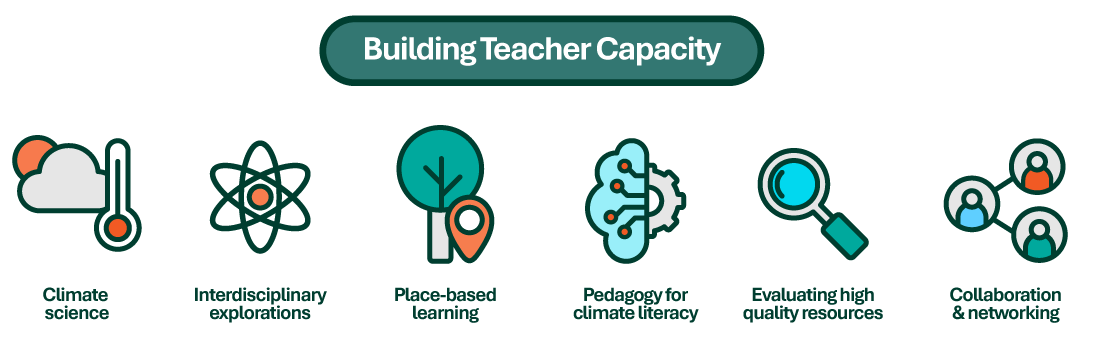
Program topics included explorations of basic climate science, interdisciplinary explorations in STEM and/or the humanities, place-based experiential learning opportunities, pedagogy to support climate literacy, guidance on selecting and evaluating existing high-quality resources, and opportunities for collaboration and networking for the development of new learning resources. Special sessions for school and district administrators were also offered to provide the content knowledge and technical assistance required to create optimal conditions for climate learning in their schools and classrooms.
Over the course of the 10-month program implementation period, the CCLCs collectively offered 160 unique learning opportunities, 99 of which were in-person, with a total of 2,460 attendees. Survey data from 2057 attendees indicated that 95% of participants felt better supported in implementing climate change education initiatives based on their training experiences.
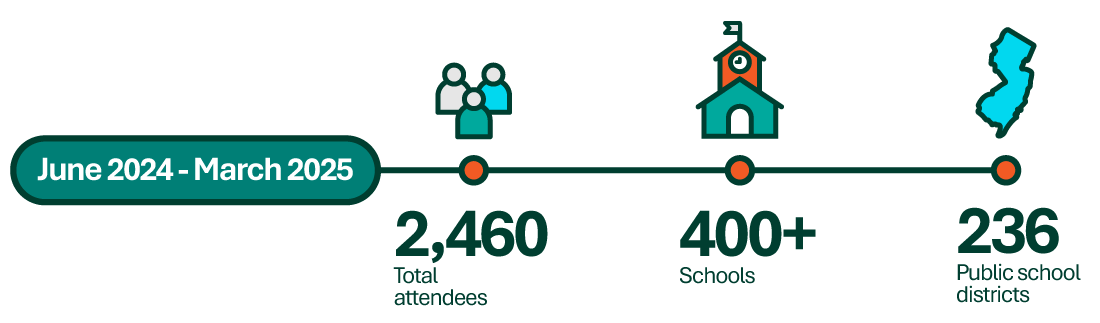
Teacher participants represented all nine content areas, four grade bands, and twenty-one counties across the state. From June 2024 to March 2025, many teachers returned for multiple learning opportunities, establishing supportive collaborative networks among the 2,460 total attendees, across 400+ schools, and 236 public school districts. This collaborative network was further supported by each CCLC’s culminating event in March 2025, which celebrated student and teacher learning across the grant project period and offered opportunities for participants to share artifacts of their learning and action.
To ensure consistency and support collaboration across the CCLCs, the Climate Change Education Unit engaged CCLC leadership and partners in regular meetings to share best practices and emerging research. They also performed extensive site monitoring, participating in both in-person and virtual learning opportunities at all CCLCs, which deepened relationships and allowed for feedback in real time. These activities resulted in higher quality programming for participants and increased communication and resource sharing across the network.
The Climate Change Education Unit also engaged the College of New Jersey’s Environmental Sustainability Education Program (TCNJs-ESEP) to conduct a comprehensive evaluation of the CCLC grant program. As a part of this evaluation, the TCNJ team led focus groups with each CCLC’s project leadership team and participating teachers, conducted observations of professional development and culminating events at all four CCLCs, reviewed each CCLC’s website, and administered a survey to CCLC teacher participants. Through monthly meetings with the grant managers in the Climate Change Education Unit, the evaluation findings were used to make iterative adjustments to technical assistance and program feedback and informed the development of the FY 2025 CCLC continuation grant. Key findings of this qualitative evaluative study include:
- The successful development of “a comprehensive network of centers with the capacity to support the widespread adoption of interdisciplinary climate change education statewide.” – TCNJs-ESEP Evaluation Team
- The creation of high-quality professional learning opportunities offered in a variety of formats to meet teachers’ needs and schedules.
- Participation from a large proportion of mid-career teachers, many of whom attended multiple learning opportunities and seemed primed to serve as teacher leaders in their home districts and more broadly, across their region.
Expanding Access to Climate Change Education and the New Jersey Student Learning Standards through Interdisciplinary Learning and Community Resilience Projects Grant Opportunity (24-WB05-G02)
Total Grant Funds Expended: $1,908,793
Grant Project Period: June 1, 2024 – May 31, 2025
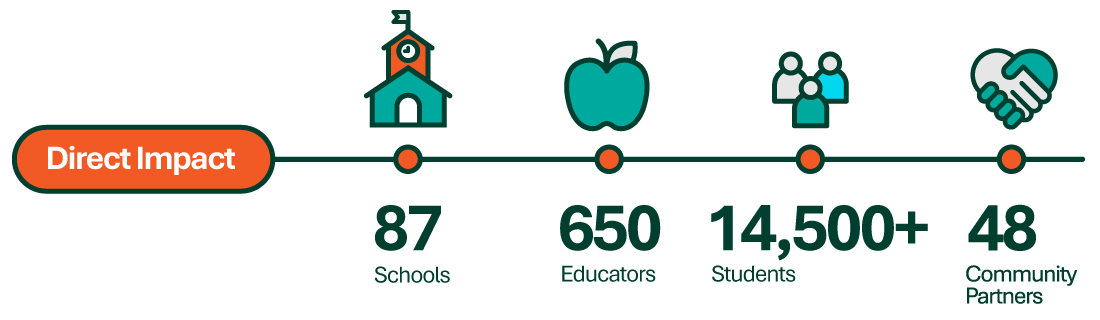
This grant opportunity, available to all operating LEAs, provided funding to support the development of model interdisciplinary instructional units and related student-driven climate resilience projects in their schools and local communities. Thirty-two public school districts were awarded grant funding, representing eighteen counties across the state. Grant programming directly impacted eighty-seven schools, six hundred fifty educators, over 14,500 students, and 48 community partners.
Grant projects ranged from single school, single grade-level endeavors, to whole school and in some cases, whole district projects. Sixty-two percent of projects engaged secondary classrooms (grades six through twelve); however, grantees also developed programming that supported younger learners, including pre-school students at one school district. The diversity of projects supported by grant funding mirrors the diversity of the public school districts across our state, offering model programs for schools and districts of all sizes and contexts.
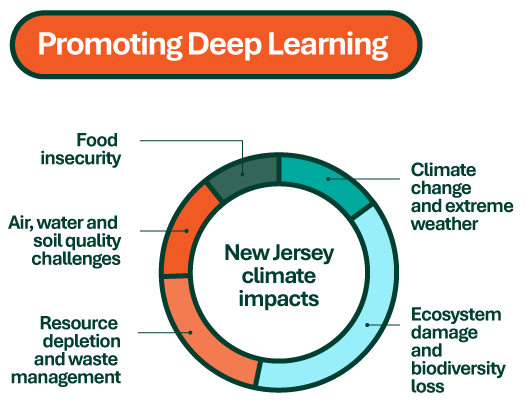
Climate impacts across New Jersey vary as much as our landscape. Accordingly, grant-generated interdisciplinary learning units engaged students around their own unique, local challenges. Learning extended beyond the classroom walls into their communities and further afield for fieldwork and other forms of experiential learning. Through these opportunities, students became more aware of the people in their communities already working to address local climate impacts and the career pathways that led them to this work. The interdisciplinary learning units focused on topics ranging from coastal erosion to food insecurity and promoted deep learning across five major categories of New Jersey climate impacts: climate change and extreme weather; ecosystem damage and biodiversity loss; resource depletion and waste management; air, water, and soil quality challenges; and food insecurity.
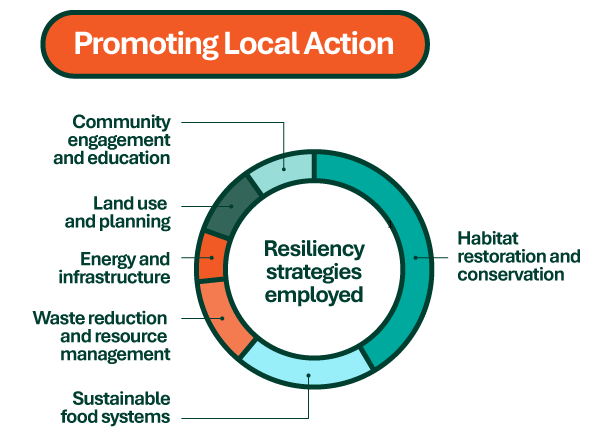
Students applied their learning to address a local climate issue through their community resilience projects, which included multiple opportunities to learn from and share learning with their community. Resilience projects ranged from community-facing festivals that shared education and action opportunities, to habitat restoration projects on school grounds and in local parks. Students led projects promoting local action, which fell into six major categories: habitat restoration and conservation; sustainable food systems; waste reduction and resource management; energy and infrastructure; land use and planning; and community engagement and education.
Grantees were able to access the services of their regional Climate Change Learning Collaborative to provide professional development and technical assistance to their staff. They were also required to identify at least one local community partner with expertise in addressing local climate impacts.
This partnership, a key component of the grant, anchored learning in local issues, fostered intergenerational learning and relationship building, and deepened connections between schools and their community. Many LEAs established partnerships with more than one local community partner, garnering additional support for their projects and broadening their network across their community. The forty-eight community partners represented a variety of sectors, providing invaluable skills and insight from their perspective to public school district students and staff.
The Climate Change Education Unit staff also engaged the district grant leadership teams in regular meetings to share best practices and emerging research. Based on the participants’ recommendations, these sessions evolved to include representatives from each regional CCLC, and reserved time for regional brainstorming and problem-solving sessions. Each site also received at least one site monitoring visit during the project period. These opportunities for frequent collaboration and observation meant that districts received regular feedback and support throughout the project period to ensure the successful completion of their project’s goals and objectives.
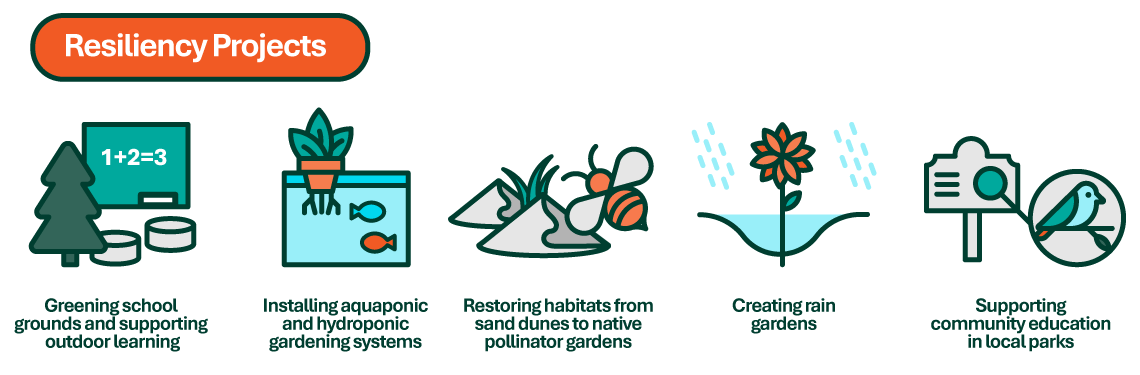
Across the state, the grant provided community resilience project funding for greening school grounds and supporting outdoor learning; installing aquaponic and hydroponic gardening systems; restoring habitats from sand dunes to native pollinator gardens; creating rain gardens; and supporting community education in local parks. It supported the reimagining of CTE programs that now focus on sustainable agriculture and climate resilience. Through work with their community partners, districts created positive feedback loops, where students were inspired by dedicated adults in their community, who were equally inspired by the energy, dedication, and hope of the young people they encountered in program activities.
FY 2025 and Beyond
In the FY 2025 state budget, Governor Murphy allocated an additional $3.5 million to continue to support climate literacy efforts. All FY 2024 grantees were eligible for a continuation grant, and an additional competitive grant was available for a new district cohort. All four CCLCs were awarded continuation grants with a project period of April 1, 2025, through March 31, 2026. Twenty-four districts applied for and were awarded continuation grants, and a new cohort of seven districts also received funding for this program year, both with a project period of June 1, 2025 – May 31, 2026.
In the FY 2026 state budget, Governor Murphy allocated another $2.225 million, which will support continuation grants for the CCLCs and the second cohort (FY 25) of district grantees. Additionally, the NJDOE released a new competitive LEA grant, the Climate Literacy Innovation Opportunity (CLIO). CLIO aims to expand support for out-of-school time climate change education through after-school, weekend, or summer learning opportunities that might allow for programs that are challenging to implement in the traditional school day. These grants will provide programming from June 2026 – August 2027.