Official Site of The State of New Jersey

Indicator 7: Preschool Outcomes
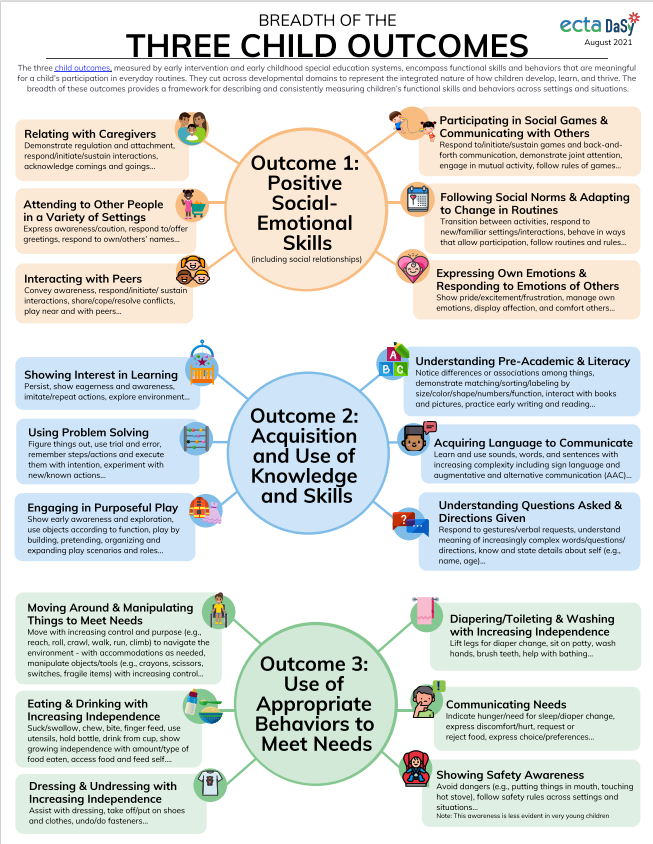
Welcome! This site is designed to support schools and families in understanding and implementing Indicator 7: Preschool Outcomes. Indicator 7 measures how children receiving preschool special education services are progressing in three key outcome areas:
- Positive social-emotional skills, including social relationships
- Acquisition and use of knowledge and skills, including early language and early literacy
- Use of appropriate behaviors to meet their needs
Our goal is to provide clear guidance, helpful tools, and practical resources to assist educators and families in promoting meaningful progress for every preschool learner.
These outcomes are assessed through the Child Outcomes Summary (COS) Process, a team-based approach used to understand how a child functions across everyday routines, activities, and settings. The COS uses a variety of information, such as assessments, observations, family input, and data from educational staff, to providea comprehensive view of the child’s abilities. The COS Team, made up of the child’s IEP Team members, works together to develop a shared understanding of the child’s strengths and needs in order to determine accurate and meaningful COS ratings.
The COS Process takes place twice during a child’s time in preschool special education:
- Entry Rating: Completed within the first 30 days of starting preschool special education services.
- Exit Rating: Completed within the last 30 days before the child exits preschool special education services.
COS Teams, this site provides a variety of guides, tools, videos, and training materials designed to support consistent, high-quality implementation of the COS Process.
What is the Child Outcomes Summary Process?
The Child Outcomes Summary (COS) Process summarizes information on a child’s functioning in three child outcome areas using a 7-point rating scale. With the COS Process, a team of individuals who are familiar with a child — typically the child’s Individualized Education Program (IEP) team — reviews multiple sources of information, including parent and provider observations and direct assessment results. Based on this comprehensive review, the team determines a rating that best reflects the child's current developmental abilities in each of the three outcome areas.
What are the three outcomes measured for preschool children with IEPs under Indicator 7?
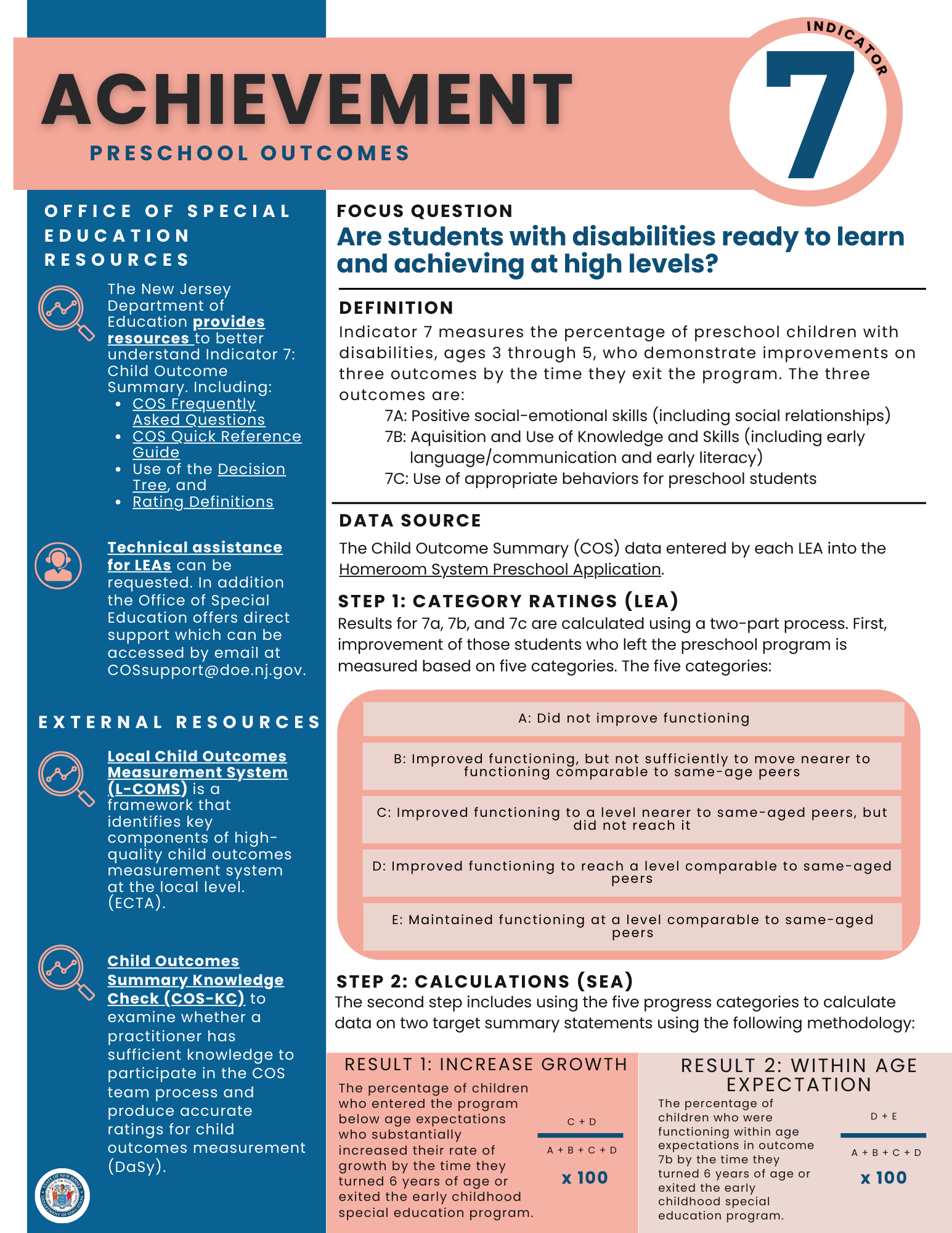
The three child outcomes measure the percentage of preschool children aged 3–5 with IEPs who demonstrate improved:
- Positive social-emotional skills (including social relationships)
- Acquisition and use of knowledge and skills (including early language/communication and early literacy)
- Use of appropriate behaviors to meet their needs
What data does New Jersey Department of Education (NJDOE) report to the United States Office of Special Education Programs (US OSEP)?
As part of its State Performance Plan/Annual Performance Report (SPP/APR), New Jersey is required to report data for Indicator 7 to USOSEP. For each of the three child outcomes, the state reports the percentage of children who fall into one of five progress categories listed below, which are based on comparisons of a child’s entry and exit ratings and whether the child made progress. The categories are:
- Preschool children who did not improve functioning
- Preschool children who improved functioning but not sufficient to move nearer to functioning comparable to same-aged peers
- Preschool children who improved function to a level nearer to same-aged peers but did not reach it
- Preschool children who improved functioning to reach a level comparable to same-aged peers
- Preschool children who maintained functioning at a level comparable to same-aged peers
OSEP also requires states to report on the two summary statements below for each of the 3 outcomes using the progress category data.
- Statement 1: Of those preschool children who entered the preschool program below age expectations in each Outcome, the percentage who substantially increased their rate of growth by the time they turned 6 years of age or exited the program.
- Summary Statement 2: The percentage of preschool children who were functioning within age expectations in each Outcome by the time they turned 6 years of age or exited the program.
When is the data collection timeline for entry and exit ratings?
|
Entry Rating |
Must be completed within 30 days of a child starting preschool special education services. |
|
Exit Rating |
Must be completed within the last 30 days of a child exiting preschool special education services. |
|
Minimum Participation |
USOSEP requires a child to be in the program for at least six months to have a valid exit rating. |
|
Transition to School-Age |
If a child stays in preschool beyond age five, the exit rating should be completed when they transition to a school-age program. |
Does COS data collection and submission continue indefinitely, or is there a defined end date? There is no end date for collecting COS data. New Jersey made a statewide transition to using the COS Process for the purpose of Indicator 7 reporting and expects all districts to continue using it indefinitely, unless otherwise directed by the New Jersey Department of Education – Office of Special Education.
How many times is the Child Outcomes Summary Process completed for an individual student? Each student should have two COS ratings during their time in preschool special education:
-
Entry rating- completed within 30 days of starting preschool special education.
-
Exit rating- completed within 30 days of exiting preschool special education.
When should entry and exit COS data be collected for students transferring within the State?
-
Entry rating: If the student was enrolled in the original program for more than 30 days, the sending district must upload the entry data to the Homeroom PRESCHOOL Application before the transfer. If the receiving district gets a student with an IEP but no entry of COS data, they must complete the entry of COS. If entry of COS data already exists, do not complete a second entry.
-
Exit Rating: When a student transfers within New Jersey, the sending district does not complete an exit COS. The receiving district is responsible for completing the exit COS when the child exits preschool special education.
When should exit COS data be collected for students transferring Out of State? If a student transfers to another state and has been in the preschool special education program for at least six months, an exit COS rating must be completed within 30 days of the child exiting preschool special education in New Jersey by the sending district before the student leaves.
Who is responsible for completing the entry and exiting COS data for students in an Out of District Placement? When a student is placed out-of-district, the sending and receiving districts must work together to complete the COS ratings and who will enter the data into the Homeroom PRESCHOOL Application. Regardless of which district is responsible, the COS should be completed within 30 days of the child starting special education services.
Should the COS process be completed for every preschool student? The COS Process should only be completed for preschool students eligible for special education services and an active IEP. It is not intended to be used as part of the eligibility determination process and should only be completed after a student is officially eligible.
Upon a student’s declassification, should the COS process be used to complete exit data? Yes, exit COS data should be completed for any student who is declassified. However, it is important to note that COS exit ratings should not be used to support or justify the declassification decision.
Does the preschool environment affect how COS entry and exit data are collected? No, the environment in which the child receives services does not impact how COS data should be collected. The same procedures apply whether the child is in a regular early childhood program, a separate special education class, a separate school or residential facility, or receiving services at home. Whether the program is full-day or half-day also has no effect on the data collection process.
Is it possible to assign more than one rating per outcome based on different environments, such as home and school? No, a child can only receive one rating per outcome for both entry and exit. Ratings are not assigned based on different environments. The COS team must agree on a single rating for each of the three outcomes. All team members should have an equal opportunity to share their observations and input regarding the child’s skills, and all available data sources should be considered when determining the final rating. The team makes a collective decision about the most accurate rating for each outcome.
If the team does not have any concerns with the student’s functioning in any of the three outcomes, is it still required to give the student a rating for that outcome? Yes. Every preschool student with an active IEP must receive a rating for each of the three outcomes, even if the team has no concerns in a particular area. This ensures consistent and complete data collection for all students.
How can the COS Team ensure consistency and accuracy when assigning ratings during the Child Outcomes Summary Process? To ensure consistency and accuracy, all COS Team members should have a shared understanding of the COS Process, the three child outcomes, the 7-point rating scale, and developmental milestones to support age-anchoring. Teams should use multiple sources of information—such as assessments, observations, and parent input—and collaborate to determine accurate ratings. The COS Decision Tree is designed to help guide consistent decision-making across team members. Ongoing use of NJDOE resources and training supports reliability and shared expectations in the COS Process.
Is the Child Outcomes Summary Process being used to help determine eligibility? No, the Child Outcomes Summary (COS) Process is not used to determine eligibility for special education. It is only used to measure a child's progress after they have already been found eligible for preschool special education services.
Is there a single developmental milestone document I can use to support the COS Process? Yes, the NJDOE has created a specific Indicator 7 Developmental Milestones to Support Age-Anchoring Document to help teams with the Child Outcomes Summary (COS) Process. This document helps teams understand what skills are expected by age for children in the three outcome areas. By using this resource, all team members have a shared reference point, which leads to more consistent and accurate ratings. It helps teams age-anchor by guiding them to compare a child’s skills to those typically seen in same-aged peers.
Who should be a part of the COS Team? The COS Team should consist of people knowledgeable about the child and their developmental progress. This team should include all members of the child’s IEP team, such as parents or family members, teachers, child study team members, related service providers, and, if appropriate, childcare providers. The team should include people who can provide informed insights into the child's skills across different settings and situations.
When should the COS Process first be discussed or introduced to teams? The COS Process should be introduced to IEP team members during the initial IEP meeting. Then, the team should review the three outcome areas, explain the purpose of the COS Process, and go over the 7-point rating scale. The NJDOE encourages teams to use the resources available at the bottom of this website to guide this discussion and ensure all members are informed and prepared to participate in the process.
Is a separate meeting to discuss the COS required? A separate meeting is not required to complete the COS. However, all team members must be given an equal opportunity to participate in the discussion and decision-making process. To ensure consistent and meaningful input, every member of the COS team should have a solid understanding of the COS Process, including the three child outcomes and the 7-point rating scale. Discussions about the child’s functioning in the three outcome areas can take place during the regular school day or as part of existing team meetings. If the team feels that a separate meeting would be helpful, they may choose to schedule one, though it is not required.
Where can I find additional training on the Child Outcomes Summary Process? Additional training on the COS Process is available through a self-paced online learning module developed by the Early Childhood Technical Assistance (ECTA) Center and the DaSy Center (The Center for IDEA Early Childhood Data Systems). This module provides essential information about the COS Process and best practices for making consistent and meaningful decisions. Users can revisit the module as often as needed.
Where do districts find paper copies of the Child Outcomes Summary Form (COSF)? Districts can find two versions of the COSF—Version A and Version B—at the bottom of this website. Both versions are located under the data collection tools to drop down as fillable PDFs and are updated to reflect what is submitted in the Homeroom Preschool application. Version A includes space to record both entry and exit data on the same form, while Version B provides space for either entry or exit data only. Districts may choose which version to use, but they are required to retain a completed copy in each student’s file. The NJDOE does not collect the physical COSFs; all data must be entered into the Homeroom PRESCHOOL Application.
Where can I find all the resources for the Child Outcomes Summary Process? All resources related to the COS Process are available on this website. Additional guidance and tools can also be found on the ECTA Center’s Website. For resources that help explain the COS Process to families, the PACER Center offer helpful materials.
Who is my district’s Homeroom Administrator? To identify your district’s Homeroom Administrator, visit the NJDOE Homeroom Homepage and click on the link titled “Complete list of Homeroom Administrators.” This list will provide the contact information for the administrator assigned to your district.
How can I be assigned a login to upload the data to the Homeroom PRESCHOOL Application? Your district’s Homeroom Administrator is responsible for assigning logins for the PRESCHOOL Application. Each district may assign as many individual logins and passwords as they need. Staff members involved in COS data entry should reach out to the Homeroom Administrator to request access.
When should COS data be uploaded onto the Homeroom PRESCHOOL Application? COS data is required to be uploaded into the Homeroom PRESCHOOL Application at least twice each year: once on the third Friday in December and again on the third Friday in June. While districts may collect data throughout the year and choose to upload it later, it is strongly recommended that data be entered as soon as a COSF is completed to help ensure deadlines are met. To assist with organizing data prior to uploading, districts can use the Excel Data Collection Sheet available on this website (Under Data Collection Tools -> Excel Data Collection Sheet). Please note that this spreadsheet is intended only as a planning tool and does not replace the requirement to upload all COS data into the Homeroom system by the specified deadlines.
Are the dates that COS data is due to the Homeroom PRESCHOOL Application specific to entry data in December and exit data in June? No, the December and June reporting windows are for both entry and exit COS data. For example:
- If a child starts preschool special education in January, complete the entry rating within 30 days and submit it by the third Friday in June.
- If a child exits in October after receiving services for more than six months, complete the exit rating and progress question within 30 days and submit it by the third Friday in December.
What do I do if my district has no new students that began or exited preschool special education in the period when data entry is due? If no new students began services and no students exited the program during the reporting period, the district is not required to enter any new data into the Homeroom PRESCHOOL Application for that cycle.
Who is the person responsible for inputting data into the Homeroom PRESCHOOL Application? Each Local Education Agency (LEA) is responsible for deciding who will input the COS entry and exit data into the Homeroom PRESCHOOL Application. It is recommended that the number of people entering data be limited to reduce the risk of errors and ensure consistency in data submission. The individual inputting the data into Homeroom should be familiar with the COS Process and the data submission process.
How do you input entry and exit data into the Homeroom PRESCHOOL Application? To assist with entering both entry and exit COS data, the NJDOE provides a Child Outcomes Summary Manual. This manual offers step-by-step instructions and can be accessed on the NJDOE website to help ensure accurate data entry into the Homeroom PRESCHOOL Application.