navigation bar
DEP Graphic  
Division of Parks and Forestry Graphic
parks home parks home njdep home
Materials for Sale

forestry home state lands mgt private lands mgt urban and community forestry education seedling nursery forestry health


Trees of New Jersey and the mid Atlantic States Forest Fever CD-rom Shrubs and Vines

Big Trees

$10.00
$10.00
$10.00
$6.00

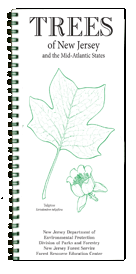
Trees of New Jersey and the Mid-Atlantic States

Trees of New Jersey and the Mid-Atlantic states is easy to use. 146 New Jersey native and non-native tree species are covered in the guide. The guide includes a glossary of terms, an identification key, regional maps, forest facts, and contact information for statewide forestry and environmental education programs.

Sixth edition – 2007
112 pages

Discounts available for orders in quantities of 50.

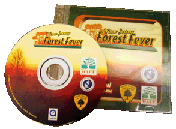
NJ Forest Fever
Interactive CD-ROM

  • Manage and grow a virtual forest over 100 years
  • Balance social, economic, and environmental challenges in forestry
  • Identify and resolve current forestry issues
  • Discover tree products and forest benefits
  • Learn about forestry careers

Visit MACE Forest Fever for screen shots and more information.

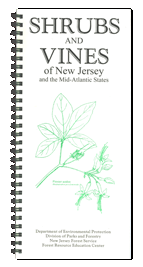
Shrubs & Vines of the New Jersey & the Mid Atlantic States

Shrubs and Vines of New Jersey and the Mid-Atlantic region covers species of 77 shrubs and 9 vines. An identification key, forest facts, contact information for forestry programs, and info boxes are also included in the guide.

Second edition - 2007
114 pages

Discounts available for orders in quantities of 50.

New Jersey's Big Trees

The Big Tree Guide, compiled by the Community Forestry program of the NJ Forest Service, includes listings for the current champion trees, four pages of color pictures, and information on historical trees.

Order Form


Book Reviews - Trees of New Jersey and Shrubs and Vines of New Jersey


"These are two handsome spiral-bound booklets that can be easily used by field botanists.  The booklets aim to familiarize the user with the most common woody species in the area.  There are 95 tree species, one species per page of the booklet, 77 shrubs, one per page, and 9 vine species.  There is a drawing of each species, including flowers and/or fruit, along with a great deal of information for each species (reminiscent of the Audubon guides): family; other common names; habitat and range; leaves; stems; flowers; fruit, description of similar species; and  a narrative of interesting facts. 

In addition, there are a lot of other helpful features to aid the beginner and the more experienced field botanist.  There are drawings of types of leaves, leaf arrangements, types of fruits and parts of the flower; a glossary of terms; species locator keys; specialized keys for some of the genera more difficult to identify; and a breakout of the species by plant communities.

One of the nice features of the booklets is that they include some of the "more horticultural," non-native species that field botanists often see in the area but which are often not covered in guidebooks."

  nynjctbotany.org


"The principal strengths of Shrubs and Vines of New Jersey include the technical accuracy of the descriptions and illustrations, the informative narratives that accompany many of the species, and the cost. Given these, the authors are also successful in their purpose "to familiarize the reader with the most common shrubs and vines" of the region. The scope and content of the book are versatile enough to appeal to both professional and nonprofessional botanists, and it is clear to me that its purchase should be a priority for any student of the flora of the Mid-Atlantic Region."

  Terry O'Brien, Department of Biological Sciences, Rowan University


"This is not a guide for those who know well their barks and bundle scars and move with ease through the Peterson's tree book. However, if you are among the arborally challenged (and this reviewer definitely is) you might be more comfortable with this new book as your primary guide. Only the species you are likely to come across in New Jersey are covered (146 in all), using a simplified key approach. Simple drawings of leaf types and arrangements and fruit types help get you started and a glossary in the back gets you through the botanical lingo. Most of the species included are accompanied by concise black and white line drawings, many of which were done for Common Forest Trees of New Jersey in the 1950's.

A good sampling of New Jersey's native trees are profiled; 27 non-indigenous species are given full-page treatment as well, including some exotics that have naturalized. A narrative at the end of each profile offers facts about each tree's natural history, historical uses and ecology. All in all, the book is clear and thorough enough (and small enough) to be a welcome companion on your walks, whether through woodland, along the canal or in a city park. Little "Info-Boxes" tucked here and there help make the book fun reading anywhere. It also includes a brief history of the NJ Forest Service, a list of their programs and contacts for further information. And, should you be so lucky, there is a form to photocopy for submitting candidates to the New Jersey Big Tree Program.

There is also a companion guide "Shrubs and Vines of New Jersey and the Mid-Atlantic States" by the same author."

Pat Sziber, Washington Crossing Audubon Society

bottom footer

parks and forestry: find a park | forestry | forest fire | natural lands | education | historic sites| historic preservation
department: njdep home | about dep | index by topic | programs/units | dep online
statewide: njhome | citizen | business | government | services A to Z | departments | search

Copyright © State of New Jersey, 1996-2004
Department of Environmental Protection
P. O. Box 402
Trenton, NJ 08625-0402

Last Updated: March 11, 2008

nj home citizen business government services a to z departments dep home contact dep privacy notice legal statement accessibility statement nj home