 Official Site of The State of New Jersey
Box Tree Moth (BTM)
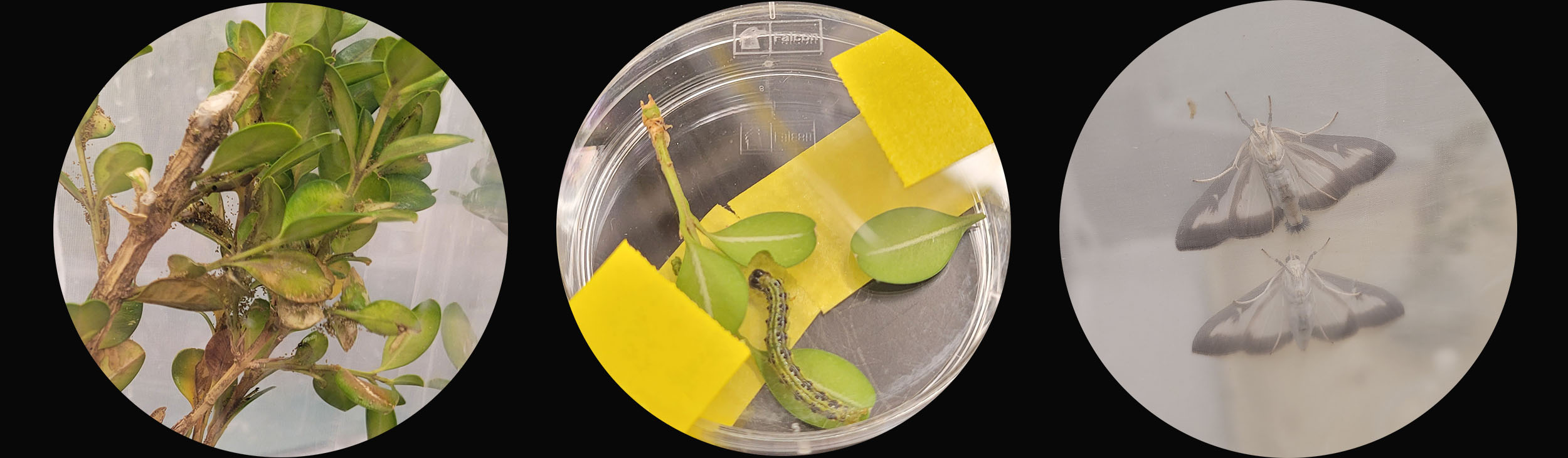
The box tree moth (Cydalima perspectalis) is an invasive pest that mainly targets boxwood plants (Buxus species). It can completely defoliate these plants and severely damage landscapes.
- The moth spreads both naturally and through human activity.
- It poses a serious threat to ornamental landscaping, especially boxwoods.
- Early detection and control are important to limit its spread.

Press Release
- NJDA Establishes Quarantine After Box Tree Moth Detected in Cape May County...
- Official Press Release here.
- NJDA BTM Quarantine
Host Plants
- Primary host:
- Boxwood (Buxus spp.)
- Secondary hosts (when boxwood is depleted):
- Burning bush (Euonymus alatus)
- Japanese spindletree (Euonymus japonicus)
- Purple holly (Ilex chinensis)
- Orange jessamine (Murraya paniculata)
Symptoms
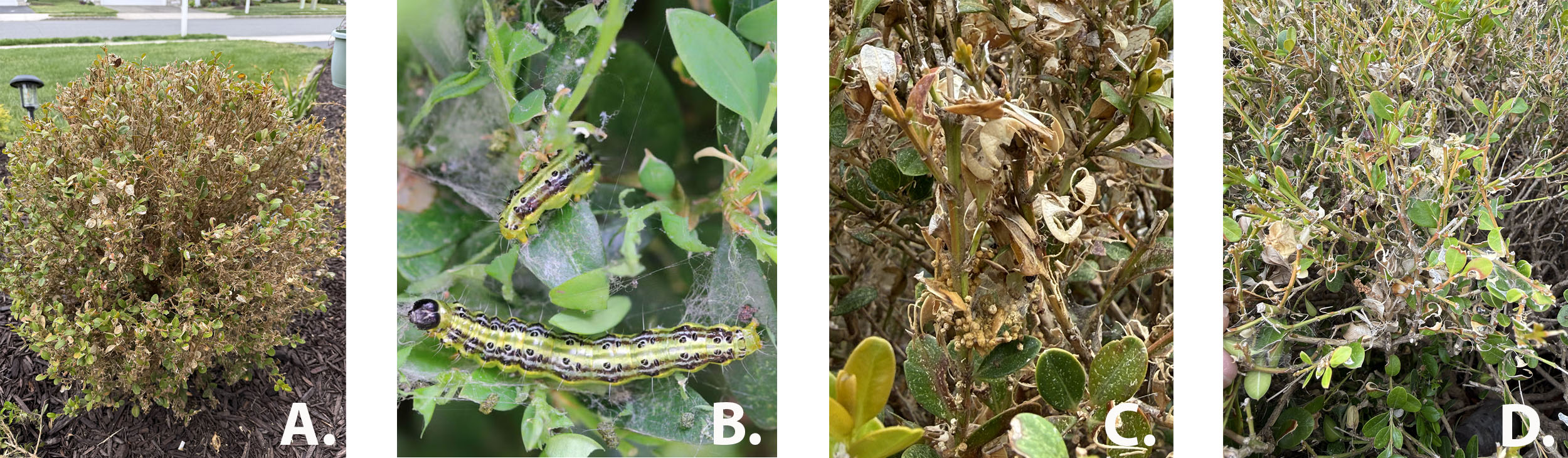
A. Partially or fully eaten leaves.
B. Adult boxtree moth caterpillar, green/yellow with green, black, white stripes & black spots.
C. Frass pellets incased inside masses of silk webs.
D. Foliage - Straplike remains left behind.
Distribution & Spread
- Native range:
- Temperate and subtropical regions of Asia
- Spread timeline:
- 2007: First detected in Europe
- 2007 - 2017: Rapid expansion across Europe, Western Asia, and Northern Africa
- 2018: Found in Canada
- 2021: Confirmed in the United States (Niagara County, New York)
- 2026: Confirmed in New Jersey (Cape May County)
- View BTM Federal Quarantine map here.
Movement & Dispersal
- Human-assisted spread:
- Primarily through transport of infested boxwood plants
- Responsible for long-distance jumps across regions
- Natural spread:
- Typically 3–6 miles per year
- Can peak up to 96 miles per year in some cases
- Capable of sustained flights over 20 miles
Blank Reports (to be printed):
Online Reports (to be completed electronically)
View BTM Quarantine Compliance Presentation here.
Insecticide Options for BTM management.pdf
Pre-Shipment Treatment Products:
|
Active ingredient
|
Commercial name
|
EPA Reg. #
|
REI
|
IRAC Class
|
Rates
|
|
bifenthrin
|
Talstar S
(7.9% active ingredient)
|
279-3155
|
12 hrs
|
3
|
21.7 oz
/100 gal
|
|
chlorantraniliprole
|
Acelepryn
(18.4% active ingredient)
|
100-1489
|
4 hrs
|
28
|
16 oz
/100 gal
|
|
cyantraniliprole
|
Mainspring GNL
(18.66% active ingredient)
|
100-1543
|
4 hrs
|
28
|
8 oz
/100 gal
|
|
lambdacyhalothrin
|
Scimitar GC
(9.7% active ingredient)*
|
100-1088
|
24 hrs
|
3
|
5 oz
/100 gal
|
|
permethrin
|
Perm-Up 3.2 EC
(36.8% active ingredient)
|
70506-9
|
12 hrs
|
3
|
8 oz
/100 gal
|
*Restricted use
Production System Treatment Products:
| Active ingredient | Commercial name | EPA Reg. # | REI | IRAC Class | Rates |
| Bacillus thuringiensis, kurstaki |
Javelin WG
(85% active ingredient)
|
70051-66 | 4 hr. | biological |
1.0 lb.
/100 gal
|
| spinosad |
Conserve SC T&O
(11.6%active ingredient)
|
62719-291 | 4 hr. | 5 |
6 oz
/100 gal
|
| methoxy fenozide |
Intrepid 2F
(22.6% active ingredient)
|
62719-442 | 4 hr. | 18 |
8 oz
/100 gal
|
-
Alpha Scents, Inc:
- Evergreen Growers Supply
- BTM Lure: https://www.evergreengrowers.com/box-tree-moth-lure.html
- Uni-trap (green): https://www.evergreengrowers.com/green-uni-trap.html
- ChemTica
- Uni-Trap (green) https://www.chemtica.com/site/?p=3700
- Great Lakes IPM
- BTM Lure: https://www.greatlakesipm.com/monitoring/lures/home-amp-garden/gltr329225-trece-pherocon-box-tree-moth-btm-lures-25cs
- Uni-trap (green): https://www.greatlakesipm.com/monitoring/traps/bucket-traps/glip235103-bucket-trap-green-3cs
- https://www.greatlakesipm.com/monitoring/traps/bucket-traps/glip235125-bucket-trap-green-25cs
- Trece
- has lures and may have green bucket traps: https://www.trece.com/products/insect-traps-lures/