Delaware • New Jersey • Pennsylvania
New York • United States of America

- Report Published September 2026
- Development & Application of SWEET
- Conclusions, Recommendations & Next Steps
- Related Resources
 |
Surface Water Availability in Select Tributaries of the Delaware River Basin
In September 2026, DRBC published a report describing the development and application of a screening tool - Surface Water Estimation and Evaluation Tool, SWEET - used to evaluate in-stream surface water availability across a range of hydrologic conditions in six tributary watersheds of the Delaware River Basin. The analysis focused on whether streamflow during dry periods - for example, a repeat of the 1960s Drought of Record - can support recent water demand for public water supply, thermoelectric generation and other needs.
View Report & Appendices
• Surface Water Availability in Select Tributaries of the Delaware River Basin (September 2026; archived PDF)
• Appendices (September 2026; archived PDF)
News Release
• DRBC Reaches Milestone in Planning for a Sustainable Water Future (issued September 30, 2026)
Key Takeaway
- Screening results demonstrate that most of the Basin's in-stream tributary surface water withdrawals for public water supply would be able to maintain present-day withdrawal volumes during a future drought.
Opportunities to Learn More
This report will be discussed at the following meetings:
- Pennsylvania State Water Plan: Delaware Regional Committee Meeting
- October 6, 2026; Hybrid: Virtual via Teams // In Person at PADEP Southeast Regional Office, Norristown, Pa.
- View Presentation (PDF)
- October 6, 2026; Hybrid: Virtual via Teams // In Person at PADEP Southeast Regional Office, Norristown, Pa.
- DRBC Water Management Advisory Committee
- October 14, 2026; Virtual via Zoom Webinar
- View Presentation (PDF)
- October 14, 2026; Virtual via Zoom Webinar
- American Water Resources Association's 2026 Annual Water Resources Conference
- November 11, 2026 (Session 57)
- In Person, Hilton Penn's Landing, Philadelphia, Pa.
- November 11, 2026 (Session 57)
 |
SWEET was developed to evaluate surface water availability in the Delaware River Basin with a repeat of hydrologic conditions observed from 1960–2010, including the drought of record (1961–1967).
• Data Inputs: USGS DRB Streamflow Estimator Tool [DRB-SET], groundwater withdrawal data, NPDES data, upstream surface water withdrawal data, permitted withdrawal data at each location and pass by flow information.
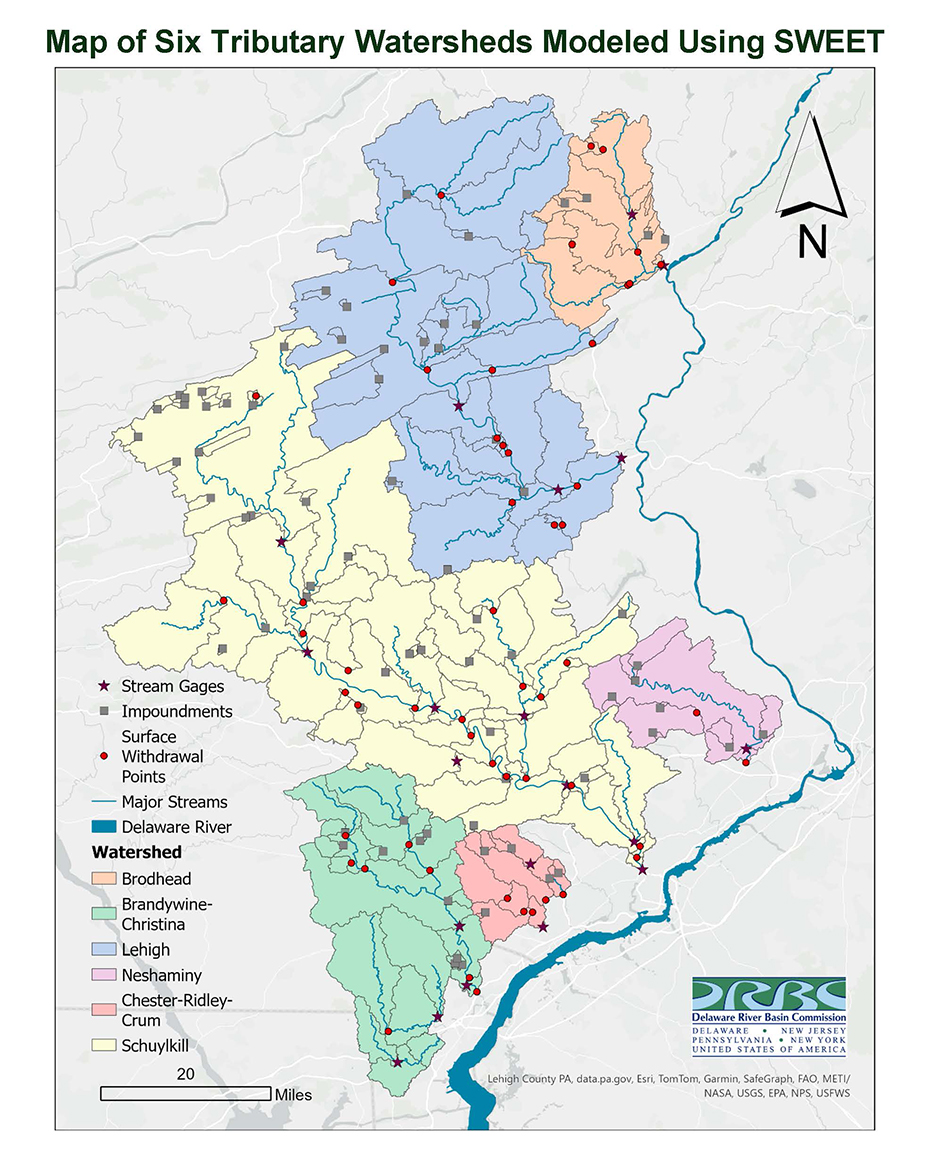
• Screened Tributary Watersheds: Brodhead Creek; Brandywine-Christina River; Lehigh River; Neshaminy Creek; Chester-Ridley-Crum Creek; and Schuylkill River Watershed
These six watersheds represent the majority of surface water withdrawals on non-tidal tributaries and contain public water supply surface water intakes that meet the following conditions: (1) do not draw from the main stem Delaware River; (2) do not draw from a reservoir or impoundment; and (3) do not draw from tidal waters.
• Modeled Locations: Within the six watersheds, 54 surface water withdrawal locations were modeled (see red dots on map on left; click to enlarge). These 54 points include 75%, by volume, of the non–main stem public water supply withdrawals in the DRB.
SWEET evaluated surface water availability at these 54 locations by applying recent average withdrawal volumes to hydrologic conditions observed from 1960 to 2010. If the intended withdrawal is less than the available streamflow on any day, that withdrawal point is "flagged" for potential surface water availability challenges and further study.
Study results show that of the modeled points, nearly two-thirds met their current withdrawal volumes on every modeled day under repeated hydrologic conditions from 1960 to 2010, including a repeat drought of record.
Due to its limitations - the base dataset is only from 1960-2010, conservative model assumptions and the inability to model reservoir operations or tidal changes - SWEET is intended as a screening tool only.
This assessment of surface water supports Commission's mission to ensure water availability and drought readiness now and into the future.
Recommendations
-
Keep the model up-to-date by using current water withdrawal data, for example, surface water withdrawal points and withdrawal volumes, pass by flows and return volumes
-
Update the USGS dataset - DRB-SET - that is the foundation for the model (it only is from 1960-2010)
-
Additional study of the points in the Lehigh River watershed that were flagged for potential availability concerns
-
Monitor updates to pass by flow regulatory values; any adjustments to pass by flows would change the results of this study
Next Steps
Future work may include evaluating additional public water supply intakes in the Basin, notably those that draw water from the main stem Delaware River, draw from a tidal water body and/or draw water from a reservoir or other impoundment.
Additional potential future applications of SWEET include:
-
Incorporating data and impacts from recent dry periods, for example, Fall 2024 and Fall 2025
-
Computing how much additional storage may be needed to meet demand under specific conditions
-
Evaluating how water loss impacts water availability
-
Supporting evaluation for newly proposed surface water intakes
-
Studying the impacts of climate change on water availability
This work is part of DRBC's ongoing Water Supply Planning for a Sustainable Water Future 2060.
Additional DRBC Water Availability Publications
- Estimated Groundwater Availability in the Delaware River Basin 2020 - 2060 (December 2022; archived PDF)
- Water Withdrawal and Consumptive Use Estimates for the Delaware River Basin (1990-2017) with Projections through 2060 (October 2021)
DRBC Water Storage Study
- Evaluation of Additional Storage in the Delaware River Basin (April 2023; ongoing)
