 Official Site of The State of New Jersey

Disconnection Prevention and Student Re-Engagement (DPSR)
Every Student Has a Pathway Towards Success
Early and consistent support changes life outcomes. By identifying risk early, building relationships, and connecting students to resources, schools can ensure every young person stays on a path toward education, employment, and long-term success.
Disconnected Youth are defined as young people — typically ages 16–24 — who are not enrolled in school and not participating in the workforce.
Often called “Opportunity Youth," these young people are navigating barriers that have interrupted their educational and career pathways. This is most often the outcome of unmet needs and system gaps.
About
Effective disconnection prevention and student re-engagement (DPSR) efforts must be a systemic ongoing process within the school and community. DPSR efforts are designed to support students at-risk of not graduating or re-engage students who have left school with opportunities to gain the academic, personal/social and work readiness skills necessary to graduate and lead productive lives. Significantly reducing the number of students who disconnect from school takes a combination of efforts at the community, district, school, classroom, and individual student levels.
DPSR expands efforts in reducing school disconnection rates (also known as dropout rates), increasing student engagement in school, and increasing the number of students meeting graduation and postsecondary/workforce expectations. Through providing support for school and district strategies, this initiative works to:
- Ensure all New Jersey students experience a safe and supportive learning environment that promotes attendance and engagement.
- Improve the graduation and disconnection rate each year.
- Improve rates and decrease the gaps between individual student groups and overall statewide rates.
School-Related State and Federal Requirements Pertaining to Immigrant Students and Families
What Is an Early Warning System?
An Early Warning System (EWS) is a data-driven tool that helps schools identify students who are at risk of disconnecting from school before a crisis occurs — when there is still time to intervene. Students who show warning signs in one or more of these areas — sometimes called the "ABC" indicators — are significantly more likely to disconnect from school unless they receive timely, targeted support. These indicators are especially powerful in the transition from middle to high school. (Balfanz et al.,2007; National Research Council, 2011).
Research consistently shows that these three core indicators predict whether a student may be at risk of disconnecting and not graduating.
The “ABC” Indicators are:
- Attendance: Missing 10% or more of school days (chronic absenteeism).
- Behavior: Disciplinary referrals or suspensions.
- Course Performance: Failing a core course, particularly in 9th grade.
Early Warning Systems and Underlying Causes of Disconnection
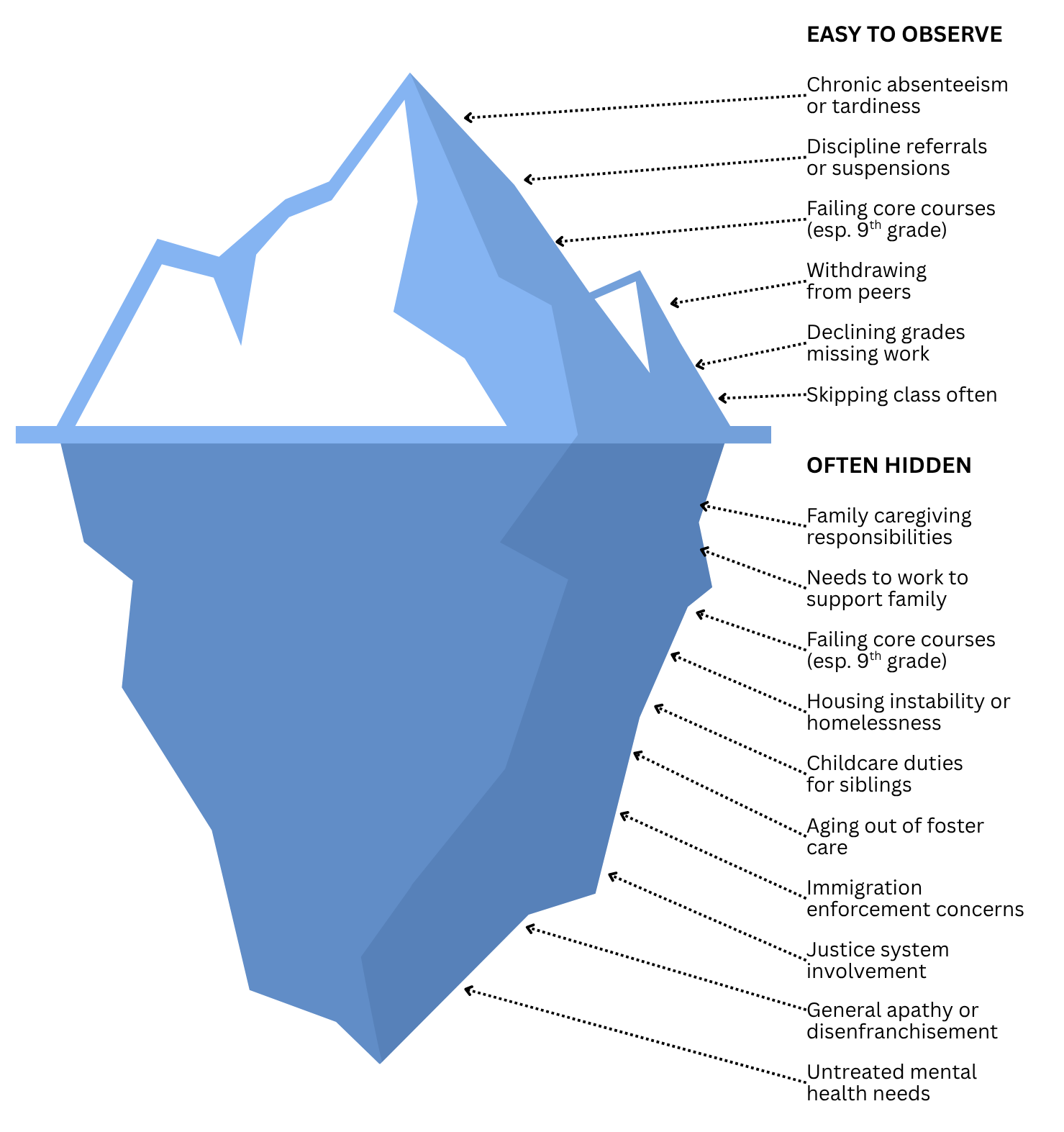
Above the waterline — Easy to Observe: The visible tip of the iceberg is labeled with six warning signs that are relatively easy for educators to detect: chronic absenteeism or tardiness, discipline referrals or suspensions, failing core courses (especially 9th grade), withdrawing from peers, declining grades and missing work and skipping class often.
Below the waterline — Often Hidden: The much larger submerged portion of the iceberg represents underlying causes that are harder to see but drive the observable warning signs above. Ten hidden factors are listed: family caregiving responsibilities, needs to work to support family, failing core courses (especially 9th grade). housing instability or homelessness, childcare duties for siblings, aging out of foster care, immigration enforcement concerns, justice system involvement, general apathy or disenfranchisement, untreated mental health needs.
The iceberg metaphor conveys that what educators observe on the surface is only a fraction of what is driving a student's disconnection, and that effective intervention requires addressing the deeper, less visible causes.
How EWS Connects to the NJTSS
New Jersey's EWS approach is integrated within the New Jersey Tiered System of Supports (NJTSS) — the state's framework for delivering the right interventions to the right students at the right time. Schools can use their existing NJTSS data infrastructure and Intervention and Referral Services (I&RS) teams to monitor early warning indicators and assign appropriate supports at Tier 1, Tier 2, or Tier 3.
Additional Indicators that Must be Addressed
Disconnecting from school is rarely a sudden decision, it is often the result of ongoing challenges. We can support young people from disconnecting from school by checking in with students who are exhibiting behavior that may precede disengagement and implementing the appropriate interventions.
Some common indicators that a student may be at risk for school disconnection are below:
- Chronic Absenteeism
- Frequent tardiness
- Frequent unexcused absences
- Skipping specific classes on a regular basis
- Frequently leaving school early
- Declining Academic Performance
- Sudden drop in grades or failure in core subjects
- Increase in missing assignments or incomplete work
- Repeated course failure
- Low Engagement in School Activities
- Lack of participation in class discussions, activities or projects
- Lack of, or decreased, participation in extracurricular activities
- Expressing disinterest in learning
- Behavioral Changes
- Increased disciplinary issues, such as detentions or suspensions
- Withdrawal or conflicts with peers
- Increased conflicts with teachers and administrators
- Verbalizing that school feels pointless or irrelevant
- Personal or Family Challenges
- Financial pressures requiring students to work during school hours
- Concerns around immigration enforcement at school
- Family caregiving responsibilities
- Aging out of foster care
- Childcare responsibilities
- Housing insecurity
- Social Isolation or Peer Influence
- Lack of connection with peers; feeling disconnected from the school community
- Experiences of bullying from peers
Early identification and cross-system collaboration are critical to prevention and recovery.
High-Risk Transition Points
Students are especially vulnerable during:
- 8th → 9th grade transition
- School transfers or mobility
- Returning from suspension or expulsion
- Pregnancy or parenting
- Justice system involvement
Using NJDOE Data to Identify At-Risk Students
The NJDOE collects and publishes a range of data that schools and districts can use to identify at-risk students and target intervention resources:
- School Performance Reports include chronic absenteeism rates, discipline data, and graduation cohort information at the school and district level.
- Conditions for Learning resources assist in addressing chronic absenteeism by fostering safe and inclusive learning environments that encourage consistent attendance.
- The NJDOE Accountability Dashboard identifies schools with low graduation rates and chronically underperforming student groups.
Based on the New Jersey Disconnection Prevention Framework, the Disconnection Prevention and Student Re-engagement (DPSR) Initiative develops tools, resources and other support that can help accelerate school and district efforts to improve student engagement and re-engagement, disconnection, and graduation.
- Frequently Asked Questions (coming soon)
- Disconnection Prevention Framework (coming soon)
- Guidance: This Initiative develops and shares guidance on best practices that schools and districts can implement to prevent students from disconnecting from school and re-engage students in education after they have disconnected.
This effort is authorized by New Jersey Senate Bill 3080 and builds on the state’s commitment to ensure graduation and school success for all students and re-engaging out-of-school youth.
To request technical assistance on Disconnection Prevention and Student Re-engagement (DPSR) from the Office of Student Support Services within the Division of Educational Services, please complete and submit the Student Assistance Form.
Technical Assistance may include, but is not limited to:
- Consultation on a specific student or situation
- Guidance on systemic or school-wide issues
- Help interpreting data or identifying root causes
- Support in designing re-engagement strategies
Through this process, the NJDOE can serve as a thought partner and connector, collaborating with school personnel to identify available resources and strengthen strategies for preventing disconnection and supporting student re‑engagement. The NJDOE may connect school personnel to non-Agency resources that may exist.
Why 9th Grade Matters
The transition from middle school (8th grade) to high school (9th grade) is one of the highest-risk periods for school disconnection. Research shows that a student who fails to earn enough credits to be promoted to 10th grade on time is significantly more likely to eventually disconnect from school — even if their grades and attendance were adequate in middle school. (Allensworth & Easton, 2007; Balfanz et al.,2007).
In New Jersey, 9th grade course failure is amongst the strongest predictors of noncontinuing student status. Noncontinuing student status is the designation used in the state's adjusted cohort graduation rate for students who leave school without graduating and without a verified transfer.
The “ABC” Indicators in 9th Grade
During 9th grade, students' Attendance, Behavior, and Course performance are highly predictive of eventual graduation. (Allensworth & Easton, 2005; Allensworth & Easton, 2007). Schools should monitor these indicators closely during the first semester of 9th grade — when intervention is most effective — and act immediately when warning signs appear.
Strategies to Support 9th Grade Success
- 9th Grade Academies and Cohort Models: Organizing 9th graders into smaller learning communities with dedicated counselors and teachers who track each student's progress.
- Freshman Seminars: Transition courses that help students develop study skills, school identity, and knowledge of graduation requirements.
- Early Credit Recovery: Identifying and supporting students who fail a course in the first semester before they fall too far behind.
- Peer Mentoring: Pairing incoming 9th graders with trained upperclassmen who provide academic guidance, social-emotional support, and firsthand knowledge of navigating high school.
- Cross-Level Data Sharing: Middle schools proactively sharing student data — attendance patterns, behavioral history, academic performance — with receiving high schools to enable early identification and relationship-building.
- Summer Bridge Programs: Intensive academic and social orientation programs during the summer before 9th grade, particularly for students from high-risk middle schools.
Youth who are involved with the juvenile justice system face some of the highest risks of school disconnection. Involvement with the justice system often disrupts school enrollment, leads to extended absences, and — without proper supports — can permanently interrupt a young person's educational trajectory. (Hirschfield, 2009; Office of Juvenile Justice and Delinquency Prevention, 2019; Sweeten et al., 2009).
New Jersey is committed to ensuring that justice-involved youth remain connected to education and have a clear pathway back to school upon release from any placement.
Rights of Justice-Involved Youth
All New Jersey youth who are detained or incarcerated in a juvenile facility have the right to receive an education. Youth in New Jersey's juvenile justice system are entitled to:
- Educational services during placement, including access to special education services for students with Individualized Education Programs (IEPs).
- A transition plan for returning to school or an alternative educational program upon release.
- School enrollment without unnecessary delays following release — no school district may refuse to enroll a returning youth based on prior disciplinary or justice involvement alone.
How Schools and Districts Can Support Justice-Involved Youth
- Transition Planning: Schools should begin planning for a student's return to school before they are released from placement. This includes credit reconciliation, scheduling, and connecting the student to in-school supports.
- Warm Handoffs: Effective reintegration requires coordinated communication between juvenile justice staff, educational providers within placement facilities, and the receiving school or district.
- Dedicated Point of Contact: Schools serving populations with high justice-system involvement should designate a staff member responsible for supporting the reintegration of returning youth.
- Trauma-Informed Practices: Staff working with justice-involved youth should be trained in trauma-informed approaches, which recognize that many youth in the justice system have experienced significant adverse childhood experiences.
Students experiencing homelessness or housing instability are among the most likely to disconnect from school. (Cunningham et al., 2010; Murphy, 2011). New Jersey's McKinney-Vento Act obligations require schools to immediately enroll students experiencing homelessness, ensure they have access to transportation to remain at their school of origin, and connect them with services.
Student Rights Under McKinney-Vento
Students experiencing homelessness in New Jersey have the right to:
- Immediate school enrollment, even without typical enrollment documents.
- Remain enrolled in their school of origin or enroll in the school where they are temporarily living.
- Transportation to and from school.
- Access to free meals, Title I services, and other programs for which they are eligible.
- A district-level homeless liaison to assist with enrollment, services, and advocacy.
Resources for Schools and Districts
- NJDOE Homeless Education Resources and McKinney-Vento Information
- NJ Department of Children and Families — Housing Resources
- Attendance Works — Chronic Absence and Housing Instability
- National Center for Homeless Education
If you need assistance with finding resources for students or families, please utilize the District Liaison Directory to contact the appropriate New Jersey Homeless Liaison.
The Disconnection to Reconnection Spectrum
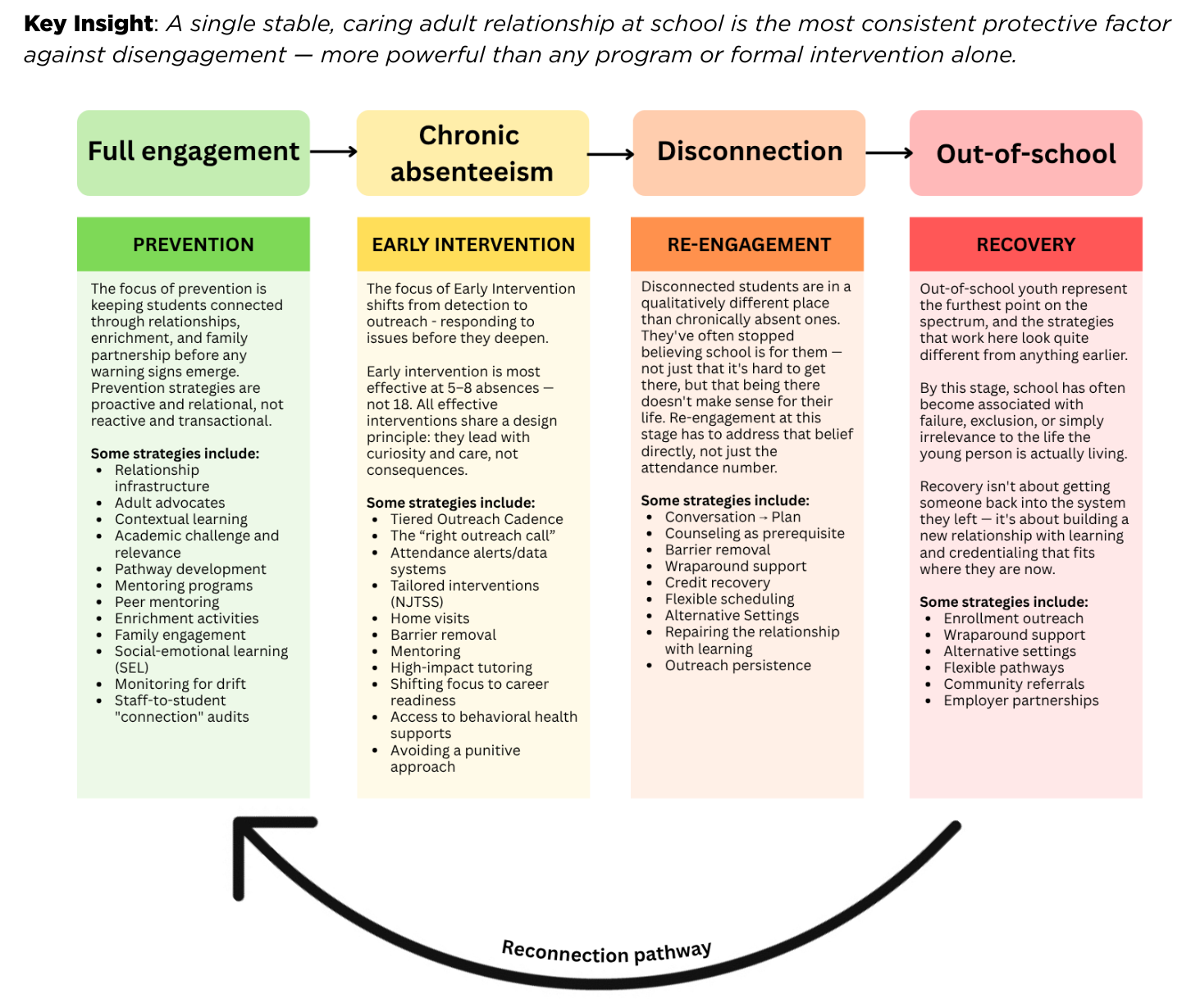
The graphic shows four stages arranged left to right as a progression, each with a corresponding intervention category below it:
Stage 1 — Full Engagement (green): Intervention category: Prevention. Description: The focus of prevention is keeping students connected through relationships, enrichment, and family partnership before any warning signs emerge. Prevention strategies are proactive and relational, not reactive and transactional. Strategies listed include: relationship infrastructure, adult advocates, contextual learning, academic challenge and relevance, pathway development, mentoring programs, peer mentoring, enrichment activities, family engagement, social-emotional learning (SEL), monitoring for drift, and staff-to-student "connection" audits.
Stage 2 — Chronic Absenteeism (yellow): Intervention category: Early Intervention. Description: The focus of early intervention shifts from detection to outreach — responding to issues before they deepen. Early intervention is most effective at 5–8 absences, not 18. All effective interventions share a design principle: they lead with curiosity and care, not consequences. Strategies listed include: tiered outreach cadence, the "right outreach call," attendance alerts and data systems, tailored interventions (NJTSS), home visits, barrier removal, mentoring, high-impact tutoring, shifting focus to career readiness, access to behavioral health supports, and avoiding a punitive approach.
Stage 3 — Disconnection (orange): Intervention category: Re-Engagement. Description: Disconnected students are in a qualitatively different place than chronically absent ones. They've often stopped believing school is for them — not just that it's hard to get there, but that being there doesn't make sense for their life. Re-engagement must address that belief directly, not just the attendance number. Strategies listed include: conversation leading to a plan, counseling as prerequisite, barrier removal, wraparound support, credit recovery, flexible scheduling, alternative settings, repairing the relationship with learning, and outreach persistence.
Stage 4 — Out-of-School (red): Intervention category: Recovery. Description: Out-of-school youth represent the furthest point on the spectrum. By this stage, school has often become associated with failure, exclusion, or irrelevance. Recovery isn't about getting someone back into the system they left — it's about building a new relationship with learning and credentialing that fits where they are now. Strategies listed include: enrollment outreach, wraparound support, alternative settings, flexible pathways, community referrals, and employer partnerships.
At the bottom of the graphic, a curved arrow sweeps from right to left beneath all four stages, labeled "Reconnection pathway," indicating that movement back toward full engagement is possible from any point on the spectrum.
Additional Strategies and Practices
- Adult advocates: Caring adults who form a web of support for students who are struggling and support, engage, listen to, advise and motivate students as they overcome barriers and successfully complete K–12 education.
- Contextual Learning: Opportunities for students to make connections between knowledge and its applications to their lives as family members, citizens, and workers. Contextual learning includes but is not limited to service-learning, work-based learning, project-based learning and capstone projects.
- Expansion of the school year/structured learning time and summer transition programs: Many students who are in danger of or who have disconnected from school are often overage and under-credited, having severe academic challenges, such as lacking literacy, numeracy, and other academic skills. (Allensworth, 2013; Neild & Belfanz, 2006). Overage and under-credited is often defined as high school students who are at least two years behind in expected credit accumulation for their age, often putting them off-track for graduation. In such instances, more time is needed to complete high school. Providing expanded learning time opportunities may offer academic enrichment and socio-emotional supports to increase school engagement and prepare students for success.
- Expansion of high-impact tutoring programs: As mentioned above, students who are at risk of, or have already disconnected from school may have any increased need for individualized academic supports. Providing expanded access to high-impact tutoring programs can help ensure this population of students receives the support they need outside the classroom, to succeed academically.
- Programs and systems specifically designed to serve transient students including migrant, Multilingual Learners, Immigrants, Refugees and Newcomers: These programs are intended to accelerate English language acquisition, develop academic content vocabulary and higher-level thinking skills, promote the development of social and academic skills that students will need when entering district high schools, build a foundation for long-term academic and socio-cultural success.
- School Culture and Behavioral Health: Behavioral health refers to the social, emotional, and behavioral well-being of all students, including students with mental health needs. Students' behavioral health is intricately connected to academic, social, and emotional success at school.
- Pathway Development: Pathways for college, career and civic readiness are intentional educational structures within a school system that enable students to build agency, identify personal interests, strengths and talents, identify career interests aligned with those strengths and talents and understand the connection between academic learning and future success.
- Tailored Interventions: Providing universal, targeted and intensive interventions can help schools meet students’ individual academic and social/emotional needs so all students can succeed. The New Jersey Tiered System of Supports (NJTSS) builds on Intervention and Referral Services (I&RS) and gives schools structure to meet the academic, behavioral, health, enrichment and social/emotional needs of all students.
- Lowering Rates of Chronic Absenteeism: Student absenteeism can lead to low academic achievement and be a warning sign of school disconnection. Research shows that a positive school climate and culture can help prevent chronic absenteeism and foster regular student attendance. Students who feel safe, supported, and engaged are more likely to attend school consistently. (Morales et al., 2021; Van Eck, et al., 2017)
- Alternative Education: Alternative education programs can be an effective strategy for districts addressing disconnection when a student’s current school environment is a contributing factor to disengagement, such as needs related to pregnancy or parenting, requiring alternative scheduling like evening courses, anxiety, health or medical condition, or being behind in credits. These programs offer smaller class sizes, individualized planning, and comprehensive academic and support services aligned to New Jersey Student Learning Standards, while maintaining a clear pathway to graduation.
- Credit Recovery: Students who fall behind in earning credits toward graduation — particularly following a course failure in 9th grade — face a significantly elevated risk of disconnecting from school. (Allensworth & Easton, 2005; Allensworth & Easton, 2007). Credit recovery programs give students the opportunity to retake or complete courses through flexible modalities, including online, blended, and competency-based approaches. Effective credit recovery programs are designed to accelerate students' progress without compromising academic rigor, are tied to clear graduation pathways, and are paired with counseling and monitoring to ensure students stay on track.
- Restorative Practices: Punitive disciplinary approaches — including out-of-school suspensions — are strongly associated with increased risk of school disconnection, particularly for students who are already struggling. (Leung-Gagné et al., 2022; Noltemeyer et al., 2015). Restorative practices shift the focus from punishment to repairing relationships and addressing the underlying needs that drive behavior, while maintaining accountability. Schools implementing restorative approaches consistently report improved school climate, reduced referrals, and improved attendance among previously at-risk students.
NJDOE Resources
- Re-engagement Language Guide
- School Counselor Action Checklist
- Conditions for Learning
- NJ Adult Education — High School Equivalency (GED) Pathways
- NJDOE Homeless Education Resources and McKinney-Vento Information
- Educational Stability for Children in Foster Care
- New Jersey Tiered System of Supports (NJTSS)
- School Performance Reports
- NJDOE Accountability Dashboard
- NJ Department of Education — Graduation Rates
- NJ Department of Education — Dropout Rates
- 21st Century Community Learning Centers Program website
Other State Resources
- NJ Department of Labor — WIOA Youth Program (Out-of-School Youth Services)
- NJ One-Stop Career Centers / American Job Centers
- NJ Department of Children and Families — Housing Resources
- School Stability for Children in Resource Home Care – Information for Parents
- School Stability for Children in Resource Home Care - General Information
- N.J.A.C. 6A:16 Programs to Support Student Development
- Legislation and Regulations
Other Resources
- Early Warning Systems
- National Dropout Prevention Centers
- National Center for School Engagement
- Edutopia, Social-Emotional Learning
- MENTOR – The National Mentoring Partnership
- Attendance Works
- Secondary Success Indicator One-Pagers
- Collaborative for Academic, Social and Emotional Learning
- Everyone Graduates Center
- Mentoring: A Critical Support Strategy for Youth Career Engagement and Workforce Development
- IES What Works Clearinghouse — Dropout Prevention Practice Guide
- IES What Works Clearinghouse — Early Warning Systems Practice Guide
- American Institutes for Research — Early Warning Intervention and Monitoring System Implementation Guide
- America’s Promise Alliance