Official Site of The State of New Jersey
Opening of Cannabis Business Classes
Starting September 27th, 2023, the NJ-CRC will begin accepting applications for wholesale, manufacturing, and delivery cannabis business licenses. This is a fantastic opportunity for new cannabis entrepreneurs to enter the New Jersey market and expands the vertical integration opportunities for existing operators. The opening of the three classes rounds out the cannabis industry in the state.
- A Class 3 Wholesale license allows the holder to store, buy, and sell bulk cannabis and cannabis products. Wholesalers cannot cultivate, manufacture, or package cannabis or cannabis products, and cannot sell cannabis or cannabis products directly to consumers.
- A Class 4 Distribution allows the holder to transport bulk cannabis and cannabis products between cannabis cultivators, manufacturers, or retailers within the state of New Jersey. Distributors cannot cultivate, manufacture, or package cannabis or cannabis products; or sell cannabis, or cannabis products directly to consumers; or purchase or resell cannabis or cannabis products.
- A Class 6 Delivery license allows the holder to transport retail purchased cannabis and cannabis products to consumers. Holders of a delivery license cannot cultivate, manufacture, or package cannabis or cannabis products, or store any cannabis or cannabis products at the licensee’s administrative office.
As with the other business classes, applicants can apply for either a conditional license or an annual license.
- Conditional license – provisional license allows for an abbreviated application process that does not require site control and municipal approval, and gives applicants more time to gather the requirements for an annual license.
- Annual license – license that allows applicants to begin operations after passing NJ-CRC inspections.
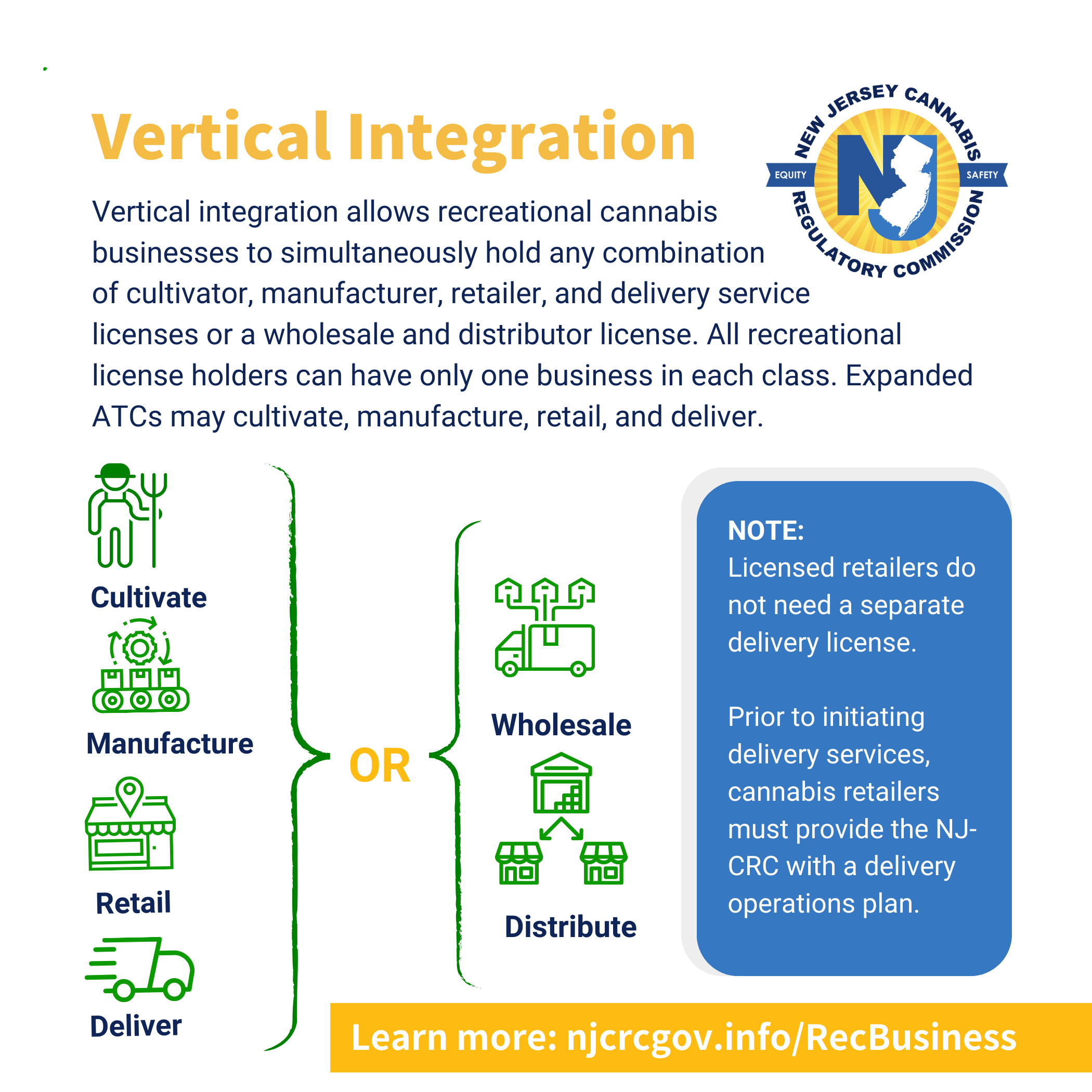
The additional licenses allow for more vertical integration options. Currently, a cannabis business can simultaneously hold licenses for cultivation, manufacturing, and retail – and deliver, since retailers are allowed to do their own delivery. With the additional licenses opening, a business holding a cultivation license can also hold a delivery license and wholesalers can also be distributors. License holders can hold only one of each license class.
Priority Applications
In addition to deciding the type of license you want - conditional or annual - you should also determine your priority status before applying. The NJ-CRC designates priority to Social Equity Businesses and Diversely-Owned Businesses in both the review and approval portions of the application process. These businesses will be prioritized in the licensure process so that their applications are reviewed before other applicants – regardless of when they apply.
- Social Equity Businesses - owned by people who have lived in an Economically Disadvantaged Area of the state, or who have convictions for cannabis-related offenses (expunged or not). Applications from Social Equity Businesses for wholesale, manufacturing and delivery licenses will be accepted exclusively for 90 days - from September 27, 2023, to December 26, 2023.
- Diversely-Owned Businesses - minority-owned, woman-owned, and/or disabled veteran-owned businesses - as certified by the New Jersey Department of the Treasury. While still accepting applications from Social Equity Businesses, applications from Diversely-Owned Businesses will begin to be accepted on December 27, 2023.
The application process opens for all other applicants on March 27, 2024.
Further, applicants can decide if they want to pursue a microbusiness or a standard business license. A microbusiness is a licensed business with a relatively small operation. Microbusinesses can be a cannabis cultivator, manufacturer, distributor, retailer, or delivery service. The business must meet all the following requirements:
- have no more than 10 employees at one time.
- have a physical plant of no more than 2,500 square feet; and in the case of a cannabis cultivator, the canopy height cannot be more than 24 feet.
- possess no more than 1,000 mature cannabis plants each month (cannabis distributors are exempt.)
- acquire no more than 1,000 pounds of usable cannabis (or the equivalent amount in other forms) each month.
We aim to make navigating the cannabis licensing process in New Jersey as simple as possible by arming you with all the information you need. Reviewing the application guide can help aspiring cannabis entrepreneurs figure out where to start, so they can contribute to the growth and diversity of the burgeoning cannabis industry in the Garden State.
Previous Blog Posts
Legit vs. Shady: How to spot a legal cannabis dispensary in New Jersey
04/27/2026
New Jersey has a regulated cannabis market with more than 300 licensed dispensaries across the state. In 2025, the NJ cannabis industry generated more than $1.16 billion in sales and $67.5 million in sales tax. With any new and lucrative industry, unlicensed operators try to cash in. Illegal marijuana isn’t just a legal risk for the business operators; it can also be dangerous for consumers. Unregulated products skip the safety testing, labeling requirements, and warnings that New Jersey law requires, and the shops don't have the guardrails in place to protect vulnerable populations like kids, teens, and young adults from gaining access to these products. Is legal cannabis on your shopping list? Here's how to spot a state-licensed cannabis dispensary:
Five years of regulation, responsibility, and growth
04/2/2026
As we approach the New Jersey Cannabis Regulatory Commission’s fifth anniversary, I’ve been reflecting on what it means to build two things at once: a new government agency and a new regulated industry. Neither comes with a roadmap. Both require patience, clarity of purpose, and the willingness to make difficult decisions in real time. In five short years, the Commission has significantly expanded access to medicinal cannabis and launched the adult-use market, which to date has generated approximately $4 billion in sales. But our success cannot be measured solely by speed; it must be measured by whether we built an industry grounded in equity, accountability, and meaningful opportunity. From the beginning, our work has been guided by a set of core principles that continue to shape every decision we make.

How Terpenes Affect Your Cannabis Experience
03/24/2026
Terpenes are aromatic compounds found in plants, including cannabis. They give plants their characteristic scents, help protect them from mold, fungus and other pathogens, and play a crucial role in modulating cannabis' psychoactive effects. For example, two strains with identical THC percentages can feel completely different, one may leave you sedated and the other may leave you energized. More than a hundred terpenes exist in cannabis, each with its unique aroma and potential therapeutic benefits. Terpenes are essential for shaping the plant’s impact on the human body and mind.