Official Site of The State of New Jersey
THC is THC: Why the NJ-CRC will now regulate intoxicating hemp products
You can walk into a gas station or convenience store in New Jersey and find products labeled as “hemp” that can produce the same intoxicating effects as cannabis. Many consumers assume these products are regulated the same way as those sold in state-licensed dispensaries. They are not.
Across our state, products that can get you high are being sold in places that many consumers would never expect, including environments where youth under the age of 21 can easily access them.
At the heart of the confusion is a distinction that doesn’t mean much to the average consumer. These products all come from the Cannabis sativa L plant. Labels like “hemp” and “cannabis” may carry legal significance, but they obscure a critical issue: products that are prohibited in New Jersey’s regulated cannabis market—due to THC content—have been widely available under the banner of “hemp.”
At the New Jersey Cannabis Regulatory Commission (NJ-CRC), we regularly hear from local officials, law enforcement, and residents asking the same question: What’s allowed, and what isn’t? When even regulators are fielding constant questions, it’s clear there is more confusion than clarity.
That lack of clarity has real consequences.
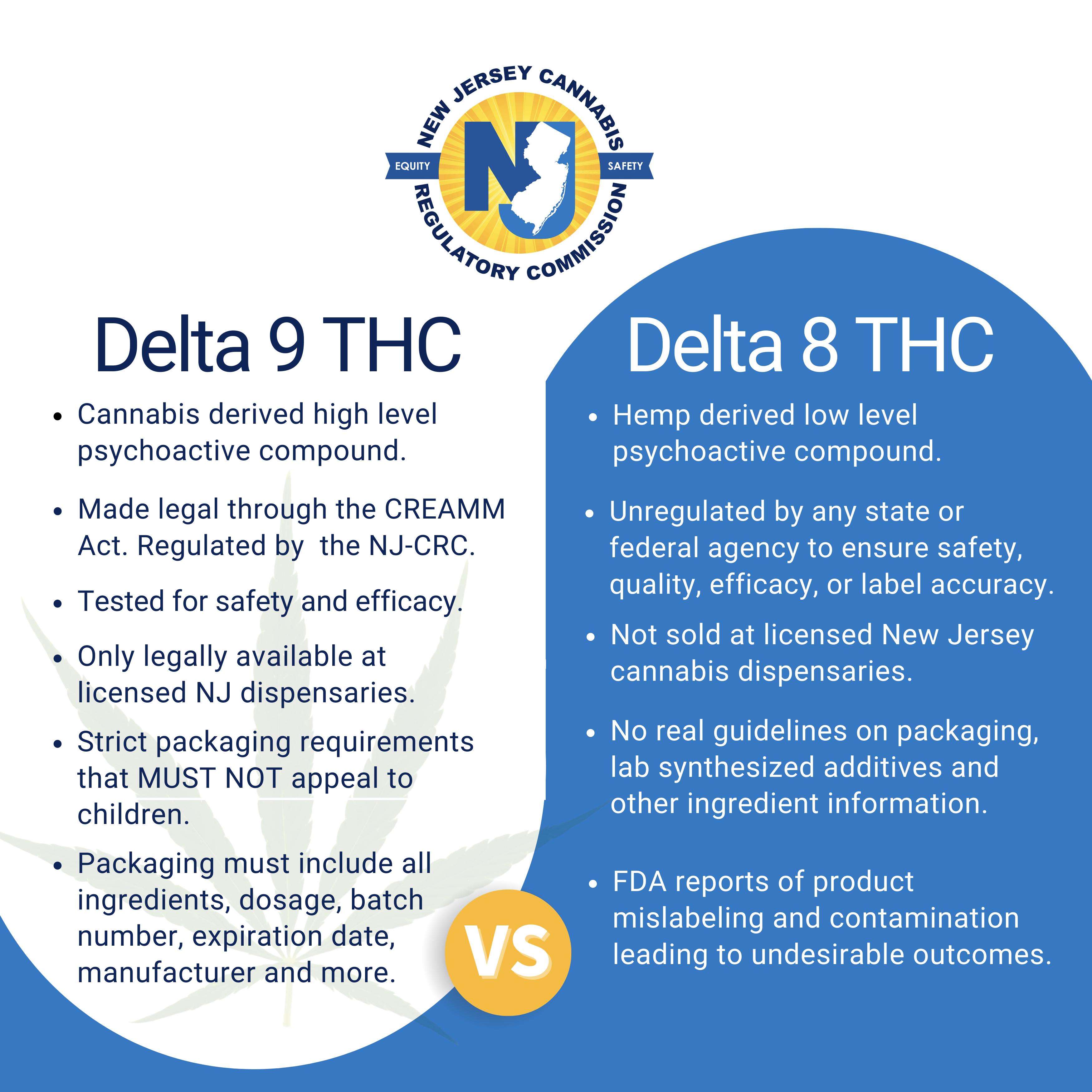
Unlike unregulated cannabis products, many intoxicating hemp products have been sold without consistent standards for testing, labeling, or manufacturing, largely due to a loophole created by the 2018 federal Farm Bill that allowed certain hemp-derived products to enter the market with limited oversight. They may contain contaminants, vary widely in potency, and be marketed in ways that would not be permitted in the regulated cannabis market.
Equally concerning is how these products are presented and sold. Many are packaged in ways that appeal to youth—trademarked gummies, snacks, and vape products that resemble familiar consumer goods advertised for children. These are the very types of products New Jersey’s regulated cannabis framework is designed to restrict. Yet in some cases, they have been available in everyday retail settings without the same age gating required of licensed cannabis businesses.
That’s not how New Jersey intended legal cannabis to work.
Over the past several years, the state has built one of the most tightly regulated cannabis markets in the country—one that requires testing, enforces age restrictions, and mandates clear labeling and packaging standards. At the same time, a parallel marketplace developed where intoxicating THC products were sold with far fewer safeguards.
The result is a system where products that would be prohibited in one setting are readily available in another. That’s what New Jersey’s new law is designed to fix.
In early 2026, the state enacted legislation to regulate intoxicating hemp-derived products and align with updated federal standards. The law closes the loophole created by the 2018 federal Farm Bill and reflects changes adopted by Congress in late 2025 to place stricter limits on THC and synthetic cannabinoids.
Put simply, the law clarifies that products with THC content exceeding 0.3% or relying on synthetic or chemically altered cannabinoids are no longer treated as “hemp.” They are treated as cannabis—meaning they must now be tested, accurately labeled, and sold under strict safety and age-restriction standards overseen by the NJ-CRC.
The closing of the loophole and the clarifying the definition of intoxicating THC products helps ensure products are tested, regulated, and only marketed or sold to adults over 21.
Like many significant policy changes, this one is being implemented in phases. The law took effect in early 2026, with key changes having been rolled out in April and continuing through November 2026.
As of April 13, products that exceed strict THC limits or involve synthetic cannabinoids no longer qualify as hemp under state law. Many items that were once sold in gas stations or smoke shops are now being reclassified as cannabis—meaning they must be sold through licensed cannabis dispensaries overseen by the NJ-CRC or removed from shelves altogether. A short transition period extends through May 31, when additional limits on THC content and production compliance take effect, further tightening controls on these products.
One of the most visible examples is hemp-derived THC beverages. These products may still be available in certain retail settings, but they are now subject to strict limits on THC content, testing requirements, and age-restricted sales designed to reduce youth access during the transition. By November 2026, they will no longer be sold outside of New Jersey’s regulated cannabis marketplace.
What you’re seeing now is part of a transition—not the final system.
Whether a product is “hemp” or “cannabis,” the effect is what matters. THC is THC, and products that produce the same effects should be treated the same way. If it can intoxicate, it should meet the same safety standards—not only to protect adults who choose to consume these products, but also to ensure they are not accessible to youth.
New Jersey voters supported legalization to create a safe, regulated marketplace—not a patchwork system where similar products are treated differently based on technical definitions.
It is the responsibility of the NJ-CRC to protect consumers, support responsible businesses, and ensure intoxicating products are not sold or marketed in ways that put our youth at risk.
This new law brings us closer to that goal.
Previous Blog Posts
Legit vs. Shady: How to spot a legal cannabis dispensary in New Jersey
04/27/2026
New Jersey has a regulated cannabis market with more than 300 licensed dispensaries across the state. In 2025, the NJ cannabis industry generated more than $1.16 billion in sales and $67.5 million in sales tax. With any new and lucrative industry, unlicensed operators try to cash in. Illegal marijuana isn’t just a legal risk for the business operators; it can also be dangerous for consumers. Unregulated products skip the safety testing, labeling requirements, and warnings that New Jersey law requires, and the shops don't have the guardrails in place to protect vulnerable populations like kids, teens, and young adults from gaining access to these products. Is legal cannabis on your shopping list? Here's how to spot a state-licensed cannabis dispensary:
Five years of regulation, responsibility, and growth
04/2/2026
As we approach the New Jersey Cannabis Regulatory Commission’s fifth anniversary, I’ve been reflecting on what it means to build two things at once: a new government agency and a new regulated industry. Neither comes with a roadmap. Both require patience, clarity of purpose, and the willingness to make difficult decisions in real time. In five short years, the Commission has significantly expanded access to medicinal cannabis and launched the adult-use market, which to date has generated approximately $4 billion in sales. But our success cannot be measured solely by speed; it must be measured by whether we built an industry grounded in equity, accountability, and meaningful opportunity. From the beginning, our work has been guided by a set of core principles that continue to shape every decision we make.

How Terpenes Affect Your Cannabis Experience
03/24/2026
Terpenes are aromatic compounds found in plants, including cannabis. They give plants their characteristic scents, help protect them from mold, fungus and other pathogens, and play a crucial role in modulating cannabis' psychoactive effects. For example, two strains with identical THC percentages can feel completely different, one may leave you sedated and the other may leave you energized. More than a hundred terpenes exist in cannabis, each with its unique aroma and potential therapeutic benefits. Terpenes are essential for shaping the plant’s impact on the human body and mind.