Official Site of The State of New Jersey

Cannabis and driving in New Jersey
Driving requires focus, coordination, and quick decision-making. Cannabis can interfere with these abilities. In New Jersey, driving under the influence of cannabis is illegal, even though cannabis itself is legal for adults 21 and older.
How cannabis impairs driving
Cannabis affects the brain and body through Tetrahydrocannabinol (THC), the main psychoactive compound in cannabis. THC can impact the skills drivers rely on every time they get behind the wheel.
Regular use doesn’t make driving safe
Some people who use cannabis often believe they can drive safely because they “feel normal” or think their body is used to it. The evidence says otherwise. Frequent users still show reduced driving ability after using cannabis, even when they don’t feel very high. In fact, regular users tend to underestimate how impaired they are and are more willing to get behind the wheel when they shouldn’t be.
Tolerance can change how cannabis feels. It does not make you a safe driver. Feeling functional is not the same as being safe to drive.
No matter how often you use cannabis, don’t drive high.
How long does cannabis affect your driving?
Impairment doesn’t end the moment the “high” wears off. The effects of cannabis on driving can last for several hours after use.
Edibles can be especially deceptive:
- They take longer to take effect, sometimes 30 minutes to 2 hours.
- Their effects last much longer than smoking or vaping.
- Impairment can peak well after you’ve finished consuming — long after you think you’re fine.
Because the effects are unpredictable and last longer than they feel like they do, never try to guess when it’s safe to drive. If you’ve used cannabis, make a plan for a sober ride. Don’t drive high.
Mixing cannabis and alcohol is even more dangerous
Using cannabis and alcohol together impairs driving more than either one alone. The combination can compound the effects on reaction time, coordination, and judgment, and people are especially likely to misjudge how impaired they really are. Even small amounts of each can add up to significant impairment.
If you’ve used cannabis, alcohol, or both, don’t drive. When in doubt, leave the car. Don’t drive high.
Cannabis impairment may cause:
- Slower reaction time: Drivers may take longer to respond to sudden changes on the road.
- Reduced coordination and motor control: THC can affect movement, balance, and physical control needed for steering and braking.
- Difficulty concentrating: Drivers may struggle to focus on multiple tasks at once, such as traffic signals, pedestrians, and other vehicles.
- Poor judgment and decision-making: Cannabis can alter perception and impair a driver’s ability to judge distance or speed.
- Altered perception: Depth perception and awareness of surroundings may be distorted.
Even when impairment feels mild, these changes can make driving dangerous.
Cannabis and the Law in New Jersey
Under New Jersey law, it is illegal to drive under the influence of any intoxicating substance. This applies regardless of whether cannabis is used for recreational or medical purposes. If a driver is impaired while operating a vehicle, they can be charged with driving under the influence (DUI).
Cannabis DUIs are prosecuted under the same statute as alcohol DUIs: N.J.S.A. 39:4-50.
Law enforcement officers may use trained Drug Recognition Experts (DREs) and other evidence to determine whether a driver is impaired by drugs.
Consequences of driving under the influence of cannabis
Operating a vehicle while impaired puts your safety and the safety of others at risk and can lead to serious consequences. Penalties for drug-related DUIs are similar to alcohol-related DUI penalties in New Jersey.
First Offense
- License loss 7 months – 1 year
Monetary consequences:
- $300–$500 fine
- $230 Intoxicated Driver Resource Center (IDRC) fee
- $100 Drunk Driving Fund fee
- $100 Alcohol Education and Rehabilitation Fund (AERF) fee
- $75 Safe Neighborhood Services Fund fee
- $1,000 insurance surcharge per year for three years
Additional consequences:
- Up to 30 days in jail
- 12–48 hours of the IDRC program
Second Offense (if within 10 years of first offense)
Possible penalties include:
- License loss for up to 2 years
- Prison term of between 48 hours and 90 days
- Intoxicated Driver Resource Center (IDRC) program
Monetary consequences:
- $500–$1,000 fine
- 48 hours–90 days in jail
- 30 days of community service
- Required IDRC participation
- Insurance surcharges (up to $1,000 per year)
Third Offense (if within 10 years of the first offense)
Possible penalties include:
- License loss for up to 10 years
- Prison term of 180 days
- 30 days community service
- 12–48 hours Intoxicated Driver Resource Center (IDRC) program
- Ignition interlock device during license suspension and 1-3 years following restoration
Monetary consequences:
- $1,000 fine
- $280 IDRC* fee
- $100 to Drunk Driving Fund
- $100 donation to the AERF
- $1,500 per year (for 3 years) insurance surcharge
- $75 to Neighborhood Services Fund
Other Consequences of a DUI
A DUI conviction can affect more than your driving privileges.
Possible impacts include:
- Imprisonment
- Loss of employment opportunities
- Financial penalties and court costs
- Mandatory education or treatment programs
Make a plan before you use cannabis
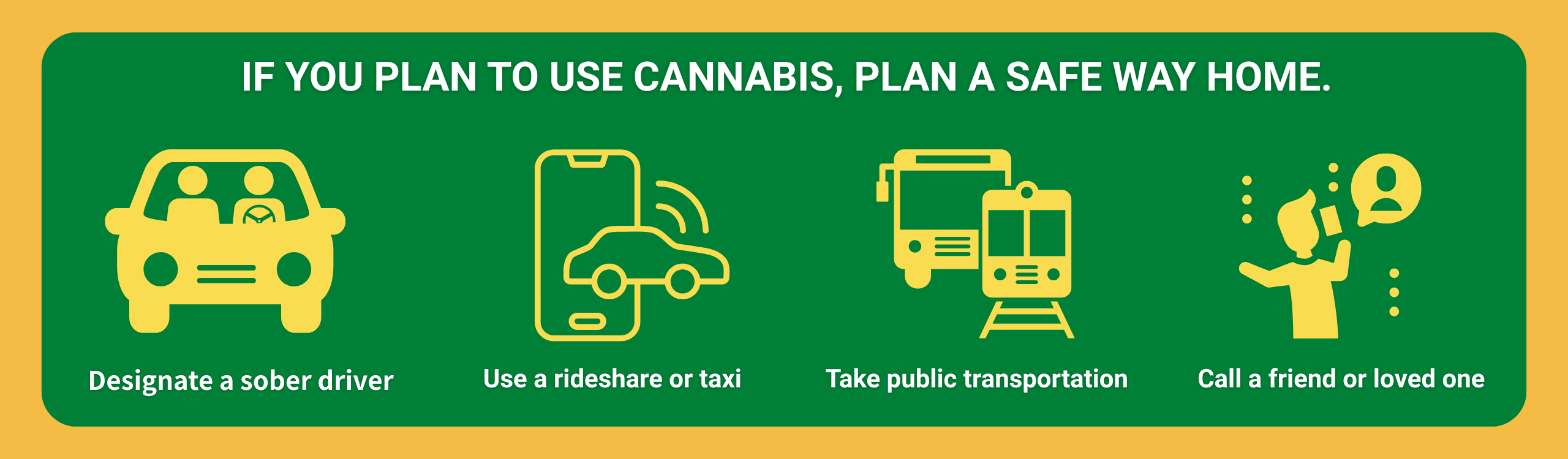
If you plan to use cannabis, plan a safe ride home.
- Designate a sober driver
- Use a rideshare or taxi
- Take public transportation
- Call a friend or loved one
Driving under the influence of cannabis is never safe. Never drive high.
Get help
New Jersey Poison Control Center: If you have concerns about accidental exposure: call 1-800-222-1222 or chat at https://njpies.org .
ReachNJ is a central call-in line for New Jersey residents who are looking for help with a substance use disorder (SUD). Serves all New Jersey residents. Call 1-844-ReachNJ or 1-844-732-2465. Learn more by visiting reachnj.gov
Substance Abuse and Mental Health Services Administration (SAMHSA) National Helpline: Free, confidential treatment referral and information service, available 24/7. Call: 1-800-662-HELP (4357) | findtreatment.gov
Disclaimer
This information is provided for general understanding and is not intended to serve as legal advice. For guidance tailored to your specific situation, we recommend consulting your own legal counsel.
The health and safety information on the Don’t Drive High page is grounded in peer-reviewed research and federal guidance on how cannabis affects driving.
Key sources are listed below.
Marcotte, T. D., Umlauf, A., Grelotti, D. J., Sones, E. G., Sobolesky, P. M., Smith, B. E., Hoffman, M. A., Hubbard, J. A., Severson, J., Huestis, M. A., Grant, I., & Fitzgerald, R. L. (2022). Driving performance and cannabis users’ perception of safety: A randomized clinical trial. JAMA Psychiatry, 79(3), 201–209. https://jamanetwork.com/journals/jamapsychiatry/fullarticle/2788264
McCartney, D., Arkell, T. R., Irwin, C., & McGregor, I. S. (2021). Determining the magnitude and duration of acute Δ9-tetrahydrocannabinol (Δ9-THC)–induced driving and cognitive impairment: A systematic and meta-analytic review. Neuroscience & Biobehavioral Reviews, 126, 175–193.
https://www.sciencedirect.com/science/article/pii/S0149763421000178
Preuss, U. W., Huestis, M. A., Schneider, M., Hermann, D., Lutz, B., Hasan, A., Kambeitz, J., Wong, J. W. M., & Hoch, E. (2021). Cannabis use and car crashes: A review. Frontiers in Psychiatry, 12, 643315.
Frontiers | Cannabis Use and Car Crashes: A Review
Ramaekers, J. G., Mason, N. L., Kloft, L., & Theunissen, E. L. (2021). The why behind the high: Determinants of neurocognition during acute cannabis exposure. Nature Reviews Neuroscience, 22(7), 439–454. The why behind the high: determinants of neurocognition during acute cannabis exposure
Rogeberg, O., & Elvik, R. (2016). The effects of cannabis intoxication on motor vehicle collision revisited and revised. Addiction, 111(8), 1348–1359. https://onlinelibrary.wiley.com/doi/10.1111/add.13347
National Highway Traffic Safety Administration (NHTSA). Drug-impaired driving. Drug-Impaired Driving | NHTSA
Pearlson, G. D., Stevens, M. C., & D'Souza, D. C. (2021). Cannabis and Driving. Frontiers in psychiatry, 12, 689444. https://www.frontiersin.org/journals/psychiatry/articles/10.3389/fpsyt.2021.689444/full