Official Site of The State of New Jersey

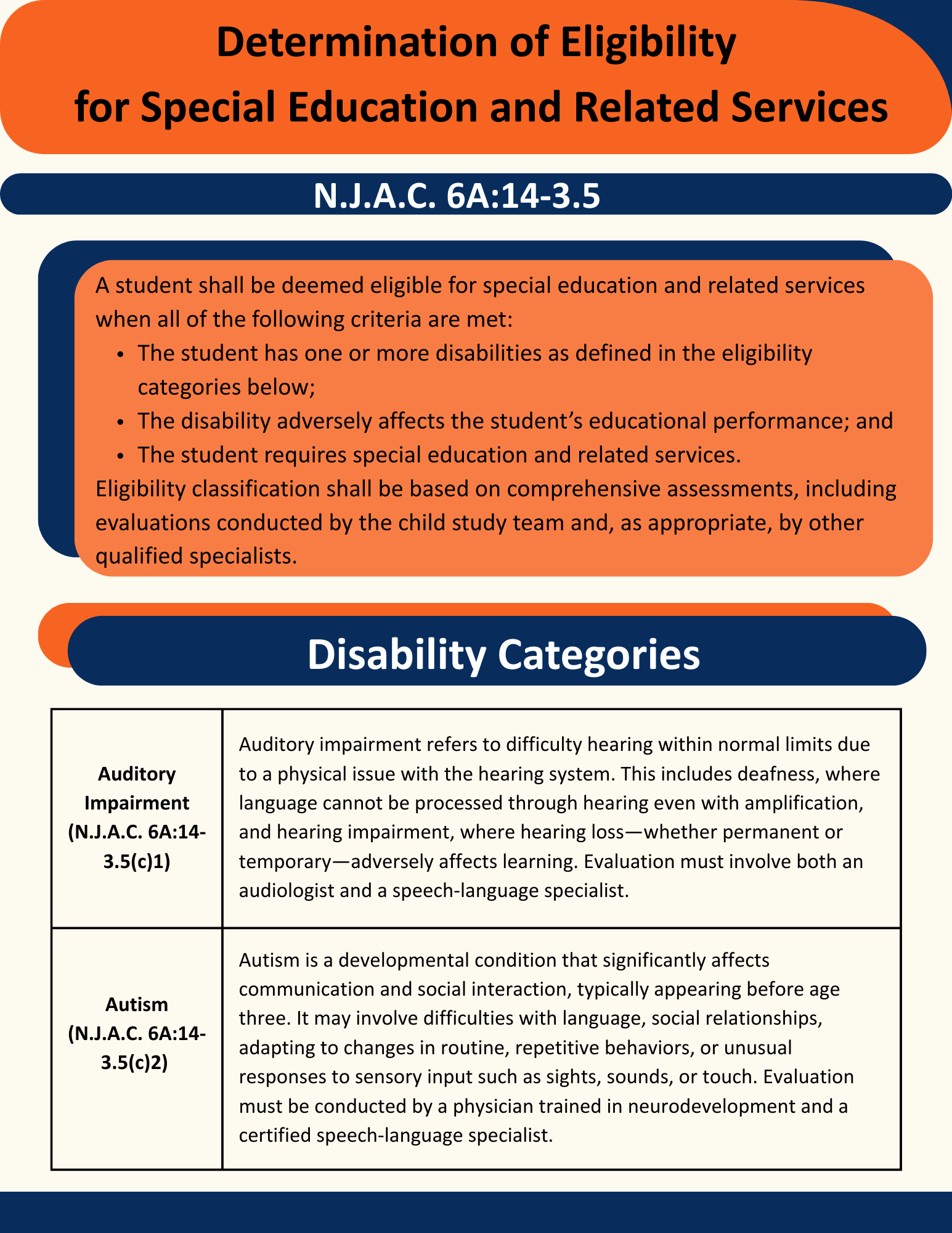
Click on the following to access the web-based resource titled “Determination of Eligibility for Special Education and Related Services.” Printing and translation options are available.
Parental Rights and Engagement
Parents and families are recognized under the Individuals with Disabilities Education Act (IDEA) as essential participants in the special education process. Federal and state regulations ensure that families are involved in decision-making related to the identification, evaluation, placement, and provision of services for students with disabilities.
In New Jersey, the Department of Education’s (DOE) Office of Special Education (OSE) provides oversight and guidance to ensure that local education agencies (LEAs) comply with IDEA and state-specific special education requirements. Families may access supports through the OSE and through organizations such as the Statewide Parent Advocacy Network (SPAN), which serves as New Jersey’s federally designated Parent Training and Information Center (PTI), offering technical assistance, training, and resources related to special education rights and procedures.
New Jersey Administrative Code for special education (N.J.A.C. 6A:14) and the federal Individuals with Disabilities Education Act of 2004 (IDEA 2004) are laws that ensure children with disabilities receive a free, appropriate education (FAPE) in the least restrictive environment (LRE). An important part of these laws provides parents with the right to participate in their children’s education.
You and representatives of the LEA are team members who are responsible for developing an appropriate educational program for your child. The PRISE booklet describes the state and federal laws affecting the provision of special education to help you understand your rights in the special education process. With this knowledge, you will be prepared to take an active role in your child’s education.
The PRISE booklet has been developed by the OSE, in an effort to provide the most comprehensive and up-to-date information. The document is periodically revised to reflect changes in the law, provide additional information that would be of use to you, and to provide the information in a more clear and concise manner.
- English (2026)
- Spanish (2026)
- Arabic (2026)
- Chinese (2026)
- Chinese Traditional (2026)
- Portuguese (2026)
- Gujarati (2026)
- Haitian Creole (2026)
- Hindi (2026)
- Korean (2026)
- Russian (2026)
- Tagalog (2026)
Response to Intervention (RTI) is an educational approach designed to identify and support students who are struggling academically or behaviorally as early as possible, before considering special education services. RTI offers proactive, tiered support specific to each student's needs, ensuring each student receives the help they need as soon as possible.
The main goals of RTI are to:
- Catch learning or behavior difficulties early,
- Provide targeted instruction and interventions,
- Use regular progress monitoring (data, screenings, assessments) to determine what is working,
- Adjust support quickly if a student is not improving.
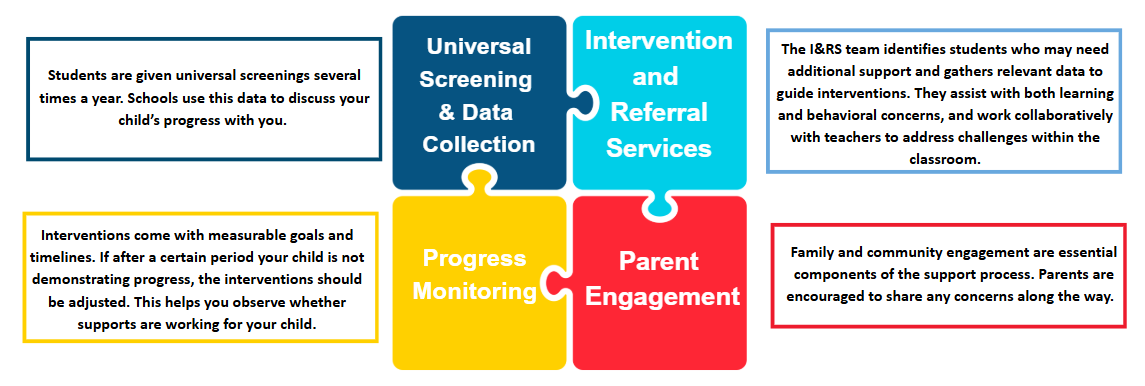
In New Jersey, RTI is not just a school practice, it is part of the New Jersey Tiered System of Supports (NJTSS). NJTSS builds on the RTI model and expands it to cover academics, behavior, and social-emotional learning.
The NJTSS framework includes several mechanisms to address these concerns:
Resources
- Office of Special Education's Interventions, Supports, and Initiatives
- New Jersey Tiered System of Supports
- Center for Multi-Tiered Systems of Support
- NJTSS Early Reading
- Literacy Resources and Interventions for Students with Disabilities
- A Parent Checklist: What Parents and Caregivers Can Ask and Do to Help Children Strive at School
- Title III, Part A Language Instruction for English Learners and Immigrant Students
- Language Instruction for English Learners and Immigrant Students: Parental and Family Engagement
Please note that the links provided are suggestions for resources and do not constitute an endorsement or approval by the NJDOE of any of the products, services or opinions of the corporation or organization or individuals.
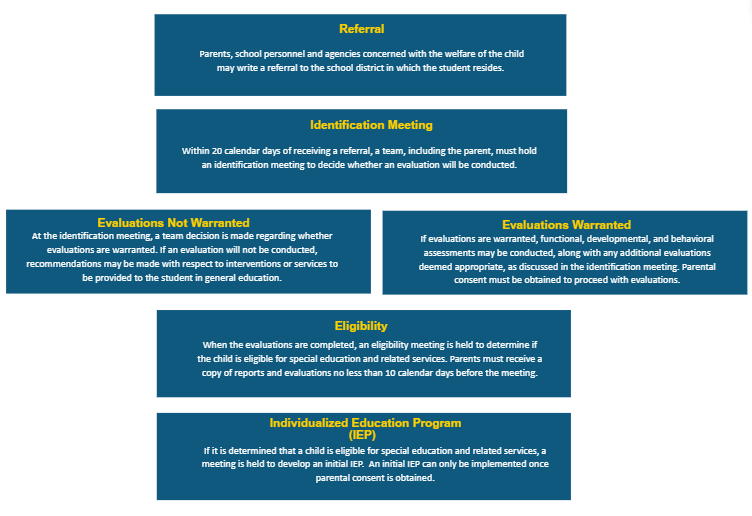
A referral is a written request for an evaluation that is given to the LEA to assess whether a child is eligible for special education services. Referrals for special education evaluations must be based on concerns regarding a student's educational performance and the suspected impact of a disability on their ability to succeed in the general education setting. Referrals can be made by:
- Parents
- School personnel
- Agencies concerned with the welfare of students, including the New Jersey Department of Education
The Referral Process
The Child Study Team
The Child Study Team (CST) is responsible for managing the initial evaluation process from the time of referral to the IEP implementation, if eligible. CST members include a school psychologist, a learning disabilities teacher-consultant, and a school social worker. Specialists who may support your child may also include (but are not limited to) speech-language specialists, occupational therapists, physical therapists, audiologists, school nurses, advance practice nurses, and physicians who are appropriately certified and/or licensed to carry out activities, as related to the needs of your child.
Resources
Special education is a tailored instructional program designed to meet the unique learning needs of students with disabilities. It is provided by LEAs at no cost to families and includes a range of services, supports, and accommodations. Special education is guaranteed under the IDEA, which ensures that eligible students receive individualized education and that parents/guardians are afforded specific legal rights in the process.
Eligibility for Special Education and Related Services
Eligibility classification shall be based on comprehensive assessments, including evaluations conducted by the CST and, as appropriate, by other qualified specialists.
A student shall be deemed eligible for special education and related services when all of the following criteria are met:
- The student has one or more disabilities as defined in the eligibility categories;
- The disability adversely affects the student’s educational performance; and
- The student requires special education and related services.
Eligibility for Speech-Language Services Only
Eligible for speech-language services means a speech and/or language disorder as follows:
- A speech disorder in articulation, phonology, fluency, voice, or any combination, unrelated to dialect, cultural differences, or the influence of a foreign language, that adversely affects a student's educational performance; and/or
- A language disorder that meets the criteria at N.J.A.C. 6A:14-3.5(c)4 and the student requires speech-language services only.
Resources
- Individual with Disabilities Education Act (IDEA)
- NJ Administrative Code
- N.J.A.C. 6A:14, Special Education
- State-Imposed Rules, Regulations, and Policies Not Required by IDEA or Federal Requirements (February 2024)
- Disability & Special Education Acronyms
Please note that the links provided are suggestions for resources and do not constitute an endorsement or approval by the NJDOE of any of the products, services or opinions of the corporation or organization or individuals.
An IEP is a written plan that is created to meet the unique needs of students with disabilities. It is created by the IEP team, which is comprised of the student’s parents, teachers, and other professionals who are familiar with the student or who have knowledge in an area related to the student’s disability. The IEP describes a student’s special education program, which includes any services or accommodations that the student may receive to help them meet their goals. IEPs are reviewed annually to assess the student’s progress, skills, and needs.
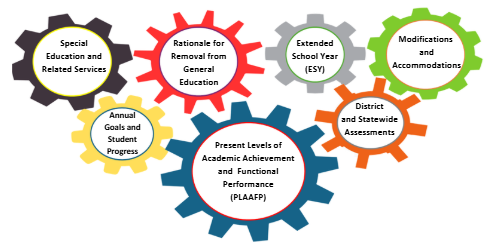
An IEP contains different sections that all work together to create an individualized program for the student. Like every child, every IEP is unique. Some sections that you will see in your child’s IEP include:
Resources
- Components of an Individualized Education Program (IEP)
- Overview of an IEP
- Contents of an IEP
- Navigating an IEP
- IEP Overview-Tip Sheet for Parents
- The IEP Team - Tip Sheet for Parents
- IEP Team Meeting Guide for Families
Please note that the links provided are suggestions for resources and do not constitute an endorsement or approval by the NJDOE of any of the products, services or opinions of the corporation or organization or individuals.
The OSE encourages parents and LEAs to work collaboratively, in the best interests of children, to resolve disagreements that may occur when working to provide a positive educational experience for students with disabilities. There may be a time when you and your LEA disagree. Many disagreements can be resolved by communication with your child’s teacher, case manager, the school principal, or other school district personnel. There are also procedures established under state and federal law to address your concerns, such as complaint investigation, mediation, or a due process hearing.

Creating Partnerships through Communication
Facilitated IEPs (FIEPs)
Facilitated IEP meetings help to promote effective communication and assist the IEP teams in developing a mutually acceptable IEP, while also addressing conflicts and disagreements that may have occurred before or emerge during the development of the IEP. FIEPs provide an alternative to formal dispute resolution and encourage collaborative student-focused IEP meetings, supported by facilitators from the OSE.
Dispute Resolution
When efforts to resolve disagreements are unsuccessful, the IDEA and N.J.A.C. 6A:14 provide specific options for resolving disputes between parents and LEAs.
Dispute resolution is a formal process to address and resolve disagreements between parents and schools regarding the identification, evaluation, educational placement, or provision of FAPE for students with disabilities. This process ensures that families and LEAs have access to procedural safeguards, as mandated by the IDEA, to protect the rights of students with disabilities and their parents.
- Mediation and Due Process
- If there is a disagreement regarding the identification, evaluation, reevaluation, classification, educational placement, the provision of FAPE, or a disciplinary action, under N.J.A.C. 6A:14-2.6-2.7, a mediation or due process hearing may be requested.
- Complaint Investigation
- A procedure for alleging that a public or private education agency providing publicly funded educational programs and services to students with disabilities, including the State Department of Education, has violated federal or state special education law. A State complaint, as its name indicates, is filed with the State Department of Education, and requests an investigation by the OSE of the alleged violation(s).
Additional Information and Resources
- Facilitated IEPs (FIEPs) Website
- Dispute Resolution Website
- E-Learning Opportunities
- NJDOE’s Contact Information for Dispute Resolution
- Complaint Investigation: specialeducationcomplaints@doe.nj.gov
- Due Process/Mediation: osepdisputeresolution@doe.nj.gov
Please note that the links provided are suggestions for resources and do not constitute an endorsement or approval by the NJDOE of any of the products, services or opinions of the corporation or organization or individuals.
The OSE is committed to supporting families of students with disabilities. To enhance this support, the OSE created the Family Support Specialist (FSS) position, a role dedicated exclusively to assisting families navigating disagreements related to special education services. The FSS offers individualized guidance via phone and email on topics such as effective communication with districts, early resolution, mediation, and due process. This role complements the broader function of the Special Education Ombudsman by focusing specifically on helping families understand and access their dispute resolution options.
The FSS ensures families receive clear, up-to-date information and practical tools tailored to their unique needs, empowering them to make informed decisions. With over half of all inquiries to OSE involving dispute resolution—most initiated by families—the creation of the FSS role addresses a growing demand for focused, empathetic, and knowledgeable support. By tracking data daily, the FSS identifies trends and provides feedback to improve the dispute resolution system, keeping family perspectives central to program development.
Contact Information for the Family Support Specialist
Cynthia Hoenes-Saindon
Phone: 609-376-9060
Email: cynthia.hoenes-saindon@doe.nj.gov
Resources
- Family Resource Network
- Family Connects NJ
- Caregivers of New Jersey
- Family Support Organizations
- Family Success Centers
- National Center for Families Learning
- NJ Parent Link Resource Center
- Center for Parent Information and Resources
- Department of Health - Special Needs
- Perform Care
Helplines and Hotlines
Each district board of education shall ensure that a special education parent advisory group is in place in the district to provide input to the district on issues concerning students with disabilities. (N.J.A.C. 6A:14-1.2(h))
A Special Education Parent Advisory Group (SEPAG) is a district-level, parent-led group required by New Jersey law (N.J.A.C. 6A:14-1.2(h)) to give input on issues impacting students with disabilities. SEPAGs create a space for families and school leaders to collaborate on special education services and supports at the district level. Designed to be inclusive, SEPAGs focus on improving outcomes for all students with disabilities.
A Guide for Best Practices in Developing and Implementing an Effective SEPAG
The Building Resources for Inclusive Development and Growth in Education (BRIDGE) Initiative is a new partnership between Rutgers University and the NJ Department of Education Office of Special Education. It promotes strong partnerships between families and schools to help students with disabilities make steady progress towards their learning goals. The BRIDGE initiative's work is centered around the areas of SEPAG development, improvement, and sustainability; family and school literacy partnerships; and New Jersey Tiered Systems of Support (NJTSS) understanding and home support.
There are many resources about special education and family engagement, but it can be hard to know what you need, what to trust, and how to use it. BRIDGE brings the best materials together in one place. The BRIDGE team curates, creates, and organizes high-quality resources so you can easily find what works and get support in putting it into practice. Resources can be found on the The BRIDGE Portal -an online library of videos, guides, activities, and events with an AI assistant to help you find what you need and use what you learn. The portal houses high-quality materials designed for a variety of audiences around meaningful parent engagement.
For more information, including access to The BRIDGE Portal, resources, and partnership opportunities:
- Visit The BRIDGE Initiative | Rutgers CESP & NJDOE; or
- Email: cesp@gse.rutgers.edu.
Web-based Parent Information
-
Student Information Card for School Bus Drivers and Aides Serving Students with Disabilities
- Student Information Card (Template)
- Broadcast Memo (August 2026)
- Broadcast Memo (January 2025)
- Bus Safety Website Overview
- Student Information Card (Template)
-
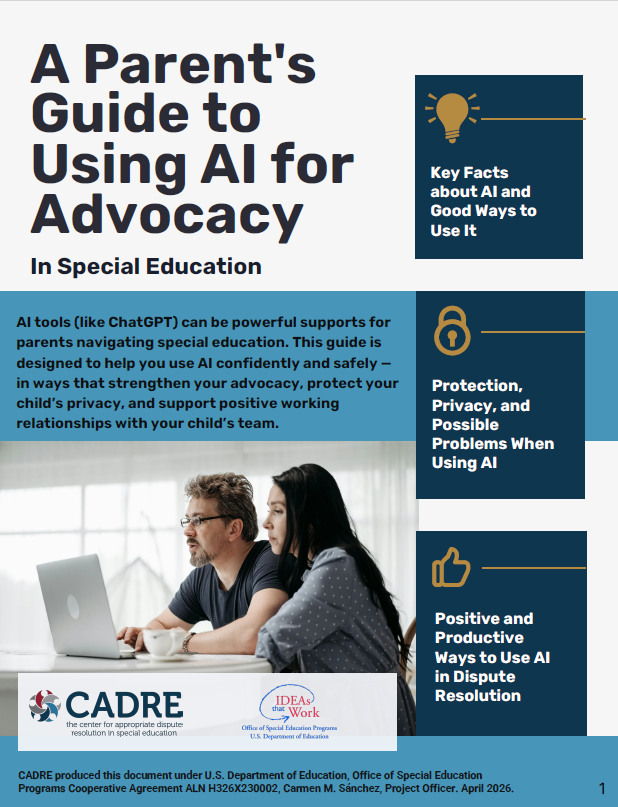
Click on the following to access the web-based resource titled “A Parent's Guide to Using AI for Advocacy.”
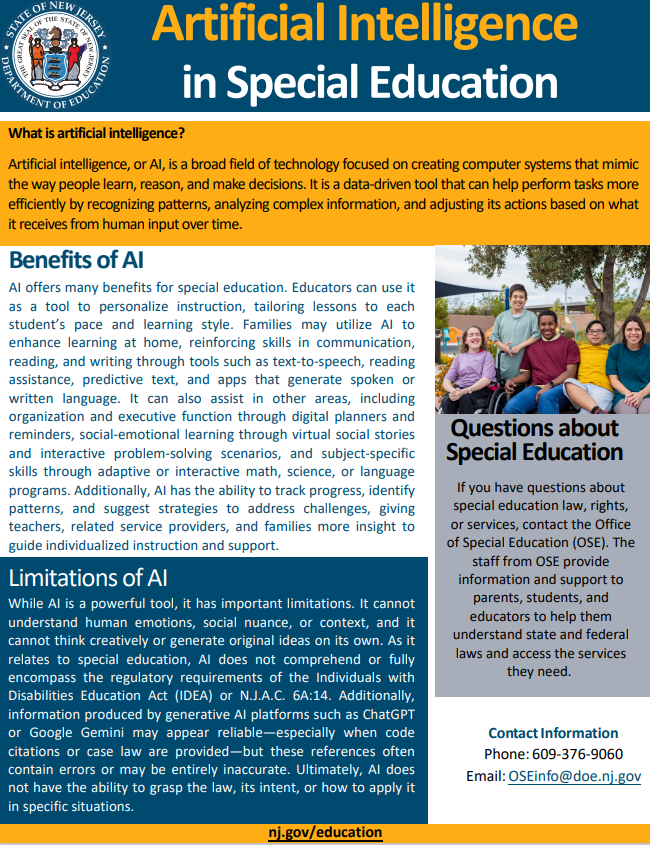
Click on the following to access the web-based resource titled “Artificial Intelligence in Special Education.”
-
-
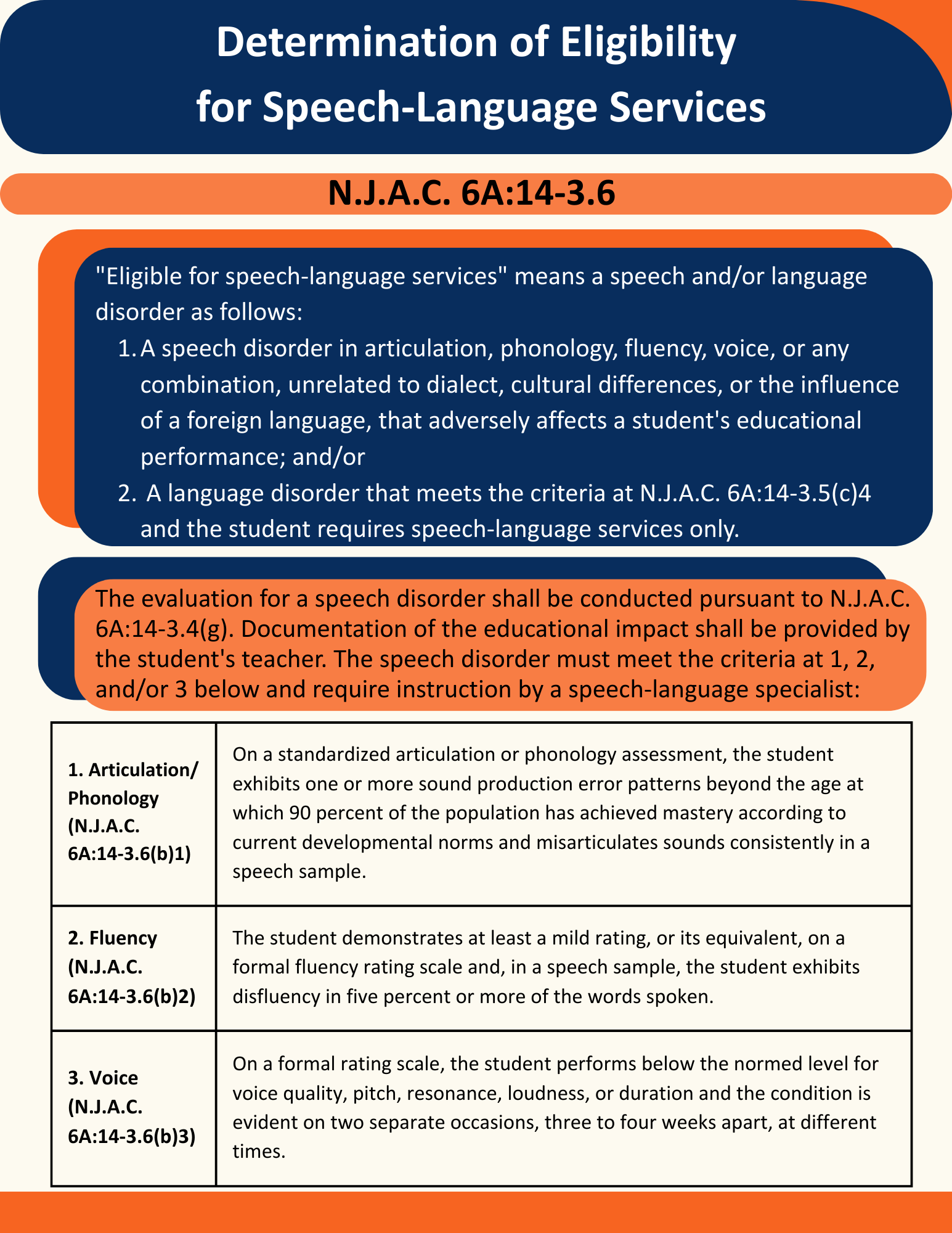
Click on the following to access the web-based resource titled “Determination of Eligibility for Speech-Language Services.” Printing and translation options are available.
-
Click on the following to access the web-based resource titled “IEP Components.” Printing and translation options are available.