Official Site of The State of New Jersey
What Individuals, Families and Providers Should Know
The New Jersey Department of Human Services (DHS), through its Office of Program Integrity and Accountability (OPIA), works to make sure that adults with developmental disabilities receive safe, high-quality care. One important way DHS does this is through its Risk Management System (RMS).
What is the Risk Management System?
Risk management means taking steps to reduce the chance of harm, both to individuals and to the systems that support them. The RMS helps DHS monitor and improve the quality of services provided by licensed agencies that serve adults with developmental disabilities.
How Does It Work?
DHS gathers important information from several sources, including but not limited to:
- Licensing inspections
- Reports of serious incidents
- Investigations
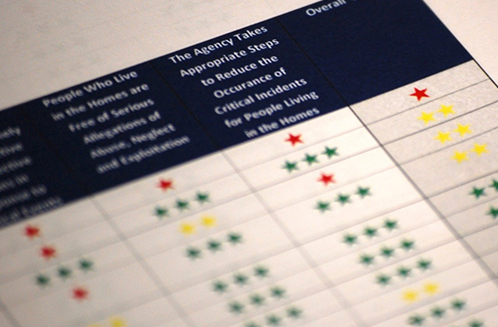
This information is compiled into the DHS Licensed Provider Report Card, which gives a clear picture of how each provider is doing. DHS uses this data to spot patterns that might signal a provider needs extra help or attention to prevent future problems. The Companion Guide to the DHS Licensed Provider Report Card explains how to understand and use the information in the Provider Report Card, which is published in a format to enable consumers and families to compare provider performance to inform decisions about where to seek care.
- Published on September 1, 2026 - Provider Report Card July 1, 2025 - June 30, 2026
- Published on September 1, 2026 - Companion Guide to the DHS OPIA Report Card
More Languages
- Guía complementaria al informe de evaluación de la OPIA del DHS Spanish (US)
- Guia-complementar-para-o-boletim-DHS-OPIA Portuguese (BR)
- DHS-OPIA-평가표-안내서 Korean
- DHS-OPIA-રિપોર્ટ-કાર્ડ-માટે-સાથી-માર્ગદર્શિકા Gujarati
- DHS OPIA 报告卡配套指南 Simplified Chinese
- DHS OPIA 通報卡配套指南 Traditional Chinese
- Gid-Konpayon-pou-Fich-Rapò-DHS-OPIA Haitian (Creole)
- الدليل المصاحب لبطاقة تقرير مكتب نزاهة ومساءلة البرامج التابعة لوزارة الخدمات الإنسانية Arabic
- Published on June 1, 2026 - Provider Report Card April 1, 2025 - March 31, 2025
- Published on March 1, 2026 - Provider Report Card January 1, 2025 - December 31, 2025
- Published on December 1, 2025 - Provider Report Card October 1, 2024 - September 30, 2025
- Published on February 1, 2025 - Provider Report Card January 1, 2024 - December 31, 2024
- Published on February 1, 2024 - Provider Report Card January 1, 2023 - December 31, 2023
- Published on February 1, 2023 - Provider Report Card January 1, 2022 - December 31, 2022
The DHS Council on Systemic Risk – A team of senior leaders from different disciplines in DHS called the DHS Council on Systemic Risk, meets regularly to look closely at providers who show signs of higher risk based on the Report Card and other data. If a provider has multiple areas of concern, the Council will recommend steps to improve services and keep people safe. In circumstances when serious or repeated problems are found across a provider’s programs, DHS may assign a Quality Management Team to work directly with that provider.
What is a Quality Management Team (QMT)?
A Quality Management Team is a group formed by DHS to give a provider more intensive, direct oversight and support. While DDD and OPIA’s Office of Licensing, Office of Performance Management, and Office of Prevention address specific instances of provider noncompliance with licensing requirements and ensure appropriate actions are taken to improve quality following incidents, QMTs provide comprehensive support to providers when pervasive issues have been identified. A QMT is only used when a provider is struggling with serious issues, including but not limited to:
- Repeated non-compliance with regulations
- Poor outcomes for individuals served
- Systemic concerns about safety, health, or well-being
The QMT works with the provider to:
- Set clear expectations
- Offer structure and guidance
- Help the provider improve its systems and services
- Ensure individuals are safe and receiving high-quality care
The ultimate goal of a QMT is to help providers meet all quality and compliance standards, leading to better outcomes for the people they serve. Whenever possible, DHS tries to work proactively with providers to resolve issues before a QMT becomes necessary. Open communication and early problem-solving are always preferred. However, if a provider does not show sustained improvement in areas identified by the QMT, it may lead to additional, escalated licensing actions against one or all programs operated by the provider.
Why This Matters to Families and Individuals
The RMS, Council, and QMT process are all part of DHS’s commitment to:
- Keeping individuals with developmental disabilities safe
- Promoting accountability across the system
- Supporting providers in delivering high-quality care
- Ensuring everyone involved—individuals, families, and providers—has trust in the services being delivered
If you are a family member or a person receiving services, know that DHS is actively working behind the scenes to identify and fix problems before they affect someone’s quality of life.
If you are a provider, DHS is a partner in helping you succeed. Your success directly benefits the people, we serve.

Explore the Website