
The disability community has long faced social and economic marginalization. Over the past century, however, there have been many efforts – legal, political, and social – to ensure the civil and human rights of people with disabilities.
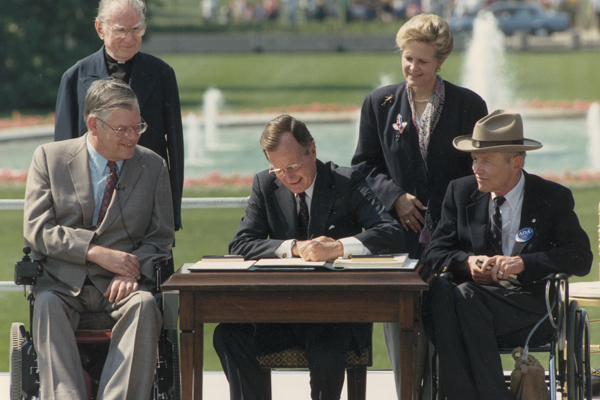
Among the most notable outcomes –
The following information and resources are available for members of the disability community to assist them in protecting their rights and obtaining the services they need and deserve.
NJ Department of Law and Public Safety
The NJ Department of Law and Public Safety (DLPS), headed by the Attorney General, has broad oversight of the state’s legal and law enforcement matters.
Under the direction of the State’s Attorney General, the NJ Division on Civil Rights (DCR) is the state agency charged with enforcing New Jersey's civil rights laws. This includes the New Jersey Law Against Discrimination (NJLAD), the New Jersey Family Leave Act (NJFLA), and the Fair Chance in Housing Act (FCHA).
The NJ Department of Education (DOE) mission is to support schools, educators, and districts to ensure all students have equitable access to high-quality education.
NJ Office of Special Education
The NJ Office of Special Education (OSE), housed in the DOE, has a responsibility under federal statute and regulations to monitor the implementation of the Individuals with Disabilities Education Act of 2004 (IDEA) by local education agencies. It provides the following legal resources for parents:
NJ Office of the Corrections Ombudsperson
The NJ Office of the Corrections Ombudsperson is an independent office that addresses concerns with the safety, health, and well-being of incarcerated individuals. The NJ Office of the Corrections Ombudsperson can provide guidance and advocacy services to an individual with a disability who has entered the State corrections system.
Any concerns regarding individuals housed in the County Jails should be directed to the County Jail Warden or Director.
The NJ Judiciary is one of three branches of state government. This branch is constitutionally responsible for ensuring that legal disputes are resolved fairly to preserve the rule of law and protect the rights guaranteed by both the US and NJ constitutions. The NJ court system includes the Supreme Court, the Superior Court, the Tax Court, and the Municipal Courts.
NJ County Surrogate Offices – Guardianship Matters
The NJ County Surrogate Offices' duties include the probating of wills, appointing of estate administrators, supervising the appointment of legal guardians for disabled individuals, and adoptions.
When individuals with disabilities and their families are planning for the transition to adulthood, one consideration is legal status. Our Legal Status Resources page provides information on types of guardianship as well as alternatives to guardianship.
NJ Judiciary Ombudsman Program
Each County Superior Court has a Judiciary Ombudsman that can assist individuals with general questions about the county court system, provide information about court proceedings, and provide necessary forms. Judiciary Ombudsmen do not provide legal advice.
The NJ court system provides reasonable accommodations for people with disabilities and maintains a list of Title II ADA Coordinators to lend assistance.
The US Department of Justice’s (DOJ) mission is to uphold the rule of law, keep our country safe, and protect civil rights.
The US Civil Rights Division (CRT), housed in the DOJ, enforces federal laws that protect individuals from discrimination based on race, color, national origin, disability status, sex, religion, familial status, or loss of other constitutional rights.
The Americans with Disabilities Act (ADA) protects people with disabilities from discrimination. ADA.gov provides information on how to file ADA complaints.
Disability Rights NJ (DRNJ)is the state’s designated protection and advocacy agency under federal law. Protection and Advocacy Systems (P&As) work at the state level to protect the rights of people with disabilities. DRNJ provides no-cost legal representation and advocacy for individuals needing help that falls under the organization’s areas of assistance.
The Arc of NJ - Criminal Justice Advocacy Program
The Criminal Justice Advocacy Program serves as a clearinghouse for information about offenders, victims and witnesses with developmental disabilities and serves as a liaison between the criminal justice and human service systems, monitoring the quality of care and service provided to those with developmental disabilities as they move from one system to another. The program does not provide legal advice. The program provides intervention, advocacy, case management, education, training, and the development of personalized justice plans for individuals with I/DD as an alternative to incarceration.
Legal Services of NJ provides no-cost representation for low-income individuals needing help with civil court matters.
Founded in 1976, the Community Health Law Project (CHLP) is a statewide not-for-profit organization that provides legal representation and advocacy services to low-income individuals with disabilities and the frail elderly.
CHLP offers services in a number of areas including, but not limited to, Social Security Disability Insurance; Supplemental Security Income; public entitlements; landlord-tenant matters; family law; Medicaid/Medicare; home care issues involving private duty nursing, personal care assistance, and durable medical equipment; consumer law; foreclosure; reverse mortgage issues; barrier-free accessibility; housing discrimination; guardianships; and document drafting such as Wills, Living Wills, and Powers of Attorney.
Local County Bar Associations offer lawyer referral services for their residents. Information on how to connect with a county bar association can be found at the NJ Bar Association website.
New Jersey Bar Association Foundation Publications:
Volunteer Lawyers for Justice’s mission is to ensure access to justice for people experiencing poverty by assisting with civil matters.
The Community Justice Center is a non-profit that serves low-income individuals with disabilities and returning disabled veterans and their families with issues related to the Department of Veterans Affairs and the Social Security Administration.
The Education Law Center pursues justice and equity for public school students by enforcing their right to a high-quality education in safe, equitable, non-discriminatory, integrated, and well-funded learning environments.
 Official Site of The State of New Jersey