 Department of the Treasury


Treasury Announces Gas Tax Rate Will Increase by 4.2 Cents Effective January 1, 2026
(TRENTON) – After a thorough review of fuel consumption statistics and consultation with the Legislative Budget and Finance Officer, the Department of the Treasury announced today that New Jersey’s gas tax rate will increase by 4.2 cents per gallon beginning on January 1, 2026 to support the State’s Transportation Trust Fund (TTF) program. This increase is the result of the 2024 law (Chapter 7) which gradually raises the State’s Highway Fuel Cap from Fiscal Year 2025 through Fiscal Year 2029. The Fiscal Year 2026 Highway Fuel Cap is set by statute at exactly $2.115 billion, which is 4.1 percent higher than the previous baseline level of $2.032 billion, and will increase each fiscal year, reaching $2.366 billion in FY 2029.
“Due to the new statutory target, and because actual consumption has trended below last fiscal year’s levels, our analysis of the new formula dictates a 4.2 cent increase this coming January,” said State Treasurer Elizabeth Maher Muoio. “We emphasize that this dedicated funding stream continues to provide billions of dollars across the State to support our critical transportation infrastructure needs.”
Under Chapter 7, New Jersey’s TTF program is required to provide nearly $11 billion over five years to support critical infrastructure improvements to the State’s roadways and bridges. In order to ensure the State has the funds necessary to support these projects, the law dictates that the Petroleum Products Gross Receipt Tax (PPGRT) rate must be adjusted accordingly to generate enough revenue to meet the statutory Highway Fuel Cap for that fiscal year.
What is generally called the “gas tax” or the “highway fuels tax” is actually two separate taxes on gasoline and diesel fuel – the Motor Fuels Tax and the PPGRT.
Under the formula explicitly outlined in Chapter 7, the PPGRT rate will increase on January 1, 2026 from 34.4 cents to 38.6 cents for gasoline and from 38.4 cents to 42.6 cents for diesel fuel. When combined with the Motor Fuels Tax, which is fixed at 10.5 cents for gasoline and 13.5 cents for diesel fuel, the total tax rates that motorists will pay for gasoline and diesel fuel will be 49.1 cents and 56.1 cents, respectively.
Background on Chapter 7 & Calculation of Tax Rate Formula
Under Chapter 7, a statutory formula determines how much the PPGRT rate is to be adjusted annually in order to meet that year’s Highway Fuel Cap. The Treasurer is required to meet with the Legislative Budget and Finance Officer on or before November 15th of each fiscal year to determine the total revenue derived from highway fuels consumption. This process just concluded, with Treasurer Muoio and Legislative Budget and Finance Officer Thomas Koenig consulting on consumption data and revenue collections.
The PPGRT rate may be adjusted annually for the following two reasons:
When necessary, the PPGRT rate is adjusted:
Fiscal Year 2026 Rate Calculation
Treasury applied the above formula based on the following revenue numbers:
Supporting Statistics
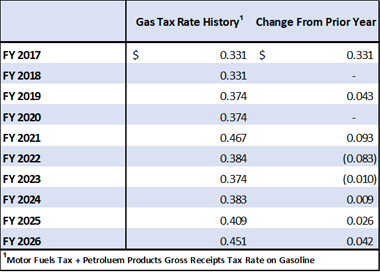
Consumption of gasoline and diesel fuel in Fiscal Year 2026 is projected to be 1.0 percent below Fiscal Year 2025 levels. As a result, the Fiscal Year 2026 PPGRT rate will be higher than in Fiscal Year 2025 because of the increased Highway Fuel Cap and declining consumption.The table below shows the annual combined Motor Fuels and Petroleum Products Gross Receipts Tax rates on gasoline since 2017, and the annual increases or decreases under the statutory formulas. There have been five rate increases, two rate decreases, and two years with no change since the annual rate adjustment calculation began. Changes to the Highway Fuels Cap, consumption behavior, and either shortfalls or surpluses in annual collections have all impacted the annual calculation. The most recent two years, Fiscal Year 2025 and Fiscal Year 2026, are under the revised statute, P.L.2024, Chapter 7.
 Official Site of The State of New Jersey